Sonar Explained: How Sound Finds Things Underwater
Sonar finds objects with sound, mostly underwater, by listening or by listening for echoes.
At a glance
- Invented or discovered by
- Walter Guyton Cady, Paul Langevin
- A kind of
- noisemaker, technique, remote sensing
The short version
- Sonar means sound navigation and ranging, and uses sound to navigate, measure distance, and detect objects, usually underwater 1.
- Passive sonar listens for sounds made by vessels, while active sonar sends out pulses and listens for echoes 1.
- Sonar is listed as a technique and a form of remote sensing, linked with Paul Langevin and Walter Guyton Cady 2.
- Early human use was recorded in 1490 by Leonardo da Vinci, who listened through a tube placed in water 1.
What is sonar, exactly?
Sonar stands for sound navigation and ranging, also described as sonic navigation and ranging 1. It is a technique that uses sound travel, usually underwater, to navigate, measure distance, communicate, or detect objects on or under the water, such as other vessels 1.
It is also described as a technique and a form of remote sensing, which means sensing things from a distance without touching them 2. The study of underwater sound has its own name: underwater acoustics or hydroacoustics 1.
The sound frequencies used in sonar systems range from very low, called infrasonic, to extremely high, called ultrasonic 1. Infrasonic means below what most people can hear. Ultrasonic means above what most people can hear.
How do active and passive sonar work?
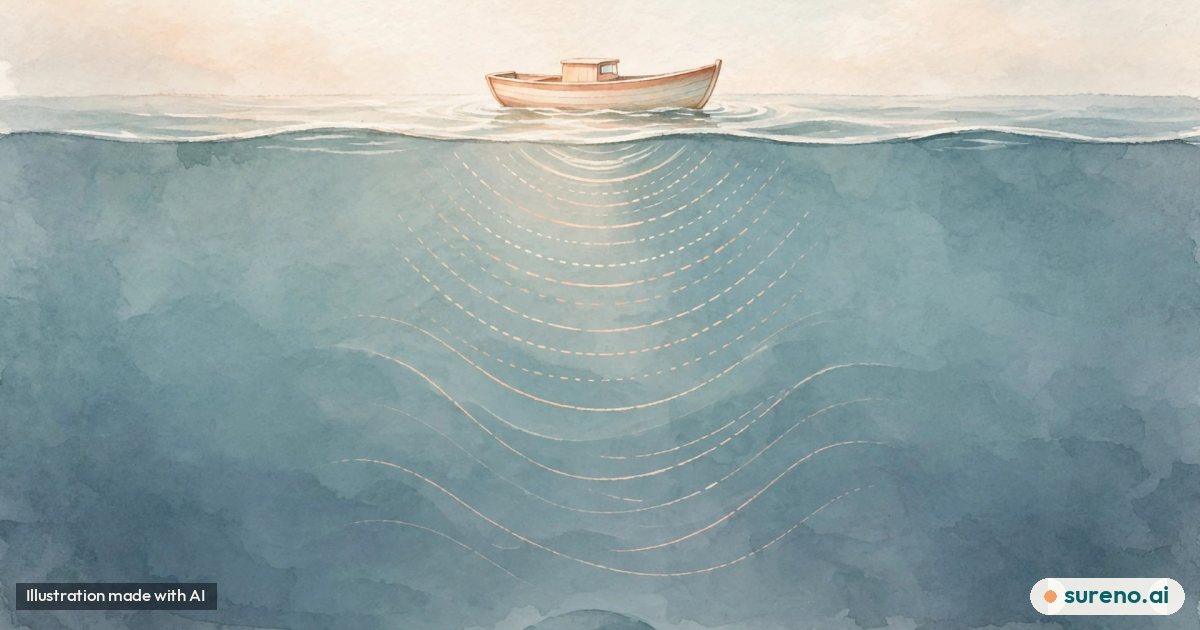
There are two main types 1. Passive sonar means listening for the sound made by vessels 1. Active sonar means sending out pulses of sound and listening for echoes 1.
Think of passive sonar like sitting quietly and listening for footsteps. Think of active sonar like calling out in a hall and timing the echo. Modern active sonar uses a device called an acoustic transducer to make the sound wave, which then reflects from target objects 1.
Sonar can be used for acoustic location and for measuring the echo traits of targets in the water 1. The same basic idea was once used in air before radar arrived 1. It is also used for robot navigation, while a related in-air system called sodar looks upward for study of the atmosphere 1.
Where did sonar come from, and where might you meet it?
Animals such as dolphins, bats, and some shrews have used sound for communication and object detection for millions of years 1. The first recorded human use in water was in 1490 by Leonardo da Vinci, who used a tube placed in the water to detect vessels by ear 1.
Interest in echo-location underwater grew after the Titanic disaster of 1912 1. An experimental system built by Reginald Fessenden from 1912 was tested in 1914 from a cutter on the Grand Banks, showing depth sounding, Morse code communication, and echo ranging, including an iceberg at a 2-mile range 1. During World War I, the need to detect submarines led to more work, with an operational passive system in use by 1918 1.
In 1915, French physicist Paul Langevin worked with electrical engineer Constantin Chilowsky on active sound devices for finding submarines 1. Langevin is also listed with Walter Guyton Cady in connection with sonar 2. Later British work under Robert William Boyle used quartz crystals to make a practical underwater active detection device, later known by the British name ASDIC 1.
Most readers will not use ship sonar. You may meet smaller versions in fish finders, depth sounders on boats, or museum exhibits. If you use one, follow the maker guide and local boating rules, and ask a trained operator or official source for help. As of October 5, 2026, sonar remains mainly a marine, research, and navigation tool.
What we don't know yet
- Which everyday sonar products are most reliable, since the sources do not compare brands or models.
- How sonar rules and practice differ by country and waterway, which needs local official guidance.
Share this explainer
A browser that helps you stay safe
Sureno is a Chromium browser with plain-language privacy settings and an assistant that only reads a page when you ask.
Questions people ask
Is sonar the same as radar?
No. Sonar uses sound, usually in water, while radar uses radio waves, usually in air. The sources note that acoustic location in air was used before radar arrived 1. Both use echoes or signals to find distance and direction.
Sources
- Sonar — Wikipedia
- Wikidata: Sonar — Wikidata
Free tools for this
They run in your browser. Nothing is uploaded and there is nothing to sign up for.
More to read
 Tech & Online SafetyBT–TalkTalk Takeover: What Broadband Customers Should KnowOct 5, 2026 · 3 min read0 views
 Tech & Online SafetyTippett Studios Closes, But Its Animation Lives On OnlineOct 5, 2026 · 4 min read0 views
 Tech & Online SafetyVivo V80 Price Leak Explained Ahead of October 6 India LaunchOct 5, 2026 · 5 min read0 views
 Tech & Online SafetyOpenAI Dots Explained: What the New Work Agent Can DoOct 5, 2026 · 6 min read0 views
 WorldFormer Prince Andrew's Action Against Police ExplainedOct 5, 2026 · 2 min read0 views
 Tech & Online SafetyChatGPT App Explained: What It Is and How to Use It SafelyOct 5, 2026 · 5 min read0 views
 Tech & Online SafetyApple Intelligence on Mac: What It Is and How to Turn It OffOct 5, 2026 · 5 min read0 views
 Tech & Online SafetySam Altman Says Some AI Harm Is the Price of ProgressOct 5, 2026 · 5 min read0 views
 Tech & Online SafetyWhy Don't More Developers Just Use the Web Platform?Oct 4, 2026 · 6 min read0 views
 WorldFormer Prince Andrew Challenges Police Search Warrants in CourtOct 5, 2026 · 5 min read0 views