How Submarines Dive, Steer and Stay Hidden Underwater
A submarine is an underwater vehicle and ship that can travel on its own below the surface.
At a glance
- A kind of
- underwater vehicle, ship
The short version
What is a submarine?
A sub is a boat that can travel alone below the sea 1. It counts as an underwater vehicle and ship 2. A submersible is different, with more limited range 1.
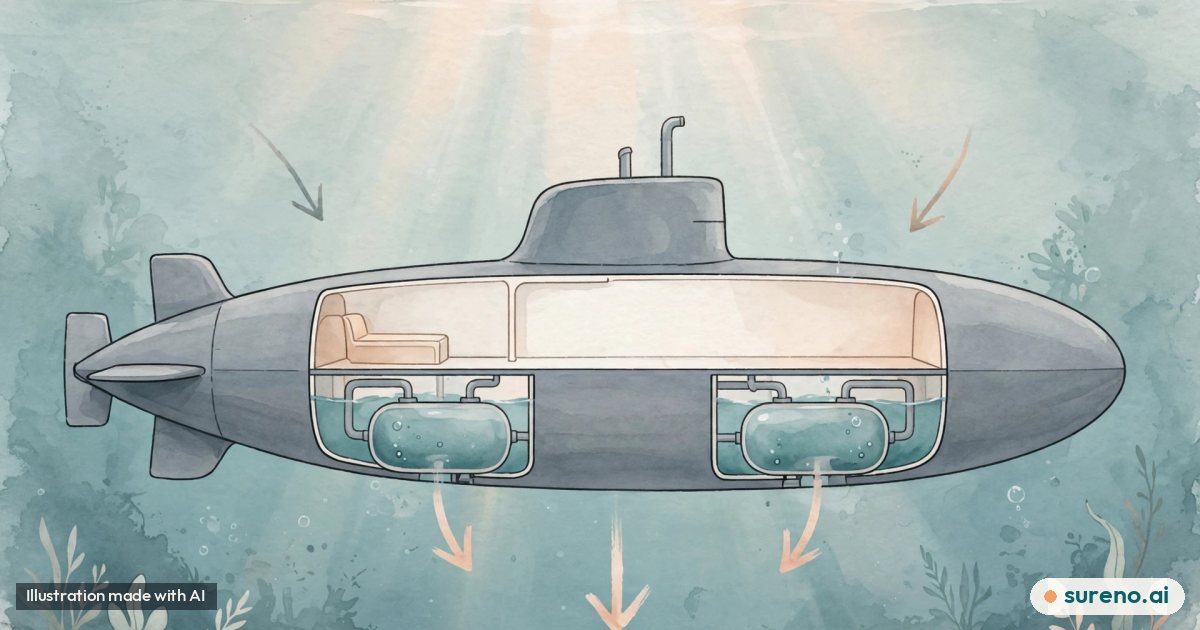
Navy custom calls them boats, even huge ones 1. Most big subs have a tube shaped hull 1. The ends are rounded to handle water pressure 1. A raised part sits near the middle 1. It holds tools for talk, sensing, and seeing 1. Americans say sail for this part 1. Europeans say fin for this part 1. A propeller or jet sits at the back 1. Small fins there help with steering 1.
How does it dive and rise again?
Diving is about float versus sink 1. Tanks inside hold either air or water 1. More water makes the boat heavier 1. Then it sinks lower in the sea 1. More air makes the boat lighter 1. Then it floats back toward the top 1. Small wings called planes also guide movement 1. They tilt to point the nose down or up 1. Forward motion plus tilt changes depth smoothly 1.
The range of designs is very wide 1. Small subs may carry one or two people 1. They may stay down for a few hours 1. Large subs may stay down for six months 1. The Russian Typhoon class was the largest 1. Subs can reach depths unsafe for divers 1.
What is its history and use today?
Early plans date back to the 1500s 1. William Bourne wrote a plan in 1578 1. John Napier wrote ideas in 1596 1. Cornelis Drebbel built a craft in 1620 1. It used oars for movement 1. He served James I of England 1. Nathaniel Symons made a ballast tank in 1747 1. It used leather bags filled with water 1. David Bushnell built Turtle in 1775 1. It held one person and moved by hand 1. It could move alone under water 1. It used screws to push forward 1. Robert Fulton built Nautilus for France in 1800 1. It used human power for movement 1. France dropped the trial by 1804 1. Design grew fast in the 1800s 1. Many navies then adopted subs 1. Wide war use began in 1914 to 1918 1.
Today many navies use subs, big and small 1. War roles include guarding ships and gathering facts 1. They can also carry special forces in secret 1. Civil roles include science and salvage work 1. They help check gear under the sea 1. Special subs help with rescue and cable repair 1. Others serve tourism and sea history study 1. Deep subs grew from the bathyscaphe design 1. That design grew from the diving bell 1. As of October 2026, more nations use subs 1. China leads the new building surge 1.
What we don't know yet
- Modern power and air systems are beyond these sources.
- Exact depth and speed limits change and need official data.
Share this explainer
A browser that helps you stay safe
Sureno is a Chromium browser with plain-language privacy settings and an assistant that only reads a page when you ask.
Questions people ask
What is the difference between a submarine and a submersible?
Sources
- Submarine — Wikipedia
- Wikidata: Submarine — Wikidata
Free tools for this
They run in your browser. Nothing is uploaded and there is nothing to sign up for.
More to read
 Tech & Online SafetyHow AI May Change Jobs and How Workers Can PrepareOct 6, 2026 · 3 min read0 views
 Tech & Online SafetySamsung Galaxy S27 Ultra: What the Early Reports SayOct 6, 2026 · 4 min read0 views
 Tech & Online SafetyWhat Could Trump’s AI Task Force Mean for the Public?Oct 6, 2026 · 3 min read0 views
 Tech & Online SafetyIs Common Lisp the Best Programming Language Today?Oct 6, 2026 · 3 min read0 views
 SportsLions vs. Panthers: What to Know About the NFL GameOct 5, 2026 · 3 min read3 views
 Tech & Online SafetyGoogle Data Center Water and Power Use: What We KnowOct 6, 2026 · 3 min read0 views
 Tech & Online SafetyWhat Inferize Adds to Nebius’s AI Inference BusinessOct 6, 2026 · 3 min read0 views
 Tech & Online SafetyYouTube TV: What It Offers, What It Costs and Who It SuitsOct 6, 2026 · 4 min read0 views
 Tech & Online SafetyBT–TalkTalk Takeover: What Broadband Customers Should KnowOct 5, 2026 · 3 min read0 views
 WorldFormer Prince Andrew's Action Against Police ExplainedOct 5, 2026 · 2 min read2 views