

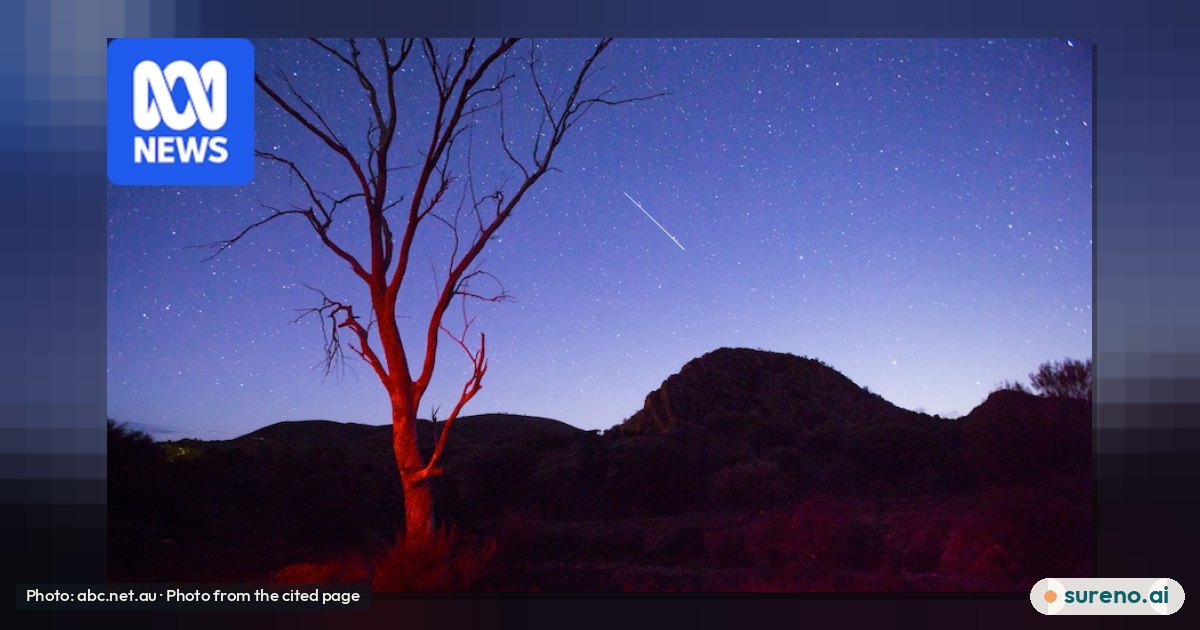
How to Watch the Orionid Meteor Shower in Australia
The shower peaks early on Thursday, October 22, but a bright Moon may make this year’s meteors harder to spot.
The short version
- In Australia, the Orionids are expected to peak early on Thursday, October 22, with the best viewing window reported as 3am to 5am. 12
- A nearly full Moon may wash out some meteors, especially earlier in the night. 12
- Choose a darker place, give your eyes time to adjust and watch with the naked eye. 2
- The shower can be seen across Australia, though astronomer Sara Webb says people farther north have a better chance of seeing more meteors. 2
When can I see the Orionid meteor shower in Australia?
The best reported time to watch is between 3am and 5am on Thursday, October 22, 2026. Astronomer Sara Webb gave that window to Nine. ABC’s report advises getting up early on Wednesday, Thursday or Friday, from about 4am, and says Thursday morning is the peak. 12
The reports agree that Thursday morning is the main opportunity, but give slightly different guidance on the hours. If you can only choose one morning, Thursday is the best-supported choice. The shower began earlier in October and is expected to continue into early November, so it is not limited to the peak night. 12
- Best reported window: 3am to 5am Thursday. 2
- ABC suggests watching from about 4am on Wednesday, Thursday or Friday. 1
Where should I look in the sky?
The meteors are visible across the Australian sky, so you do not need to face one particular direction. Webb recommends looking towards the Orion constellation, but says the shower is visible across the sky. 2
You can use a night-sky app to help find Orion, or simply watch a broad area of sky with your unaided eyes. 2 Meteors can appear in different parts of the sky, so avoid focusing only on one small patch.
- Choose a place with less artificial light if possible. 2
- Look broadly across the sky, including towards Orion. 2
Will the Moon make the Orionids hard to see?
Yes, it may make them harder to spot. The reports say the peak coincides with a nearly full Moon. Its brightness can wash out some of the display, particularly in the earlier part of the night. 12
That does not mean there will be no meteors. ABC says that under good, dark-sky conditions, viewers might see one every four to five minutes, but this is an estimate rather than a guarantee. The Moon and local viewing conditions may reduce what you see. 1
- A darker viewing spot may help limit the effect of nearby lights. 12
- Expect visibility to vary; the reported rate is conditional on good, dark skies. 1
How do I prepare to watch the meteor shower?
Pick a safe, dark place where you can see a wide stretch of sky. Give your eyes time to adjust to the darkness, and avoid looking at bright lights while you wait. Webb recommends limiting light pollution so your eyes can adjust. 2
You do not need special viewing equipment: Webb recommends watching with the naked eye. A night-sky app can help you identify Orion, but it is not necessary for seeing meteors. 2 Because the recommended hours are very early, plan ahead for the outing and check local conditions before you go.
- Allow time for your eyes to adjust to darkness. 2
- Watch without binoculars or a telescope; the advice is to use your naked eye. 2
What causes the Orionid meteor shower?
The Orionids are caused by small pieces of dust and debris left along the path of Halley’s Comet. Each year, Earth moves through this material. The particles enter the upper atmosphere and burn up, appearing from the ground as streaks of light called meteors. 2
The shower returns around October and lasts for multiple weeks, with a peak when Earth passes through a thicker part of the debris trail. 12 The meteors are therefore not Halley’s Comet itself returning to view; they are bits of material associated with it. 2
What we don't know yet
- The supplied reports do not give a forecast for cloud cover or local viewing conditions across Australian cities.
- The exact number of meteors any viewer will see is uncertain; the estimate depends on good, dark skies. 1
- The reports do not provide a city-by-city viewing time or a detailed direction to face.
Share this explainer
New discoveries on every new tab
Sureno Browser puts explainers like this one on your start page every morning, in plain words.
Questions people ask
What time is the Orionid meteor shower in Australia?
Can I see the Orionids from anywhere in Australia?
The shower is visible across Australia, according to astronomer Sara Webb. She says people farther north have a better chance of seeing more meteors. 2
Do I need a telescope to see the Orionids?
No special equipment is needed in the viewing advice provided. Webb recommends looking with the naked eye; a night-sky app can help you locate Orion. 2
Are the Orionids caused by Halley’s Comet?
The Orionids come from dust and debris associated with Halley’s Comet. As Earth passes through that material, particles burn up in the upper atmosphere and can appear as shooting stars. 2
Sources
- How to catch the peak of the Orionid meteor shower this week — abc.net.au, 2026-10-20
- How to watch stunning meteor showers lighting up Australian skies — Nine.com.au, 2026-10-21
Free tools for this
They run in your browser. Nothing is uploaded and there is nothing to sign up for.
More to read
 SpaceHow Perseverance Set a Mars Driving RecordOct 21, 2026 · 4 min read1 view
 SpaceWhat to Know About Tonight’s Full MoonOct 25, 2026 · 3 min read0 views
 SpaceNew clues from a small planet, Mars and fireballsOct 24, 2026 · 6 min read0 views
 SpaceWhat NASA’s Updated Moon Lander Plans Mean for ArtemisOct 23, 2026 · 4 min read0 views
 Tech & Online SafetyThree limits of today’s AI: confidence, decisions and languageOct 25, 2026 · 5 min read1 view
 SpaceThree space studies reveal clues about planets and cosmic structureOct 23, 2026 · 5 min read0 views
 SpaceWhat the Artemis II Orion Cabin Warning MeantOct 22, 2026 · 3 min read0 views
 SpaceWhat Falcon 9’s Planned Retirement Could Mean for U.S. LaunchesOct 22, 2026 · 4 min read0 views
 SpaceWhat Causes a Rocket Launch’s Colorful “Space Jellyfish”?Oct 21, 2026 · 3 min read0 views
 MoneyJackdaw Gasfield Approval: What It Means for UK EnergyOct 21, 2026 · 4 min read3 views