

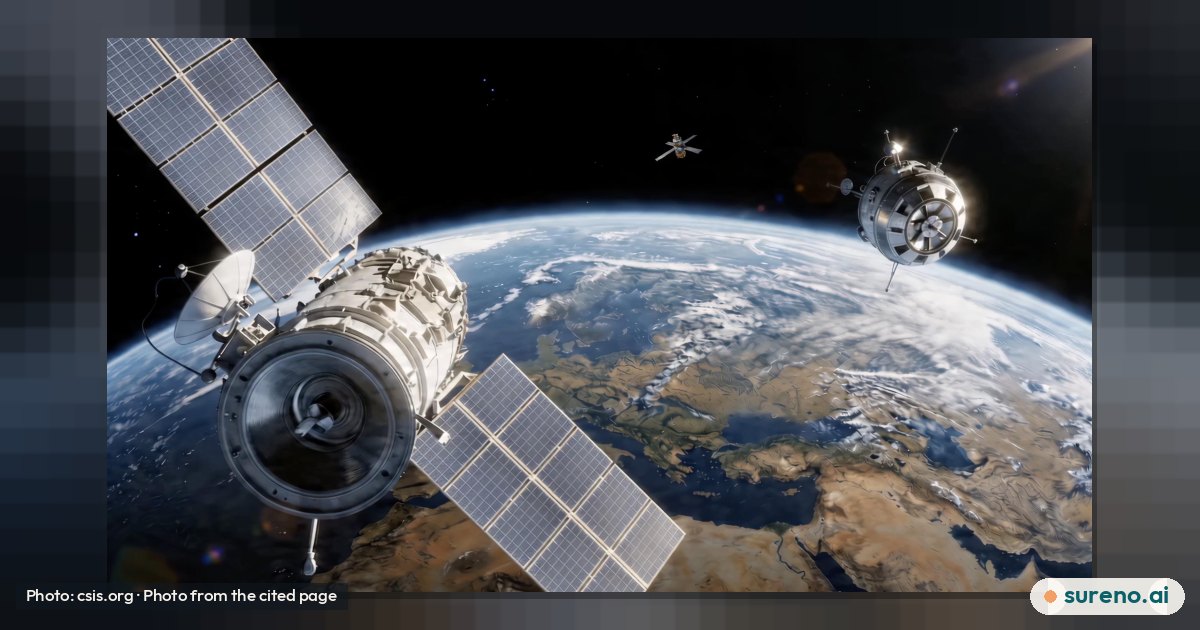
What We Know About Cosmos 2612 Near ICEYE-X36
Reports place a Russian satellite near a commercial radar spacecraft, but do not establish why it approached or whether it poses a threat.
The short version
- A report based on orbital tracking data put Cosmos 2612 roughly 1.5 kilometers from ICEYE-X36, with the Russian spacecraft moving nearer at the time 2.
- ICEYE-X36 is a commercial radar satellite, and ICEYE satellites are described as supporting intelligence work related to Ukraine 2.
- CSIS argues that the maneuver deserves attention, but the sources do not show that Cosmos 2612 intended to attack ICEYE-X36 12.
- The reporting raises possible safety and security concerns but does not say that a collision, damage, or disruption took place 12.
What happened between Cosmos 2612 and ICEYE-X36?
Cosmos 2612, a Russian spacecraft, changed its orbit several times and drew close to ICEYE-X36, according to reporting by Leonard David. The account relies on observations by Bart Hendrickx, a longtime watcher of Russia’s space program 2.
The reported orbital data showed the two satellites moving in nearly aligned orbital planes. The same report placed them about 1.5 kilometers apart and said the gap was shrinking at that time 2. That measurement describes the situation then; it does not establish where the satellites are now.
What does ICEYE-X36 do?
ICEYE-X36 belongs to ICEYE’s commercial satellite fleet and carries synthetic aperture radar, commonly called SAR 2. SAR uses radar to observe Earth’s surface. The report says ICEYE satellites provide intelligence, surveillance, and reconnaissance, and that the company’s systems support Ukraine’s armed forces 2.
That reported role helps explain the attention the maneuver has received. The sources do not specify what ICEYE-X36 itself was observing or doing during the close approach.
Why has the approach raised concern?
A spacecraft moving near another satellite can lead observers to question both safety and purpose. In its analysis, CSIS describes the episode as a close-proximity maneuver involving a U.S.-registered commercial satellite that supports Ukraine. It also points to Russia’s past space weapons tests and actions it characterizes as operating below the threshold of open conflict 1.
Those points express concern; they do not demonstrate that Cosmos 2612 was preparing an attack. The other supplied report gives information about the orbital changes and ICEYE’s work, but does not determine why the Russian spacecraft approached 2. Neither source reports a collision, damage, or confirmed interference 12.
What risks can a close approach create?
When two spacecraft pass near one another, collision is one possible safety concern. A maneuver may also prompt questions about whether a spacecraft is monitoring, interfering with, or otherwise acting against its neighbor. Those are possible concerns, not outcomes reported in the sources.
The supplied material does not give the satellites’ relative speeds, the length of time they remained nearby, or any response by ICEYE-X36. Without such details, it is not possible to judge the actual collision risk or infer the operator’s intentions.
What remains unknown about Cosmos 2612?
The sources do not explain why Cosmos 2612 changed its orbit, what its operators intend, or whether it will make further approaches to ICEYE-X36 12. They also do not confirm any effort to damage or disrupt the commercial satellite.
The reported separation is based on tracking information available when the account was written 2. Because satellite positions change, that distance should not be read as a current measurement. Further information would be needed to understand the maneuver and its significance.
What we don't know yet
- Why Cosmos 2612 changed its orbit near ICEYE-X36.
- Whether the satellites remain close as of October 19, 2026.
- Whether either spacecraft experienced interference, damage, or operational changes.
- What Cosmos 2612 was intended to do during the approach.
Share this explainer
New discoveries on every new tab
Sureno Browser puts explainers like this one on your start page every morning, in plain words.
Questions people ask
How close did Cosmos 2612 get to ICEYE-X36?
A report using orbital tracking information put the spacecraft about 1.5 kilometers apart and said the distance was decreasing at that time 2. It is not a measurement of their present separation.
Is Cosmos 2612 an anti-satellite weapon?
The supplied sources do not identify Cosmos 2612 as an anti-satellite weapon. CSIS notes Russia’s history of space weapons tests while discussing concerns about this maneuver, but that does not establish that an attack was planned 1.
What is ICEYE-X36?
Did Cosmos 2612 damage or disrupt ICEYE-X36?
Sources
Free tools for this
They run in your browser. Nothing is uploaded and there is nothing to sign up for.
More to read
 SpaceHow Perseverance Set a Mars Driving RecordOct 21, 2026 · 4 min read1 view
 SpaceWhat to Know About Tonight’s Full MoonOct 25, 2026 · 3 min read0 views
 SpaceNew clues from a small planet, Mars and fireballsOct 24, 2026 · 6 min read0 views
 SpaceWhat NASA’s Updated Moon Lander Plans Mean for ArtemisOct 23, 2026 · 4 min read0 views
 Tech & Online SafetyThree limits of today’s AI: confidence, decisions and languageOct 25, 2026 · 5 min read1 view
 SpaceThree space studies reveal clues about planets and cosmic structureOct 23, 2026 · 5 min read0 views
 SpaceWhat the Artemis II Orion Cabin Warning MeantOct 22, 2026 · 3 min read0 views
 SpaceWhat Falcon 9’s Planned Retirement Could Mean for U.S. LaunchesOct 22, 2026 · 4 min read0 views
 SpaceWhat Causes a Rocket Launch’s Colorful “Space Jellyfish”?Oct 21, 2026 · 3 min read0 views
 MoneyJackdaw Gasfield Approval: What It Means for UK EnergyOct 21, 2026 · 4 min read3 views