

What Recent Research Says About Climate and Air Pollution
The findings point to real health concerns, but each study has limits and none settles a question on its own.
The short version
- A global analysis estimated that 916 million people a year experienced at least one day of heatwave and fire-sourced air pollution together during 2000–2019 1.
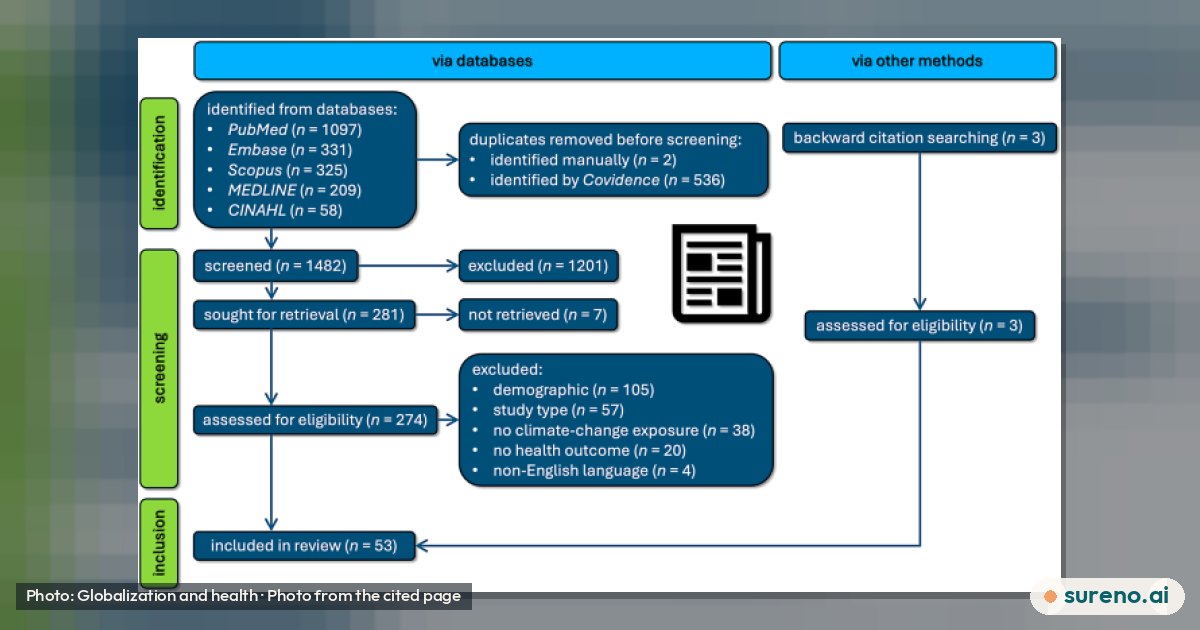
- A review of 53 studies found reports of several climate-related health effects among Indigenous children, while noting that evidence remains uneven 2.
- A U.S. cohort study linked higher nitrogen dioxide exposure with higher atrial fibrillation risk, but cannot show that pollution caused the cases 3.
- These studies strengthen concern about climate hazards and pollution, but they do not establish every health effect or explain each person’s risk.
The studies at a glance
Global population-exposure analysis
The study estimated that 916 million people per year experienced at least one day of combined exposure, with average exposed days per person rising between the two decades studied [1].
- Who or what was studied
- Populations in populated areas worldwide, assessed for heatwave and landscape-fire air pollution exposure from 2000 to 2019.
- The catch
- It estimates exposure rather than illness, and does not establish that combined exposure caused specific health outcomes.
Systematic review of earlier studies
The review identified reported effects across wellbeing, nutrition, infectious disease, perinatal health, and illness and death [2].
- Who or what was studied
- Fifty-three studies concerning climate-related health outcomes in Indigenous children and pregnant women.
- The catch
- The studies were too varied for a pooled numerical estimate, and the authors called for more geographically diverse and rigorous research.
Prospective observational cohort study
A 13.5-parts-per-billion increase in nitrogen dioxide was associated with 29% higher atrial fibrillation risk in the primary model [3].
- Who or what was studied
- 6,618 participants in six U.S. metropolitan areas, followed for a median of 16.5 years; 1,055 atrial fibrillation cases were identified.
- The catch
- The observational design cannot show that pollution caused the cases, and exposure was estimated at participants’ residences.
Three studies examine linked climate and health concerns
New research looks at climate-related hazards and air pollution from three angles: how many people experience heat and landscape-fire pollution together, what climate change means for Indigenous children’s health, and whether long-term air pollution exposure is linked with atrial fibrillation, an irregular heart rhythm. The studies were published in October 2026 123.
They use different methods. One is a global analysis of population exposure, one reviews earlier research, and one follows adults in a U.S. cohort. Each can help identify patterns, but one study rarely settles a question. Exposure estimates, study populations and methods all shape what researchers can conclude.
Heat and fire pollution increasingly overlap for many people
Researchers wanted to understand where and how often people faced heatwaves and air pollution from landscape fires on the same days. They analysed global population and exposure patterns from 2000 to 2019, rather than testing health outcomes in individuals 1.
They estimated that 916 million people per year experienced at least one day of this combined exposure. The average number of exposed days per person rose from 1.0 a year in 2000–2009 to 1.7 in 2010–2019. In 52.4% of populated areas and among 55.9% of the global population, exposure to both hazards was increasing 1.
This is an estimate of exposure, not a count of people who became ill. The analysis does not show that the overlap caused a particular health outcome, and its historical results do not by themselves predict what will happen in a specific place. It may help readers understand why heat and smoke can be considered together in public-health planning, especially as conditions vary between regions.
A review finds several climate-related harms reported for Indigenous children
The researchers asked what published evidence says about climate-related health effects among Indigenous children and pregnant women. Their systematic review—a structured search and assessment of earlier studies—included 53 studies from different settings and research designs 2.
The review grouped reported outcomes into five areas: psychosocial and cultural wellbeing, nutrition, infectious disease, perinatal health, and illness and death. Heat and changes in seasons and water-related conditions were among the exposures most often connected to these outcomes. The authors said wellbeing and cultural impacts cut across the other areas 2.
The studies were too varied for the reviewers to combine their results into a single numerical estimate. A review of existing research can map what has been reported, but it cannot make all the underlying evidence equally strong or establish that every reported outcome was caused by climate change. The authors also called for more geographically diverse and rigorous research 2.
The work matters because it brings together health and cultural wellbeing, rather than treating health only as physical illness. It also highlights that evidence and experiences may differ across Indigenous communities.
Higher nitrogen dioxide exposure was linked with more atrial fibrillation
Researchers examined whether long-term exposure to four air pollutants was associated with new cases of atrial fibrillation. They followed 6,618 participants in a community-based study across six U.S. metropolitan areas; participants had a mean age of 62, and follow-up lasted a median of 16.5 years 3.
For nitrogen dioxide, an interquartile-range increase of 13.5 parts per billion was associated with a 29% higher risk of atrial fibrillation in the main analysis. The study recorded 1,055 cases. Associations for fine particles, nitrogen oxides and ozone pointed in the same direction but were weaker 3.
This was an observational cohort study, not an experiment that assigned people different pollution levels. A link does not prove that nitrogen dioxide caused the heart rhythm condition, and the result does not predict an individual’s risk. The study used estimated exposure at participants’ homes, which may not capture all the pollution they encountered. The finding may inform wider research and public-health discussions, but it needs to be considered alongside other evidence.
The studies add evidence, not a final answer
Together, the studies show how environmental risks can be studied at different scales: global exposure patterns, health evidence for a particular population, and long-term associations in adults. They support taking heat, fire-related air pollution and other pollutants seriously as research and public-health concerns 123.
They do not show that every person exposed will become ill, or that the observed links establish cause and effect. Important questions remain about which exposures lead to which outcomes, how risks vary among places and groups, and whether the findings can be replicated. The review in particular describes an evidence base that needs to become more geographically diverse and methodologically strong 2.
What we don't know yet
- Whether the combined heatwave and fire-pollution exposure estimated in the global analysis led to particular health outcomes.
- How climate-related health effects vary among Indigenous communities, given the review’s call for more geographically diverse research.
- Whether the association between nitrogen dioxide and atrial fibrillation will be reproduced in other populations and study designs.
- How well residential pollution estimates represent each participant’s exposure across daily life.
Share this explainer
New discoveries on every new tab
Sureno Browser puts explainers like this one on your start page every morning, in plain words.
Questions people ask
Can wildfire smoke and heat affect people at the same time?
Yes. A global analysis estimated that many people experienced heatwaves and landscape-fire air pollution together, and found increasing overlap in many populated areas 1. It measured exposure, not resulting illness.
What climate-related health effects have been reported for Indigenous children?
A review of 53 studies grouped reported outcomes into wellbeing, nutrition, infectious disease, perinatal health, and illness and death 2. The underlying studies varied, so the review could not provide one combined estimate.
Does air pollution cause atrial fibrillation?
One cohort study found that higher nitrogen dioxide exposure was associated with higher atrial fibrillation risk 3. Because it was observational, it cannot establish that pollution caused the condition.
How strong is the evidence in these new studies?
The three studies use different methods and answer different questions. Their findings add evidence about exposure patterns and health associations, but they do not by themselves settle cause and effect or individual risk.
Sources
- Rising global population coexposure to heatwaves and landscape fire-sourced air pollution. — Science advances, 2026-10-14
- Global systematic review of how climate change degrades the wellbeing and health of Indigenous children. — Globalization and health, 2026-09-30
- Association of Air Pollution Exposure and Risk of Incident Atrial Fibrillation: The Multi-Ethnic Study of Atherosclerosis. — Heart rhythm, 2026-10-16
Free tools for this
They run in your browser. Nothing is uploaded and there is nothing to sign up for.
More to read
 ScienceHow Satellites Track Autumn Leaf Colour—and What It ShowsOct 26, 2026 · 3 min read0 views
 ScienceHow Scientists Trapped a Positron for MonthsOct 23, 2026 · 3 min read0 views
 ScienceWhat biodiversity means for cities, oceans and ecosystemsOct 22, 2026 · 5 min read0 views
 ScienceHow Excess RNA May Disrupt Cells’ Energy SupplyOct 21, 2026 · 3 min read0 views
 Tech & Online SafetyThree limits of today’s AI: confidence, decisions and languageOct 25, 2026 · 5 min read1 view
 ScienceHow Kelvin Waves Can Raise Pacific Sea LevelsOct 20, 2026 · 3 min read0 views
 ScienceThree studies test cleaner power’s reach, materials and claimsOct 20, 2026 · 6 min read0 views
 ScienceHow New Methods Could Reduce Animal TestingOct 19, 2026 · 4 min read0 views
 ScienceWhat Dogs’ Bouba-and-Kiki Responses May Tell UsOct 19, 2026 · 4 min read0 views
 MoneyJackdaw Gasfield Approval: What It Means for UK EnergyOct 21, 2026 · 4 min read3 views