

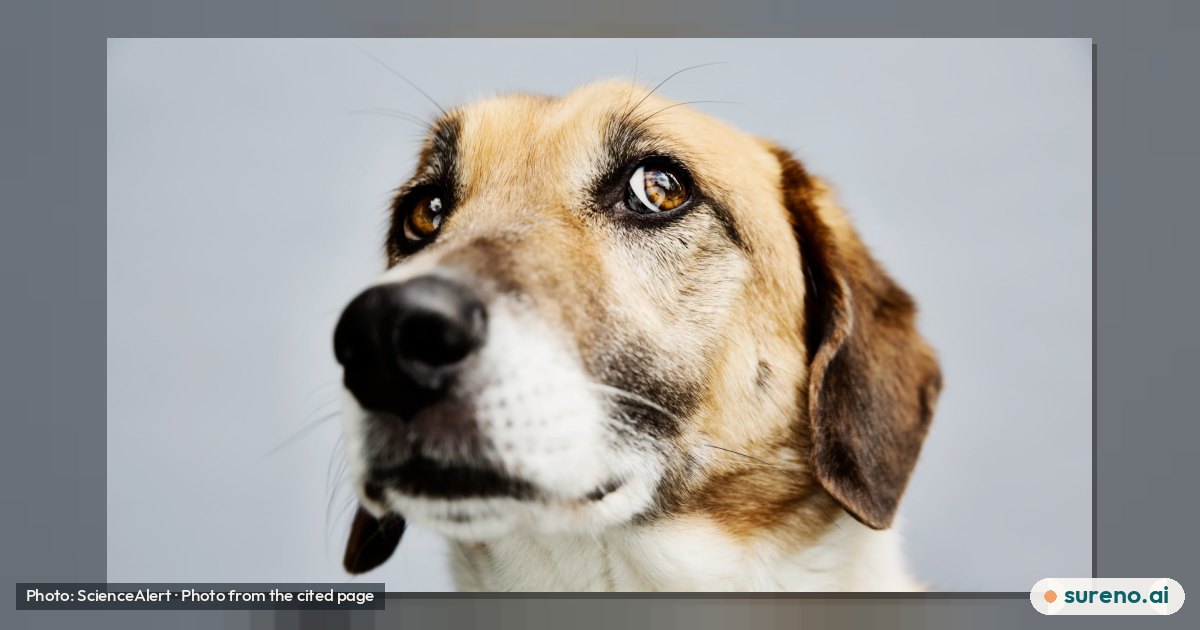
What Dogs’ Bouba-and-Kiki Responses May Tell Us
Dogs in a recent experiment tended to connect the spoken words “bouba” and “kiki” with rounded and spiky shapes, respectively.
The short version
- In a study of adult domestic dogs, researchers tested whether dogs associated the spoken sounds “bouba” and “kiki” with rounded and spiky shapes 2.
- The study reports evidence of the Bouba-Kiki effect in dogs, a tendency to match certain sounds with certain shapes 2.
- The finding suggests that sound-and-shape matching may not be unique to humans, but it does not show that dogs understand the words as language 2.
- The available source details do not establish how strong or widespread the effect is, or whether it affects dogs outside a test setting 12.
What is the Bouba-Kiki effect?
The Bouba-Kiki effect is a tendency to connect some speech sounds with particular shapes. In the familiar example, people often match “bouba” with a rounded shape and “kiki” with a spiky one, even though both are made-up words 13.
The research is about an association, not a dictionary meaning. “Bouba” does not literally mean round, and “kiki” does not literally mean spiky. The question is whether a sound can seem to fit a shape even when there is no learned definition.
What did researchers test in dogs?
A research team led by animal behaviorist Eleonora Biffi tested adult domestic dogs in two experiments. The paper, published in Proceedings of the Royal Society B, is titled “Hearing shapes: the Bouba-Kiki effect in adult domestic dogs” 12.
In the first experiment, 51 dogs took part with their owners. The setup had a screen and speaker on each side of a room. The dogs saw shapes and heard a person say either “Bouba” or “Kiki” as the screen-and-speaker combinations changed 1.
The research report describes the study as evidence that dogs show the Bouba-Kiki effect 2. The supplied source excerpts do not give enough detail about the full procedure or results to describe every test or put a precise size on the effect.
What might the dogs’ responses mean?
The result suggests that dogs can match a sound pattern with a visual shape in a way that resembles the familiar human association. That is useful evidence about perception: animals may connect information from different senses without relying on a word’s learned meaning.
The paper notes that young chicks have also been reported to associate round and spiky shapes with “Bouba” and “Kiki.” The authors present this as a reason to consider whether the effect is a broader cross-sensory correspondence, rather than something limited to language 2. Cross-sensory means involving more than one sense, such as hearing and seeing.
This does not prove that dogs think of shapes exactly as people do, or that they understand these sounds as words. A matching response in an experiment shows an association; it does not, by itself, reveal what a dog experiences internally.
Does the study show that all dogs make these matches?
No. The study recruited 70 domestic dogs across two experiments, and the first involved 51 dogs 1. Those numbers describe the participants, not every dog or every breed. The available sources do not say enough about the sample to judge how representative it was.
The experiment also took place in a prepared room with screens, speakers, shapes and spoken sounds. The sources do not establish whether the same associations guide dogs’ everyday choices or communication. The result is best treated as evidence from a specific research setting, not a general rule about every dog.
What remains unknown about dogs and sound?
The study raises a question about how the association works. The available material does not show whether dogs respond to particular features of the sounds, such as how they are pronounced, or to some other aspect of the test.
It also leaves open how stable the effect is across dogs and situations, and whether experience changes it. Further research would be needed to explain the mechanism and establish how far the finding applies. For now, the careful conclusion is that dogs showed evidence of a sound-shape association in an experiment—not that they share human language or meanings.
What we don't know yet
- How strong and consistent the association was across the dogs tested.
- Which features of the spoken sounds or test setup influenced the responses.
- Whether the effect appears in dogs in everyday situations or varies with experience.
Share this explainer
New discoveries on every new tab
Sureno Browser puts explainers like this one on your start page every morning, in plain words.
Questions people ask
Do dogs associate bouba with round shapes and kiki with spiky shapes?
A 2026 study reports evidence that adult domestic dogs show the Bouba-Kiki effect, matching certain sounds with shapes 2. The source excerpts do not provide enough results detail to say how strong the match was.
What does the Bouba-Kiki effect mean?
Does the dog study prove that dogs understand words?
No. The study concerns an association between sounds and shapes, not whether dogs understand the made-up sounds as words. A matching response does not establish that dogs attach human-like meanings to them.
How many dogs took part in the research?
The research recruited 70 domestic dogs for two experiments. The first experiment involved 51 dogs and their owners 1.
Could the Bouba-Kiki effect happen in animals besides dogs?
The dog paper refers to earlier evidence that three-day-old chicks also associate round and spiky shapes with “Bouba” and “Kiki” 2. That supports investigating the effect in other animals, but it does not settle how widespread it is.
Sources
- Dogs Seem to Agree With Humans That 'Bouba' Is Round And 'Kiki' Is Spiky — ScienceAlert, 2026-10-13
- Hearing shapes: the Bouba-Kiki effect in adult domestic dogs. — Proceedings. Biological sciences, 2026 Oct 14
- Bouba/kiki effect — Wikipedia
Free tools for this
They run in your browser. Nothing is uploaded and there is nothing to sign up for.
More to read
 ScienceHow Satellites Track Autumn Leaf Colour—and What It ShowsOct 26, 2026 · 3 min read0 views
 ScienceHow Scientists Trapped a Positron for MonthsOct 23, 2026 · 3 min read0 views
 ScienceWhat biodiversity means for cities, oceans and ecosystemsOct 22, 2026 · 5 min read0 views
 ScienceHow Excess RNA May Disrupt Cells’ Energy SupplyOct 21, 2026 · 3 min read0 views
 Tech & Online SafetyThree limits of today’s AI: confidence, decisions and languageOct 25, 2026 · 5 min read1 view
 ScienceWhat Recent Research Says About Climate and Air PollutionOct 21, 2026 · 4 min read0 views
 ScienceHow Kelvin Waves Can Raise Pacific Sea LevelsOct 20, 2026 · 3 min read0 views
 ScienceThree studies test cleaner power’s reach, materials and claimsOct 20, 2026 · 6 min read0 views
 ScienceHow New Methods Could Reduce Animal TestingOct 19, 2026 · 4 min read0 views
 MoneyJackdaw Gasfield Approval: What It Means for UK EnergyOct 21, 2026 · 4 min read3 views