Mortgage Interest Rates: Why They’re Rising and What It Means
A recent jump in mortgage rates can make buying a home more expensive, but the effect on each borrower depends on the loan and the home price.
The short version
- Mortgage rates are the interest borrowers pay on a home loan; the reported weekly average for a 30-year fixed-rate mortgage was 7.26% APR for the week ending October 1, 2026. 2
- That weekly average had risen for five straight weeks and was more than a percentage point above its level at the start of the year. 2
- A higher rate generally raises the monthly principal-and-interest payment on a new loan of the same size, though the actual payment also depends on the amount borrowed and loan terms.
- The Boston Globe reported that the recent increase could add about $1,000 to a monthly payment for a typical Greater Boston home purchase; that is a local estimate, not a universal amount. 1
What are mortgage interest rates?
A mortgage interest rate is the price a borrower pays for borrowing money to buy a home. With a fixed-rate mortgage, the interest rate stays the same over the loan term. With an adjustable-rate mortgage, or ARM, the rate can change over time. 5
The weekly figure in the recent coverage is an average for 30-year fixed-rate mortgages. APR means annual percentage rate; it is a yearly measure used to express borrowing costs. The reported average was 7.26% APR for the week ending October 1, 2026. It is a market snapshot, not a promise of the rate any particular borrower will receive. 2
Why are mortgage rates in the news now?
Rates had been climbing for five consecutive weeks, and the weekly average was more than a full percentage point higher than at the start of the year, according to the report. 2 The Boston Globe also reported that the average rate on a 30-year fixed mortgage had reached nearly 7.3% in recent months, its highest level since 2023. 1
The headlines describe a sharp recent move and its consequences for buyers. The supplied reporting gives those rate figures and trends, but it does not establish one definitive cause for the latest rise. A headline that mentions unemployment alongside mortgage rates does not, by itself, explain why rates changed.
How can higher rates change a monthly payment?
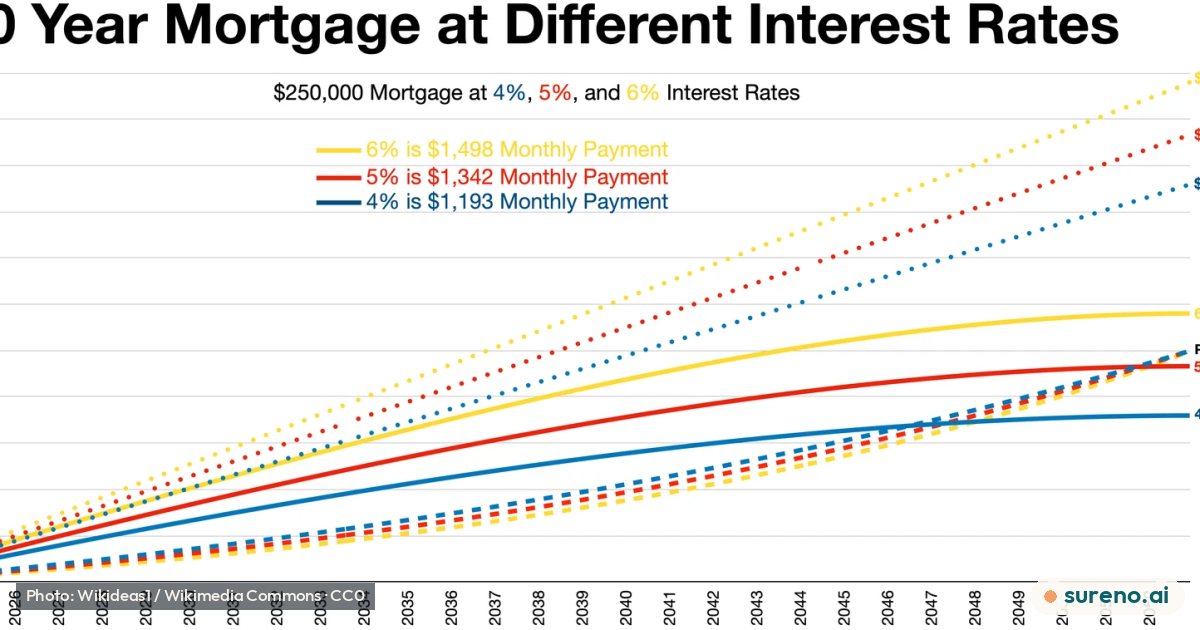
When the interest rate rises, a borrower generally pays more each month on a new mortgage of the same size and term. The total effect depends on how much is borrowed, the rate, the term, and other costs. A home’s price and a buyer’s down payment also affect the amount that needs financing.
In Greater Boston, the Globe said the recent rise could add about $1,000 to the monthly payment for a typical home purchase. That estimate describes a particular local market and purchase scenario; it should not be treated as the expected increase everywhere. 1
What does this mean if I’m buying or selling a home?
For a prospective buyer, a higher borrowing cost can make the same home harder to afford at the same monthly budget. The weekly rate report says people planning a purchase may need to reconsider their budget or timing, but it does not predict what any individual buyer should do. 2
Higher rates can also affect sellers when buyers become less able or willing to take on a large payment. The Globe described a Worcester family whose home drew no prospective buyers at two open houses despite a price cut. That is one family’s experience, not proof that every local listing will have the same result. 1
Are rates the same for every borrower?
No single weekly average guarantees the rate available to a particular borrower. The reported 7.26% figure is an average for a 30-year fixed-rate mortgage, so an individual offer may differ. The sources provided do not give a full breakdown of how borrower or loan details affect offers. 2
A fixed-rate loan keeps its rate steady, while an adjustable-rate mortgage can change according to its terms. That difference matters when comparing loan types, but the supplied sources do not provide current ARM rates or details of specific loan offers. 5
What is still uncertain about mortgage rates?
The supplied sources show a recent increase but do not say how long it will last or what rates will be next. They also do not provide a detailed explanation of the forces behind the latest rise.
Local effects may differ: the Greater Boston payment estimate is not a national estimate, and one seller’s experience cannot show how the whole housing market is behaving. For a specific loan or purchase, a mortgage professional can explain current terms and costs.
What we don't know yet
- How long mortgage rates will remain above 7% or whether they will rise or fall next.
- What specific factors drove the latest increase; the supplied sources report the change but do not establish its causes.
- How the reported payment increase would apply to a particular buyer, loan amount or location.
Share this explainer
Understand the news that affects your wallet
Sureno Browser explains the day's money news on every new tab.
Questions people ask
What is the average mortgage rate right now?
The supplied weekly report puts the average rate on a 30-year fixed-rate mortgage at 7.26% APR for the week ending October 1, 2026. That is a reported average, not an individual loan offer. 2
Why are mortgage rates going up?
The sources show that rates had climbed for five straight weeks and were more than a percentage point above their level at the start of the year. They do not establish one definitive cause for the increase. 2
How much does a higher mortgage rate add to a payment?
It depends on the amount borrowed, the rate and the loan term. The Boston Globe reported that the recent increase could add about $1,000 a month for a typical Greater Boston home purchase, but that estimate is specific to its local example. 1
Is a fixed-rate mortgage different from an adjustable-rate mortgage?
Yes. A fixed-rate mortgage keeps the same interest rate, while an adjustable-rate mortgage can change over time according to its terms. 5
Does the 7.26% mortgage rate apply to everyone?
No. The figure is a weekly average for 30-year fixed-rate mortgages, not a guarantee of the rate a particular borrower will receive. 2
Sources
- Mortgage rates are soaring, another blow to Mass. housing affordability as buyers face higher monthly payments - The Boston Globe — BostonGlobe.com, 2026-10-05
- Weekly Mortgage Rates Find a New Normal Above 7% — guampdn.com
- Adjustable-rate mortgage — Wikipedia
Free tools for this
They run in your browser. Nothing is uploaded and there is nothing to sign up for.
More to read
 MoneyMicrosoft Stock: What the AI Push Means for InvestorsOct 6, 2026 · 3 min read0 views
 MoneyAmazon Prime Day: How to Judge October DealsOct 6, 2026 · 3 min read0 views
 MoneyCould State-Owned Supermarkets Make Groceries Cheaper?Oct 5, 2026 · 4 min read0 views
 MoneyHow SpaceX and Tesla Shares Shape Elon Musk’s Net WorthOct 5, 2026 · 3 min read0 views
 SportsLions vs. Panthers: What to Know About the NFL GameOct 5, 2026 · 3 min read3 views
 MoneyInflation: what it is and what it means for everyday costsOct 5, 2026 · 4 min read0 views
 MoneyDearness Allowance Explained: Himachal DA News Before DiwaliOct 5, 2026 · 4 min read0 views
 MoneyBudget 2027: What Childcare Fee Cuts Mean for FamiliesOct 5, 2026 · 5 min read0 views
 MoneyPM Kisan 24th Instalment: What Farmers Need to Check NowOct 5, 2026 · 5 min read0 views
 WorldFormer Prince Andrew Challenges Police Search Warrants in CourtOct 5, 2026 · 5 min read4 views