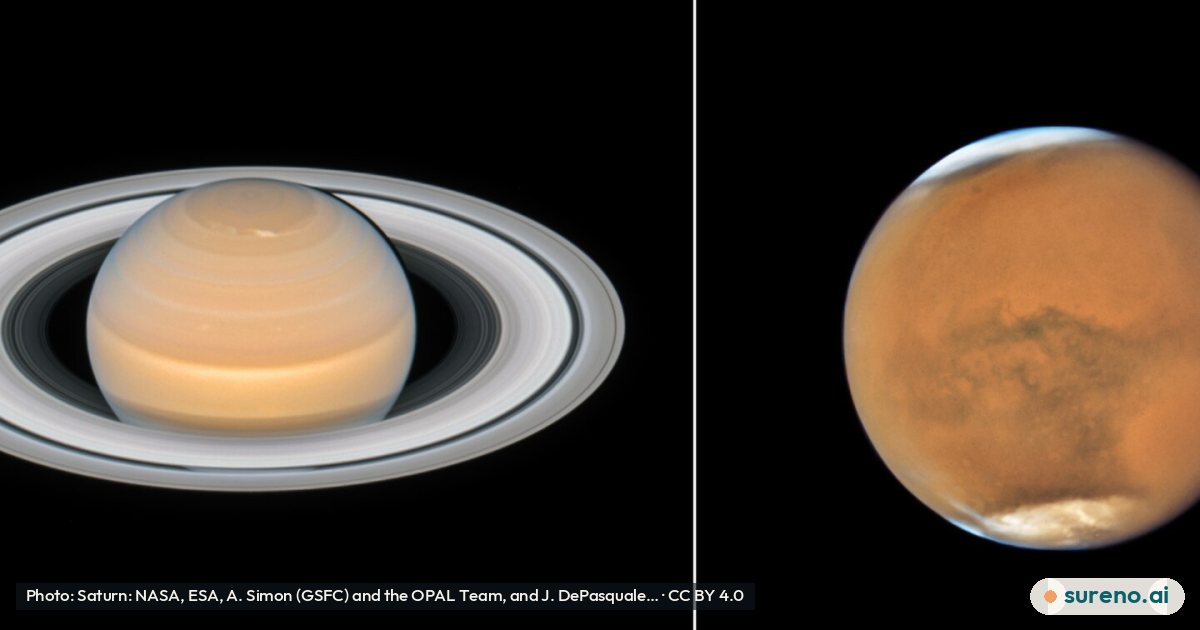
Saturn at Opposition: What to Know About the Ringed Planet
Saturn reached opposition in early October 2026, making it visible through much of the night and a timely target for skywatchers.
The short version
- Saturn is the sixth planet from the Sun and the second-largest planet in the Solar System; it is a gas giant, meaning it is made mostly of gas rather than having a solid surface like Earth. 4
- Saturn reached opposition on October 4, 2026, when Earth passed between Saturn and the Sun, placing Saturn opposite the Sun in our sky. 1
- Around opposition, Saturn rises near sunset and remains visible for much of the night, making this a convenient time to look for it. 1
- Saturn appears as a bright point to the unaided eye, while a telescope is needed to see its rings clearly. 23
What is Saturn?
Saturn is the sixth planet from the Sun and the Solar System’s second-largest planet, after Jupiter. It is a gas giant: a very large planet made mainly of gas, rather than a world with a solid surface like Earth’s. 4
Its most familiar feature is its broad ring system. Saturn also has moons, including Titan, its brightest moon in the October 2026 observing guide. 3 The supplied sources focus on what can be seen in the sky, rather than giving a full account of Saturn’s composition or how its rings formed.
Why is Saturn in the news in October 2026?
Saturn reached opposition on October 4. Opposition is the point in a planet’s orbit when Earth lies between that planet and the Sun. From our perspective, Saturn appears opposite the Sun in the sky. 1
That arrangement makes Saturn rise around sunset and stay up for much of the night. NASA described this as one of the year’s best opportunities to see the ringed planet. 1 Astronomy Magazine likewise reported that Saturn was visible through the night around the date of opposition. 3
Opposition does not mean Saturn is close in everyday terms. One observing report placed it about 1.26 billion kilometres from Earth at this opposition. 2
What does Saturn look like from Earth?
Without optical aid, Saturn looks like a bright point of light. The October observing guides give its brightness as magnitude 0.3. 23 In plain terms, it is a prominent object in that part of the sky, but its rings are too small to make out with the unaided eye.
A telescope reveals more. The guides describe Saturn’s disk as about 20 arcseconds across, with the rings tilted so that they are visible rather than appearing edge-on. 23 An arcsecond is a tiny unit for measuring angles in the sky. The exact view depends on the telescope, atmospheric conditions and when you observe.
Astronomy Magazine listed Titan, Tethys, Rhea and Dione among the moons visible through a telescope during its October 4 guide. 3 Seeing smaller moons may require a suitable telescope and a clear, steady view.
How can an ordinary reader find Saturn?
The simplest plan is to look after sunset during the period around opposition, when Saturn is up for much of the night. 1 The October 4 observing guide placed it in Cetus, near the border with Pisces, and described it as a bright point in that region. 3
The guides differ slightly in their constellation descriptions: one places Saturn in Cetus, while another describes it in central Pisces. 23 These are neighbouring parts of the sky, and the difference does not change the practical point: use a current sky chart or observing guide for your location and date.
You do not need a telescope to spot the planet, but one is needed to appreciate the rings. 23 The supplied sources do not provide location-specific viewing times or weather forecasts, so visibility will depend on where you are and whether the sky is clear.
What does this event mean for readers?
For most people, opposition is a useful viewing opportunity, not a change to daily life. It is a predictable position in the planets’ apparent arrangement, and it does not mean Saturn is suddenly approaching Earth. 12
The event can make a simple night-sky activity easier: look for the bright planet after sunset, or use a telescope if you want to see its rings. The specific best time and direction depend on your location, and the October 2026 guides do not cover every place or observing condition.
What we don't know yet
- The supplied sources do not give Saturn’s exact visibility times for every location.
- Cloud cover, local light pollution and atmospheric conditions can affect what an observer sees; the sources do not provide local forecasts.
- The sources report a developing ten-sided atmospheric wave near Saturn’s south pole, but do not establish how that feature will change over time. 1
Share this explainer
New discoveries on every new tab
Sureno Browser puts explainers like this one on your start page every morning, in plain words.
Questions people ask
What does opposition mean for Saturn?
Opposition is when Earth passes between the Sun and Saturn, putting Saturn opposite the Sun in our sky. Saturn therefore rises around sunset and stays visible for much of the night. 1
Can I see Saturn without a telescope?
When was Saturn at opposition in 2026?
How far away was Saturn at opposition?
Sky & Telescope reported a distance of about 1.26 billion kilometres, or 784 million miles, for this opposition. That is still an enormous distance; opposition describes the planets’ positions in their orbits, not a close approach in ordinary terms. 2
Can I see Saturn’s moons?
A telescope may show some of Saturn’s moons. Astronomy Magazine’s October 4 guide listed Titan, Tethys, Rhea and Dione, while noting that their positions depend on when you observe. 3
Sources
- What's Up: October 2026 Skywatching Tips from NASA — NASA Science, 2026-10-01
- Saturn Flaunts its Rings at Opposition the Night of October 3–4 — Sky & Telescope, 2026-10-02
- The Sky Today on Sunday, October 4: Saturn reaches opposition — Astronomy Magazine, 2026-10-04
- Saturn — Wikipedia
Free tools for this
They run in your browser. Nothing is uploaded and there is nothing to sign up for.
More to read
 SpaceISS Zarya on CelesTrak: What the Current Record MeansOct 4, 2026 · 2 min read1 view
 Space2027 Total Solar Eclipse: When and Where to See ItOct 6, 2026 · 3 min read0 views
 SpaceWorld Space Week 2026: What It Is and Why It MattersOct 6, 2026 · 3 min read0 views
 SpaceExoplanets: What They Are and Why New Finds MatterOct 6, 2026 · 3 min read0 views
 SportsLions vs. Panthers: What to Know About the NFL GameOct 5, 2026 · 3 min read3 views
 SpaceSombrero Galaxy Tidal Streams: What They Tell UsOct 5, 2026 · 3 min read0 views