Sombrero Galaxy Tidal Streams: What They Tell Us
Faint structures around M104 may preserve clues to collisions and mergers that shaped the Sombrero Galaxy.
The short version
- The Sombrero Galaxy’s faint tidal streams are elongated structures of stars that may have been pulled from smaller systems by the galaxy’s gravity 12.
- A deep image also shows a hazy outer halo and a diagonal ring beyond the galaxy’s familiar bright disk and dark dust lane 1.
- These features are evidence that M104 likely experienced collisions and mergers with smaller galaxies, though the image does not identify exactly what happened 1.
- The APOD image was made from observations taken over seven days in Namibia in mid-2026 1.
What are the Sombrero Galaxy’s tidal streams?
Tidal streams are long, stretched-out groupings of stars. They can form when the gravity of a larger galaxy pulls apart a smaller galaxy or a star cluster, spreading its stars along its path 2.
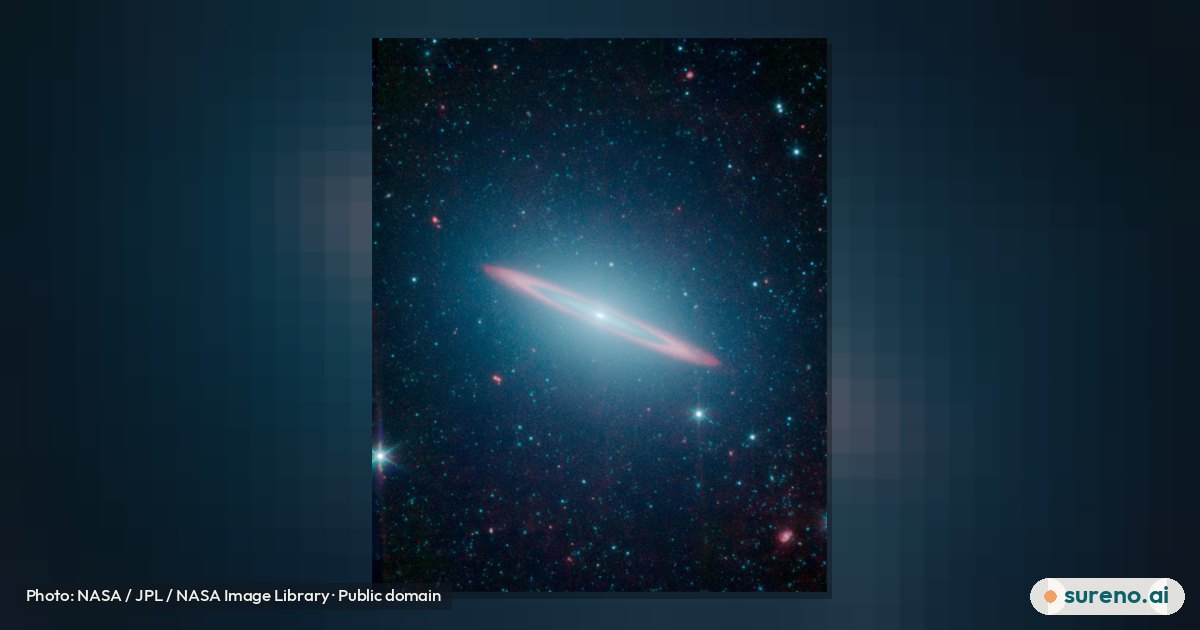
In the new deep image of M104, faint structures stand out in the galaxy’s surrounding haze. The APOD description identifies tidal streams and a diagonal ring among the features visible around the central disk 1. The source does not give a detailed account of how each feature formed.
Why does the Sombrero Galaxy look like a hat?
M104 is called the Sombrero Galaxy because it can resemble a hat in shorter-exposure images. Its familiar appearance comes in part from a dark band of dust circling the center of its disk 1.
A longer exposure reveals more than that bright disk and dust band. It brings out a broad, hazy halo containing many stars too faint to distinguish individually, along with the more subtle structures surrounding the galaxy 1.
What do the streams reveal about M104’s past?
The streams and other faint structures are clues to a more eventful history than the galaxy’s smooth appearance might suggest. NASA’s APOD explanation says they provide fresh evidence that M104 had a violent past and likely formed through collisions and mergers of smaller galaxies 1.
A stream is useful because stars can remain spread along the path of a disrupted system. But the image alone does not establish the identity, number, or timing of any galaxies involved. It points to a history of interactions without filling in every detail.
How far away and how large is M104?
The light shown in the image takes about 30 million years to reach Earth from the Sombrero Galaxy. M104 spans about 150,000 light-years across 1. A light-year is the distance light travels in one year.
Those figures help explain why even a detailed image shows the galaxy as it was in the past, rather than as it is at this moment. They also give a sense of the scale of the disk and the faint outer halo captured in the long exposure.
How was the image made, and what is still unknown?
The featured image was assembled from observations taken over seven days in mid-2026 from Namibia 1. The longer exposure made faint features visible that are harder to see in shorter exposures.
The supplied APOD account does not give measurements for the streams or explain how their shapes were mapped. It also does not specify which smaller galaxies may have contributed to them, or when the interactions occurred. Those details cannot be settled from the description alone.
What we don't know yet
- The supplied sources do not identify which smaller galaxies may have been torn apart to create M104’s streams.
- The sources do not give the streams’ ages, masses, or detailed paths.
- The APOD description does not explain how the diagonal ring formed or whether it is connected to the streams.
Share this explainer
New discoveries on every new tab
Sureno Browser puts explainers like this one on your start page every morning, in plain words.
Questions people ask
What are stellar streams?
They are elongated groupings of stars orbiting a galaxy. They can come from a star cluster or smaller galaxy that has been pulled apart and stretched along its orbit by a larger galaxy’s gravity 2.
What did the October 5, 2026 APOD show?
It featured a deep image of the Sombrero Galaxy, or M104. The image reveals a hazy outer halo, a diagonal ring, and tidal streams beyond the central disk 1.
Why are the Sombrero Galaxy’s streams important?
They are evidence of interactions in M104’s past. NASA’s APOD explanation says the visible structures support the idea that the galaxy formed through collisions and mergers of smaller galaxies 1.
How big is the Sombrero Galaxy?
Sources
- APOD: 2026 October 5 - M104: The Sombrero Galaxy's Tidal Streams - NASA Science — NASA Science, 2026-10-05
- List of stellar streams — Wikipedia
Free tools for this
They run in your browser. Nothing is uploaded and there is nothing to sign up for.
More to read
 SpaceISS Zarya on CelesTrak: What the Current Record MeansOct 4, 2026 · 2 min read1 view
 SpaceAsteroid Belt Explained: Rocky Ring Between Mars and JupiterOct 5, 2026 · 3 min read0 views
 SportsLions vs. Panthers: What to Know About the NFL GameOct 5, 2026 · 3 min read0 views
 WorldIrán: qué es, por qué es noticia y qué cambia para tiOct 5, 2026 · 6 min read5 views