NASA Instrumentation Helps Researchers Trace Aircraft Engine Noise
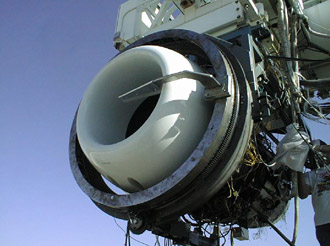
Measuring engine sound
At NASA Glenn Research Center, teams use tools including microphones, particle image velocimetry, hot wire anemometry and Raman spectroscopy to study airflow and sound. Data from the center’s experiments are used by the aviation noise reduction community to validate theories and noise prediction software.
Reducing a turbofan’s tonal noise may involve an advanced liner or an active noise control system. Engineers need information about the tone’s modal content, which a stationary microphone cannot provide. NASA Glenn engineers developed procedures using rotating microphones in the 1990s.
Rotating microphones in tests
NASA Glenn researchers have used Rotating Microphone Rakes in tests ranging from low-speed proof-of-concept work to full-scale turbofan engine ground tests. The work has included the Advanced Noise Control Fan Rig and the 9- by 15-Foot Low Noise Wind Tunnel.
Phased-array systems arrange microphones in one, two or three dimensions. Processing their recordings can pinpoint noise sources. NASA Glenn’s Array48 system has been used on scale-model jet flows, a counter-rotating open rotor fan model and a full-scale F404 military engine.
Tracking airflow disturbances
NASA-funded work has also developed a method using microphones embedded in an engine’s fan duct to locate noise sources on rotating blades. Tonal noise can arise when a fan-blade wake meets a downstream stator vane, while broadband noise can result when an engine takes in turbulent air.
Key points
- NASA Glenn uses rotating microphones because stationary microphones cannot measure a tone’s modal content.
- Phased-array microphone recordings can help pinpoint noise sources.
- Hotwire probes and Laser Doppler Velocimeters measure airflow around experimental propulsors.
- NASA Glenn’s test data help validate aircraft noise theories and prediction software.