Göbekli Tepe: Turkey's Ancient Hill of Stone Circles
Ancient stone pillars on a Turkish hilltop are changing how we think about early village life.
At a glance
- Country
- Turkey
- Location
- Şanlıurfa Province, Haliliye
- Elevation
- 760 m
- Area
- 126 hectares, 461 hectares
- Built or founded
- 100th century BC
- Heritage status
- World Heritage Site
The short version
- Göbekli Tepe is a Neolithic site in Şanlıurfa Province, Turkey, at 760 m elevation 2.
- It was in use from around 9500 BCE to at least 8000 BCE 1.
- It holds big round enclosures with tall carved stone posts from very early prehistory 1.
- It became a UNESCO World Heritage Site in 2018 1.
- As of 2021, about 10% had been dug 1.
What is Göbekli Tepe and where is it?
Göbekli Tepe is an early Neolithic place of digs in what is now Turkey 1. It lies in Şanlıurfa Province, in Haliliye, about 760 m above sea level 2. Records list 126 hectares for the site itself and 461 hectares for the wider zone 2.
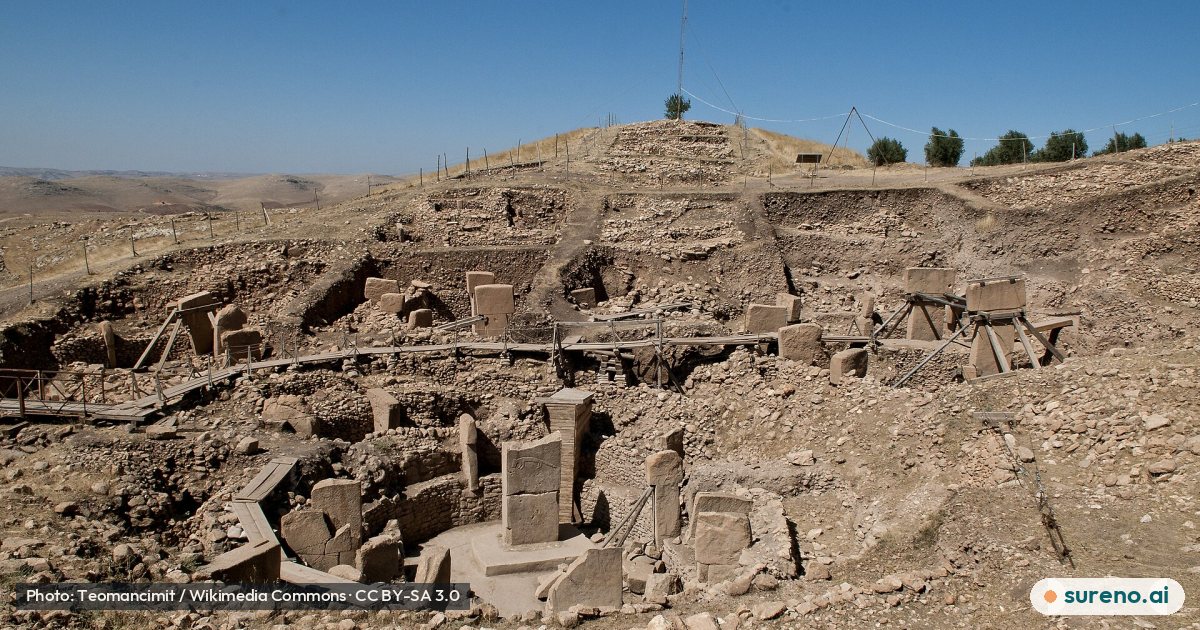
The remains form a human-made mound on high limestone ground 1. The mound rises about 15 m and covers about 8 hectares 1. It is near the village of Örencik, in a hilly area called Taş Tepeler, which means Stone Hills, below the Taurus Mountains 1.
Visitors today see rounded enclosures framed by tall T-shaped posts 1. Many posts show arms, hands, items of dress, and images of wild creatures 1. Researchers study these carvings to learn about beliefs and symbols long before writing 1.
Who built it and why does it matter?
People used the place from around 9500 BCE to at least 8000 BCE, in the era known as the Pre-Pottery Neolithic 1. That era is linked with the first stable villages anywhere 1. The people there lived mainly by hunting and gathering, with some early grain use as well 1.
The setting has raised big questions. It sits on rocky high ground without clear signs of fields, yet it holds very large stonework 1. This feeds a wider debate about whether settled life led to farming, or farming led to settled life 1. Older work viewed it as a meeting place for mobile groups 1. Work reported in 2019 points instead to homes, grain preparation, water storage, and everyday tools 1.
The exact use of the great enclosures is still not settled, though they are often called early temples in popular writing 1. They may have had roofs, and they seem to have been damaged by slips of earth and then fixed or rebuilt 1. Similar building styles appear at nearby Karahan Tepe 1.
What should visitors know before they go?
The place was noted by survey teams in 1963 1. In 1994 Klaus Schmidt saw its value, and digging started the next year 1. After his death in 2014, Istanbul University, Şanlıurfa Museum, and the German Archaeological Institute carried on together under Necmi Karul 1.
In 2018 it joined the World Heritage List for its early large-scale building 1. Only a small share has been opened so far. As of 2021, about 10% had been dug, while scans point to at least 20 large enclosures below the surface 1.
The builders worked local limestone with flint tools 1. They caught rain in cut channels that led to rock cisterns able to store at least 150 cubic metres of water 1. At the time of use, the land was wetter than now, with open grass, wild grain, and herds of sheep, goats, gazelle, and horse-like animals 1. For a trip, check official Turkish heritage and tourism pages for hours, tickets, and access, as of October 2026.
What we don't know yet
Share this explainer
Get this every day, on every new tab
Sureno Browser brings the day's stories, explained simply, to your start page.
Questions people ask
How old is Göbekli Tepe?
Sources
- Göbekli Tepe — Wikipedia
- Wikidata: Göbekli Tepe — Wikidata
Free tools for this
They run in your browser. Nothing is uploaded and there is nothing to sign up for.
More to read
 Travel & PlacesThe Rocky Mountains: How They Formed and When to VisitOct 5, 2026 · 2 min read0 views
 Travel & PlacesTrinidad and Tobago in Numbers: People, Places and CultureOct 4, 2026 · 2 min read0 views
 Travel & PlacesIsle Royale National Park: A Quiet Island in Lake SuperiorOct 4, 2026 · 3 min read0 views
 Travel & PlacesPotala Palace in Lhasa: Tibet's Hilltop Palace ExplainedOct 4, 2026 · 3 min read0 views
 WorldIrán: qué es, por qué es noticia y qué cambia para tiOct 5, 2026 · 6 min read5 views
 Travel & PlacesGiant's Causeway: Northern Ireland's Stone Stepping StonesOct 4, 2026 · 3 min read0 views