Giant's Causeway: Northern Ireland's Stone Stepping Stones
Forty thousand stone columns meet the sea in County Antrim, shaped by lava and legend.
At a glance
- Country
- United Kingdom
- Location
- County Antrim, Causeway Coast and Glens
- Heritage status
- World Heritage Site
The short version
- The Giant's Causeway has about 40,000 interlocking basalt columns in County Antrim, Northern Ireland 12.
- It formed 50 to 60 million years ago when fluid lava cooled and cracked into pillars 1.
- It is a UNESCO World Heritage Site and a national nature reserve 12.
- Access to the stones is free, with no need to go through the paid visitor centre 1.
What is the Giant's Causeway?
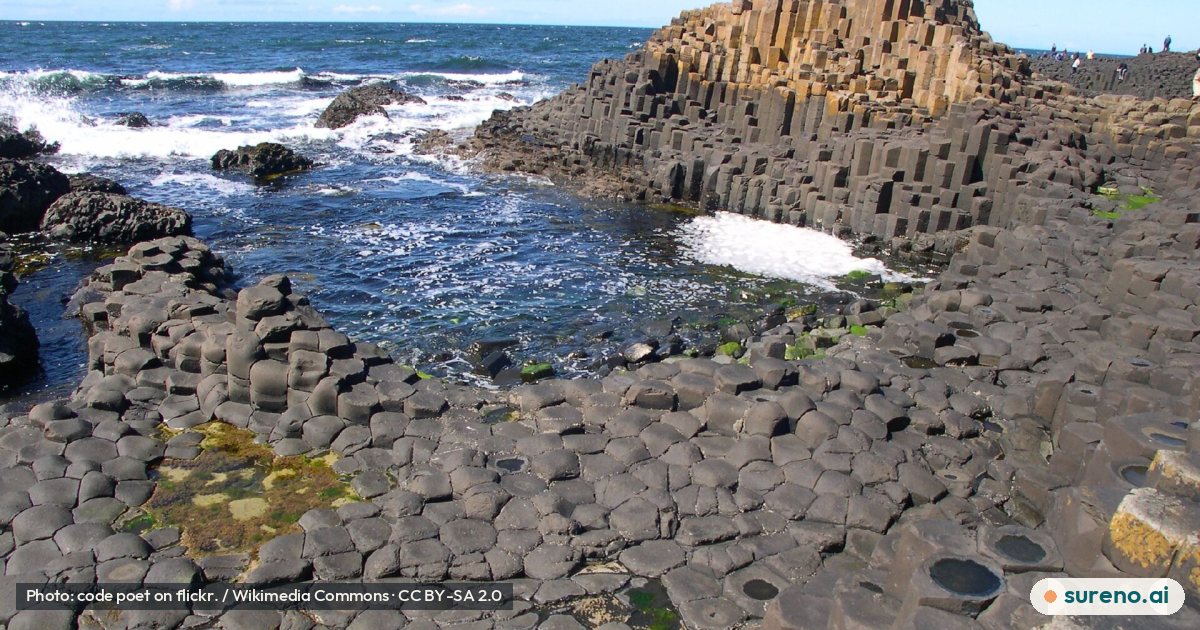
The Giant's Causeway is a coastal area of about 40,000 tightly fitted stone columns 1. It sits in County Antrim, in Causeway Coast and Glens, on the north coast of Northern Ireland 12. The country is the United Kingdom 2.
Most columns have six sides, but some have four to eight sides 1. The tallest stand about 12 metres high 1. Their flat tops form natural stepping stones that run from the base of the cliffs and slip under the sea 1.
The site is protected as a World Heritage Site and as a national nature reserve 12. Much of it is cared for by the National Trust, while other parts belong to the Crown Estate and private owners 1.
How did the columns form?
About 50 to 60 million years ago, during a time called the Paleocene Epoch, this part of Antrim saw strong volcanic activity 1. Very runny melted rock, called basalt, pushed through chalk beds and spread into a wide volcanic plateau 1.
As the lava cooled, it shrank 1. The shrinking made cracks, much like cracks in drying mud 1. The cracks spread downward and left tall pillar shapes 1. Later breaks across the pillars made shorter sections, sometimes called biscuits 1.
Many joints fit together as ball and socket shapes, with a rounded bottom and a hollow top 1. The speed of cooling largely set how wide each column grew 1. These rocks were once part of a large volcanic area called the Thulean Plateau 1.
Why is it special, and what should visitors know?
Scientists value the site because it helped people understand volcanoes and basalt 1. In 2022, it was listed among 100 geological heritage sites around the world 1. Readers have also voted it among the top natural wonders in the United Kingdom 1.
Stories add another layer 1. Legend says the Irish hero Fionn mac Cumhaill built a causeway to face the Scottish giant Benandonner 1. In one tale, Fionn wins. In another, his wife hides him as a baby to frighten Benandonner away 1. Matching columns stand across the sea at Fingal's Cave on Staffa, and they come from the same ancient lava flow 1.
The place draws many people, with nearly one million visitors in 2019 1. Entry to the stones themselves is free, and visitors do not have to go through the paid visitor centre 1. As of October 2026, check the National Trust for current paths, safety advice and facilities before you go.
What we don't know yet
- How visitor numbers and access rules may have changed since the 2019 figure in the sources.
- What future study may add about the ancient lava flows in the region.
Share this explainer
Get this every day, on every new tab
Sureno Browser brings the day's stories, explained simply, to your start page.
Questions people ask
Is the Giant's Causeway free to visit?
Sources
- Giant's Causeway — Wikipedia
- Wikidata: Giant's Causeway — Wikidata
Free tools for this
They run in your browser. Nothing is uploaded and there is nothing to sign up for.
More to read
 Travel & PlacesThe Rocky Mountains: How They Formed and When to VisitOct 5, 2026 · 2 min read0 views
 WorldFormer Prince Andrew's Action Against Police ExplainedOct 5, 2026 · 2 min read2 views
 SportsLakers Preseason Opener: What to Know About the Kings GameOct 5, 2026 · 4 min read1 view
 SportsSwitzerland vs North Macedonia: what the Nations League match meansOct 6, 2026 · 3 min read0 views