NASA Hubble charts a path for Roman science through gravitational lenses
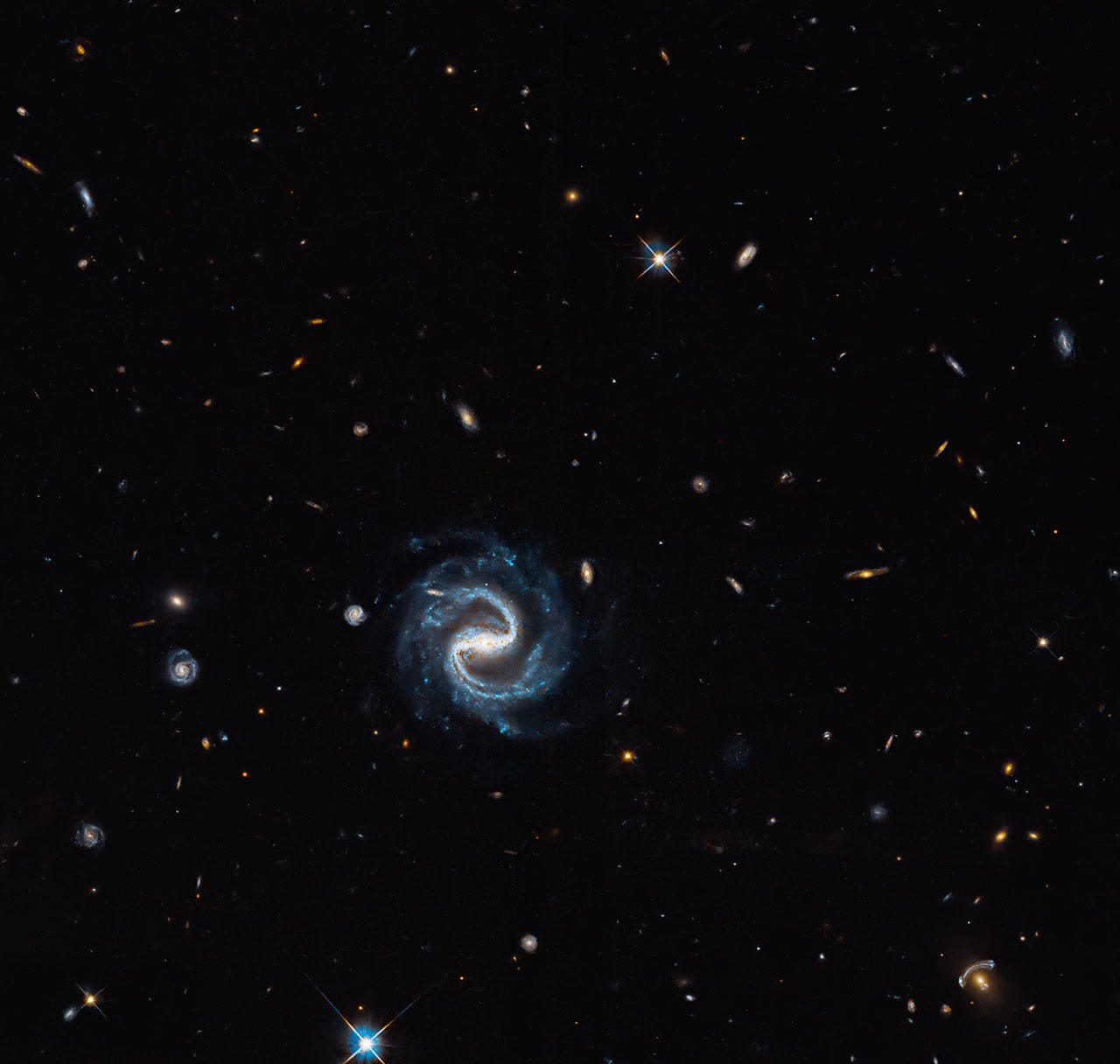
A distant galaxy appears twice
The image features a barred spiral galaxy, but the lensing system lies in its lower-right corner. There, gravity from a closer elliptical galaxy magnifies and distorts light from a background galaxy.
The foreground galaxy is about 4.5 billion light-years away, while the background galaxy is about eight billion light-years away. The background object appears as a prominent arc and a smaller, flipped image, a formation known as an arc-counterarc pair.
Gravity reveals hidden mass
Gravitational lensing occurs when a massive foreground object warps spacetime and bends light passing nearby. The effect depends on the alignment of the foreground and background galaxies. Researchers can use the distortion to estimate the foreground galaxy’s mass. Because visible matter alone cannot explain the observed bending, the measurements also help calculate how much dark matter the galaxy contains.
Two telescopes, different views
Hubble observes mainly visible and ultraviolet light, with some infrared coverage, and can provide high-resolution views of individual objects. Roman will observe mainly infrared wavelengths, along with some visible light, across a much wider field of view.
Hubble can examine gravitational lenses one at a time, while Roman is expected to detect a larger sample across the sky. Astronomers are using Hubble images to build a computer model for analyzing distortions in Roman’s larger images.
Preparing for Roman observations
The Hubble lensing images are intended to help lay the groundwork for future Roman observations. The model developed from Hubble’s sharp views will support analysis of dark matter in the lenses Roman finds.
Hubble will also follow up on interesting lenses detected by Roman. Together, the telescopes can provide a more comprehensive picture of the cosmos.
Key points
- A foreground galaxy bends and magnifies light from a background galaxy, producing two visible arcs.
- The foreground galaxy is about 4.5 billion light-years away; the background galaxy is about eight billion light-years away.
- Researchers use lensing distortions to estimate galaxy mass and investigate dark matter.
- Hubble offers detailed views, while Roman will survey a much wider area of the sky.