A medieval manuscript has confounded scholars for centuries. Have they been reading it wrong all this time?
Researchers argue incorrect binding of Voynich manuscript radically changes ideas about its drawings and indecipherable text
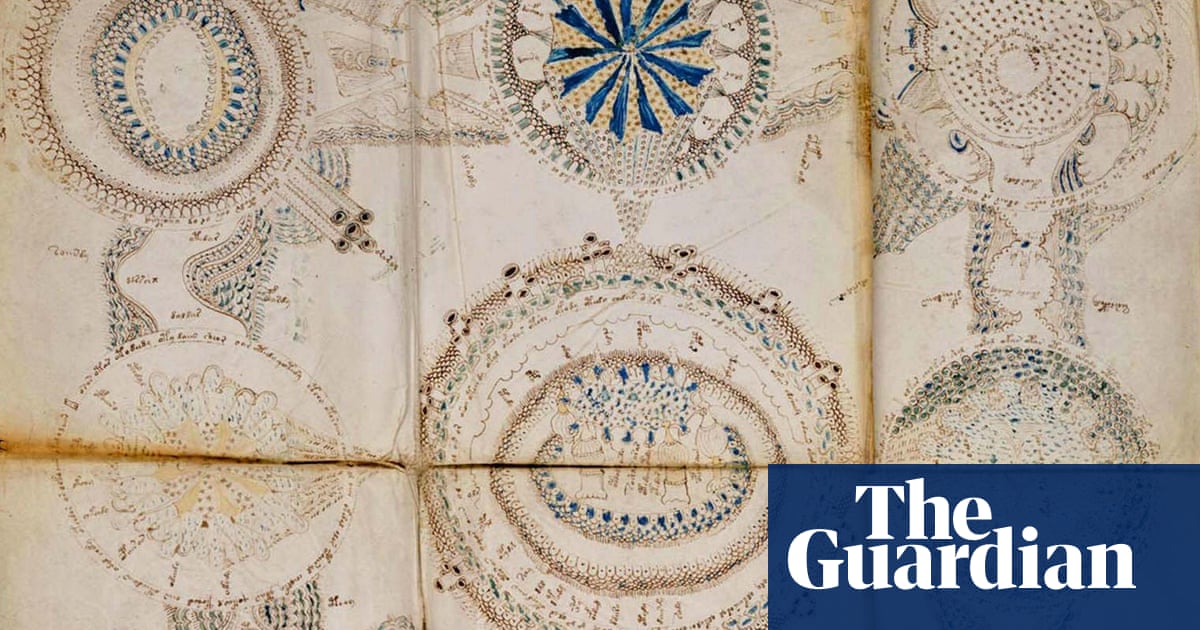
It has been called the world’s most mysterious manuscript: a medieval set of pages filled with botanical drawings, astronomical diagrams, pictures of nude women and indecipherable text. Claimed at various times to be a book in a lost language, a musical score, an instruction manual or just an elaborate hoax, the so-called Voynich manuscript’s true meaning has defied cryptographers and codebreakers for centuries.
In an article published in peer-reviewed journal Digital Medievalist, Colin Layfield and Lisa Fagin Davis argue that the manuscript’s folded sheets may have originally been piled on top of each other as “singulions” – like a stack of Christmas cards – but were mis-bound in a more typical “nested” arrangement at some point in the mid to late 15th century.
While their finding does not immediately de-code the script, written in what has commonly become known as “Voynichese”, the authors say their finding radically changes our idea of the manuscript’s function.
The manuscript’s unknown provenance has piqued scholarly interest ever since it surfaced in book collectors’ records in the 17th century. When it was bought in 1912 by Wilfrid Voynich, a Polish revolutionary and book dealer with a shop on London’s Soho Square, it was thought to be a scientific diary written by the 13th-century polymath Roger Bacon. Others have credited the codex to Leonardo da Vinci.
Recent chemical analyses of the manuscript, which is held at Yale University, have carbon-dated its parchment to between 1404 and 1438, ruling out these famous authorships.
In 2019, a biology research assistant at the University of Bristol, claimed that the manuscript was written in a “calligraphic proto-Romance” language, but the findings were later disputed, and the university subsequently removed a reference to the claims from its website.
There were also visual clues suggesting the pages were supposed to be read in a different order. In the current binding, some illustrations of streams or pipes run into the gutter – the blank space along the inner margins where pages are bound – but don’t fully match with the pictures on the opposite page. “Once you treat them as loose pages stacked together, all these artistic anomalies suddenly join up”, said Layfield, a senior lecturer in information systems at the University of Malta.
She said the only other known medieval manuscripts she has found preserved in a singulion arrangement were Qurans from north Africa, which were likely meant to be handed out as small booklets for instruction purposes.
Some of the drawings in the manuscript resemble the female reproductive system, while others hint at herbal lore and astrology. “When you put all of this together, it starts to feel like a book of women’s folk knowledge that’s being preserved,” she said. “But you cannot prove that yet.”
“The problem is that so few manuscripts have survived from the middle ages, because they weren’t bound. The irony is that whoever mis-bound this manuscript still did us a huge favour by ensuring its survival.”
Dive deeper
- Researchers argue incorrect binding of Voynich manuscript radically changes ideas about its drawings and indecipherable text
- It has been called the world’s most mysterious manuscript: a medieval set of pages filled with botanical drawings, astronomical diagrams, pictures of nude women and indecipherable text. Claimed at various times to be a book in a lost langua
- In an article published in peer-reviewed journal Digital Medievalist, Colin Layfield and Lisa Fagin Davis argue that the manuscript’s folded sheets may have originally been piled on top of each other as “singulions” – like a stack of Christ
- While their finding does not immediately de-code the script, written in what has commonly become known as “Voynichese”, the authors say their finding radically changes our idea of the manuscript’s function.
- The manuscript’s unknown provenance has piqued scholarly interest ever since it surfaced in book collectors’ records in the 17th century. When it was bought in 1912 by Wilfrid Voynich, a Polish revolutionary and book dealer with a shop on L