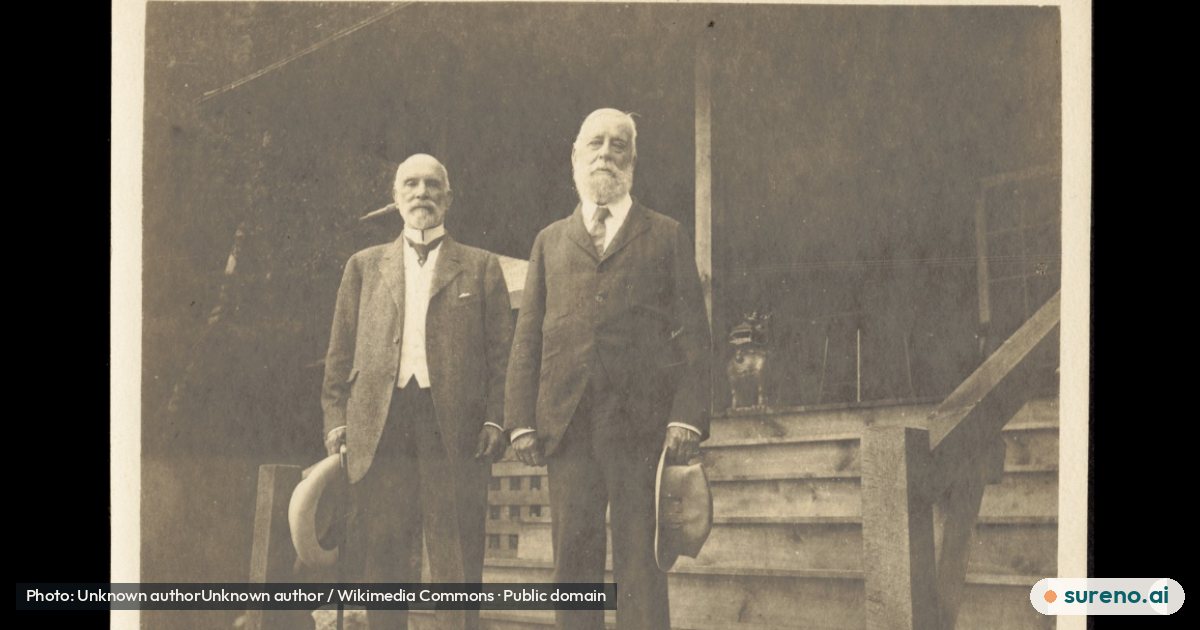
Thomas Jefferson Randolph: Jefferson's Grandson Explained
He was Thomas Jefferson's eldest grandson, manager of Monticello, and a Virginia public figure.
The short version
- Thomas Jefferson Randolph lived from 1792 to 1875 and was the eldest grandson of President Thomas Jefferson 1.
- He helped run Monticello late in Jefferson's life and later handled Jefferson's estate after his death 1.
- He held public roles in Virginia and led the University of Virginia for a time 1.
- He married Jane Hollins Nicholas in 1815 and they had thirteen children 1.
Who was Thomas Jefferson Randolph?
Thomas Jefferson Randolph was a Virginia farmer, officer, and lawmaker. He was born on September 12, 1792, and died on October 7, 1875 1. He is known today as the oldest grandson of President Thomas Jefferson 1.
His father was Thomas Mann Randolph Jr., who later served as governor of Virginia. His mother was Martha Jefferson Randolph, the oldest daughter of President Jefferson 1. He spent part of his youth at Monticello and at Jefferson's other home, Poplar Forest. He was taught privately, as was common for boys in wealthy Virginia families 1.
In 1807, at age 15, he was sent to Philadelphia for more schooling. Jefferson helped guide his studies in plants, nature, and the human body 1. His parents moved to Monticello in 1809. They later lived apart, linked in the source to his father's drinking, while Randolph stayed at Monticello with his mother and siblings 1. As a young man, he took on a leading role in the family 1. In 1819, he was badly hurt at the local courthouse in an attack by his sister's husband, Charles Bankhead 1.
What was his connection to Monticello?
Randolph started to look after Monticello in 1815, during a dry year that strained the farm 1. In 1817, Jefferson rented him two nearby farm tracts, Tufton and Lego. Randolph built a stone home there and moved his young family to Tufton 1. He stayed close to his grandfather. Jefferson named him to carry out his will in 1826 1.
Jefferson died on July 4 that year with large debts 1. Some of the debt came from loans tied to Wilson Cary Nicholas, Randolph's father-in-law, whose notes Jefferson had backed 1. After the economic crash of 1819 and the hard years that followed, those obligations weighed heavily 1. In the same period, Randolph bought his father's Edgehill farm when it was sold to pay creditors 1.
As the person in charge of settling the estate, Randolph arranged sales of household goods, land, and enslaved workers 1. Jefferson had owned 130 enslaved people, and Randolph held a sale of those people on January 19, 1827, about half a year after Jefferson died 1. The sale brought in about $35,000 toward the main debt, plus another $12,840 for interest and costs 1. Sally Hemings was not sold. Randolph's mother let her live outside slavery in Charlottesville with her two younger sons 1. Two other members of her family had been set free in Jefferson's will, after two more had left in 1822 1.
What was his family and public life?
In 1815, Randolph married Jane Hollins Nicholas 1. She was the daughter of Wilson Cary Nicholas, who had served in Congress, in the Senate, and as governor of Virginia 1. From 1829 to 1850, Jane ran a school on the family's Edgehill land 1. The couple had thirteen children 1. In 1850, the federal count listed Randolph as holding 46 enslaved people in Albemarle County 1.
Like his father and grandfathers, he farmed with enslaved labor 1. Later writers have described his link to slavery as mixed and hard to judge 1. One lasting debate concerns what he told historian Henry Randall about the children of Sally Hemings 1. Randolph pointed to his uncle Peter Carr, a nephew of Jefferson, as their father 1. He also said that some of those children looked much like Jefferson 1. Most historians now hold that Jefferson had a long tie with Sally Hemings and fathered her six children 1.
Randolph took part in Virginia public life over many years. He served in the state legislature, took part in the state constitutional meeting of 1850 and the secession meeting of 1861, and headed the University of Virginia for a period 1. During the Civil War, he served as a colonel for the Confederacy 1. His mother lived at times with him and his siblings before her death in 1836 and burial at Monticello 1.
Why does he still matter today?
For a general reader, Randolph helps explain how big history touched one family. His life shows how Monticello was run, how debt passed from one generation to the next, and how slavery supported wealthy households in Virginia 1. His work settling Jefferson's estate shows how hard that task became when land prices fell and debts stayed high 1. Monticello was at last sold in 1831 for $7,100, even though it had long been treated as worth more than $70,000 1.
He also shaped how later people viewed Jefferson. Because he knew his grandfather well and spoke with historians, his words carried weight for many years 1. Later study changed that view, above all on Sally Hemings and her children 1. As of October 4, 2026, study of letters, farm records, and family papers goes on. Readers who want more can use Monticello's official history pages or a public library for books on the Jefferson and Randolph families.
What we don't know yet
- The source gives only a short view of daily life for enslaved people on his farms.
- The excerpt ends during the 1850 census details, so later years need other reliable histories.
- Writers still discuss how to judge Randolph's words and choices about slavery.
Share this explainer
Get this every day, on every new tab
Sureno Browser brings the day's stories, explained simply, to your start page.
Questions people ask
Was Thomas Jefferson Randolph related to Thomas Jefferson?
What did Thomas Jefferson Randolph do at Monticello?
Is this the same Thomas Randolph from the Netflix show The Widower?
No. This guide is about Thomas Jefferson Randolph, who lived from 1792 to 1875 1. He is a different person from anyone with a similar name in a recent crime story.
Sources
- Thomas Jefferson Randolph — Wikipedia
More to read
 WorldFormer Prince Andrew's Action Against Police ExplainedOct 5, 2026 · 2 min read2 views
 SportsLakers Preseason Opener: What to Know About the Kings GameOct 5, 2026 · 4 min read1 view
 MoneyWhat Is Nasdaq? Why Its Record High Matters to AustraliansOct 6, 2026 · 3 min read0 views
 SportsSwitzerland vs North Macedonia: what the Nations League match meansOct 6, 2026 · 3 min read0 views