

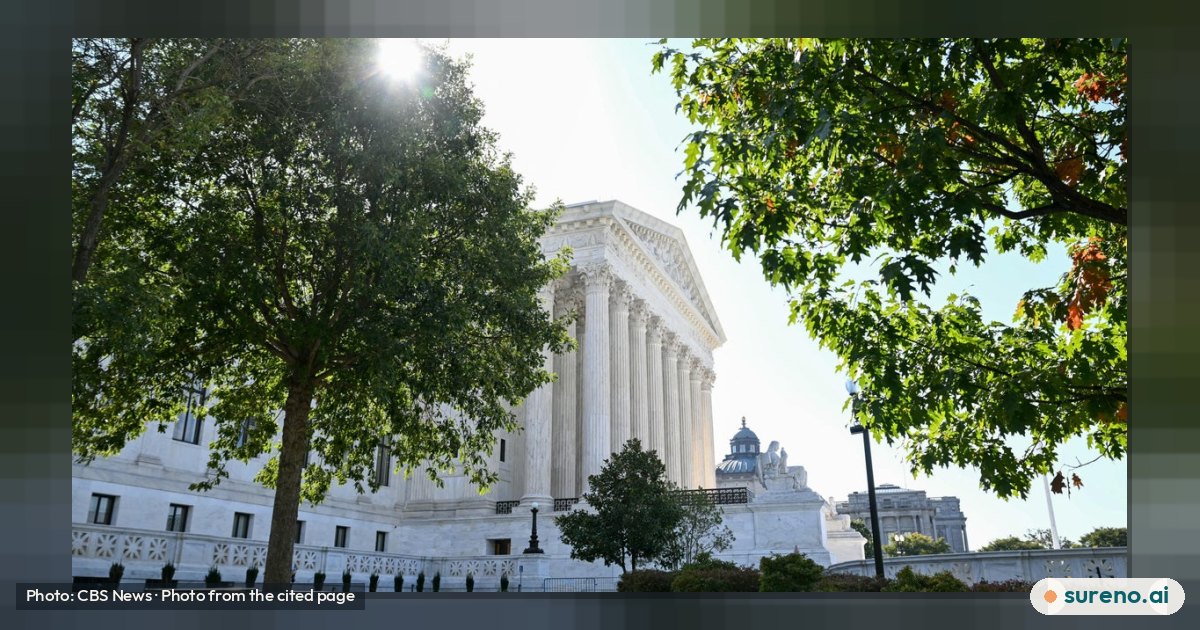
Supreme Court Rejects Bid to Set Aside California Ballots
The court declined an emergency request to separate disputed ballots, leaving them available to be counted while the wider lawsuit continues.
The short version
- The Supreme Court denied the Justice Department’s emergency request to make California set aside about 20,000 mail ballots linked to people it said might not be U.S. citizens. 12
- The unsigned order did not explain the court’s reasoning, and it addressed only the request for emergency relief. 12
- The dispute began with a federal lawsuit and had already been rejected by a district judge and the Ninth Circuit before the Justice Department appealed to the Supreme Court. 12
- The ruling means the requested pause was not imposed; it does not resolve the wider dispute over the government’s identification process or voter eligibility. 12
What did the Supreme Court decide about California’s voter rolls?
On November 2, 2026, the Supreme Court denied the Justice Department’s request for an emergency order involving about 20,000 California mail ballots. The department wanted state election officials to separate those ballots while the government’s claims were reviewed. The court did not grant that request. 12
The decision was an unsigned, one-line order, with no explanation of the justices’ reasoning. The court acted on the emergency request and did not ask California election officials to respond before ruling. 1
Why were the ballots challenged?
The federal government said a list it had compiled identified people it considered likely to be noncitizens. It asked California to keep ballots associated with those people separate from other ballots until their citizenship status could be checked. 13
That allegation is not the same as a court finding that the people on the list were ineligible voters. A federal district judge, David Carter, rejected the request to segregate ballots and described the government’s identification process as uncertain and error-prone. 1
The available reports do not explain how each person was identified or establish that the ballots in question were cast by noncitizens. The distinction matters: the emergency request concerned what election officials should do with ballots while the case proceeded, not a final determination about each voter. 12
What could the ruling change for California voters?
For the immediate election process, the Supreme Court’s denial means it did not order California to set aside the ballots covered by the request. The department had sought to prevent the state from counting them while verification was pending; the Supreme Court did not impose that temporary restriction. 12
The ruling does not, by itself, settle the broader lawsuit or establish a general rule about how California must handle voter-roll checks in future elections. The court gave no explanation, and the reports describe its action as limited to emergency relief. 12
So the practical effect is narrow: the requested intervention was denied, but the legal dispute over the government’s list and its claims was not fully resolved by this order.
What happened before the Supreme Court acted?
The Justice Department first pursued the California dispute in federal court. District Judge Carter refused to order California to segregate the ballots. The Ninth Circuit Court of Appeals also rejected the department’s attempt to overturn that result. 12
The department then made an emergency application to the Supreme Court on November 2, shortly before Election Day. The high court denied it later that day. 12
The reports also place the California request within a wider set of election-related legal disputes involving the administration. They mention a separate appeal connected to Alaska’s Senate election, but that is a different case and does not decide the California ballot dispute. 2
What remains unknown about the case?
The Supreme Court did not say why it denied the emergency request. Its order therefore does not show whether the justices agreed or disagreed with the lower courts’ reasoning. 12
The sources do not provide a final ruling on the underlying lawsuit, the number of people on the government’s list whose eligibility may be disputed, or how the list was checked. They also do not establish that the ballots were cast by noncitizens. 12
Readers should distinguish the court’s immediate decision from any later ruling on the merits. The available reports describe the denial of emergency relief, not a final resolution of every legal issue.
What we don't know yet
Share this explainer
Get this every day, on every new tab
Sureno Browser brings the day's stories, explained simply, to your start page.
Questions people ask
Did the Supreme Court block California from counting the disputed ballots?
Were 20,000 noncitizens proven to have voted in California?
The reports describe a government list of people considered likely to be noncitizens, not a court finding that 20,000 noncitizens voted. A district judge said the identification process was uncertain and error-prone. 1
What did the Justice Department ask the Supreme Court to do?
Did the Supreme Court decide whether the voters were eligible?
Sources
- Supreme Court rejects Trump — CBS News
- Supreme Court rejects DOJ's bid to block California from counting disputed ballots — CNBC, 2026-11-02
- Supreme Court rejects Trump bid to block 20,000 California ballots — dw.com, 2026-11-02
Free tools for this
They run in your browser. Nothing is uploaded and there is nothing to sign up for.
More to read
 WorldWhat the Supreme Court’s California Ballot Ruling MeansNov 3, 2026 · 4 min read0 views
 WorldWhat Haley Stevens’s Endorsement Means for Michigan’s Senate RaceNov 2, 2026 · 3 min read0 views
 WorldAlaska Ballot Lawsuit: What It Means for Senate CertificationNov 2, 2026 · 3 min read0 views
 WorldWhat the U.S. Patriot Missile Sale Means for UkraineOct 31, 2026 · 4 min read0 views
 Travel & PlacesWhy the MV Odyssey Cruise Ended Early in CambodiaNov 2, 2026 · 3 min read0 views
 WorldHow Israel’s Election Works and What Happens NextOct 28, 2026 · 5 min read0 views
 WorldWhy King Charles Is Being Asked to Apologize for SlaveryOct 28, 2026 · 3 min read0 views
 WorldHow Elon Musk’s Political Spending Could Shape U.S. PoliticsOct 27, 2026 · 4 min read0 views
 WorldWhat the Oleshky Truce and Putin Talks Could MeanOct 27, 2026 · 4 min read0 views
 Tech & Online SafetyThree AI studies test results against outside evidenceNov 2, 2026 · 5 min read0 views