

How Israel’s Election Works and What Happens Next
Israel’s exit polls point to a divided parliament, where party negotiations—not a single winner—will determine who can govern.
The short version
- Israel elects a 120-member parliament, the Knesset, through nationwide proportional representation; parties generally need to join forces to govern. 4
- Exit polls put Gadi Eisenkot’s bloc at 52 seats and Benjamin Netanyahu’s camp at 50, with 18 seats assigned to Arab parties not aligned with either bloc. 3
- Neither bloc appears to have the 61 seats needed for a majority, so negotiations may be needed before a government can be formed. 12
- The figures are exit-poll projections, not a final result, and the available reports do not establish who will ultimately lead the next government. 23
How does Israel’s election work?
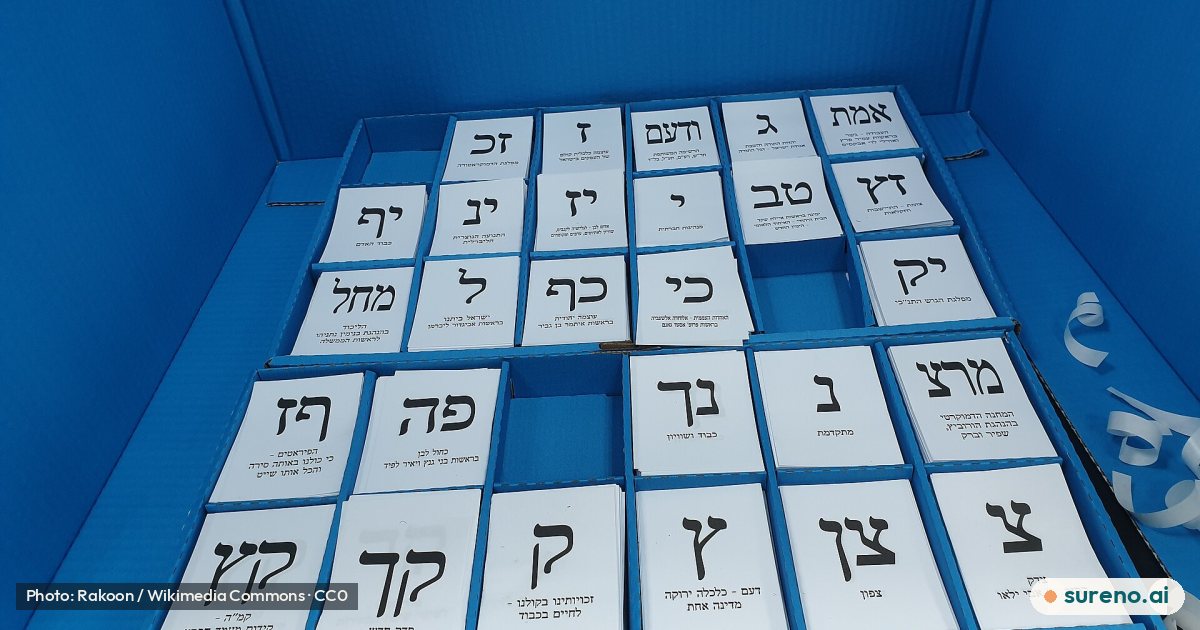
Israelis vote for parties in a national election. The country uses proportional representation: broadly, each party’s share of the vote determines its share of seats in the Knesset, Israel’s parliament. The Knesset has 120 seats. 4 This means voters are choosing among party lists rather than selecting a single local representative to fill a seat.
A party must receive at least 3.25% of the vote to qualify for seats, according to the election-system overview provided here. 4 Votes for parties that do not meet that threshold do not translate into Knesset seats. The threshold and the nationwide system shape which parties can participate in parliament, but they do not by themselves decide who becomes prime minister.
A party needs 61 seats to hold a majority in the 120-seat Knesset. 1 Since no single party has won a majority in a national election in Israel, governments are typically formed by coalitions: agreements among multiple parties to govern together. 4 As a result, a party can win more seats than its rivals without having enough support to govern on its own.
What do the exit polls say about the result?
Exit polls reported on October 27 show a close contest, not a clear winner. Updated projections from Israel’s three major television networks put Eisenkot’s bloc at 52 seats and Netanyahu’s Likud-led camp at 50. The remaining 18 seats were assigned to Arab parties described as unaligned in those projections. 3
Those figures do not give either main bloc the 61 seats needed for a majority. 13 PBS also reported that opposition parties appeared to have more seats than Netanyahu’s coalition, while still falling short of a majority. 2 The difference between leading the seat count and having enough partners to govern is central to understanding the result.
These are exit-poll projections, which may change when the votes are counted and official results are established. The sources available for this article do not provide final certified results. So it is more accurate to describe the election as deadlocked in the projections than to say that either side has won the ability to form a government. 23
What happens if no bloc has 61 seats?
Parties may need to negotiate with one another to assemble a coalition that can command a majority. The numbers suggest that the talks could be difficult: the exit polls show both main blocs below 61 seats, while the 18 seats assigned to unaligned Arab parties are not automatically part of either camp. 3 France 24 reported that Eisenkot had largely ruled out forming a government with those parties, which could further complicate coalition-building. 3
A larger bloc may have an advantage in trying to form a government, but the exit-poll lead is not the same as a confirmed governing majority. The available sources say Eisenkot’s bloc could have the first chance to form a government, while also warning that neither side has a clear path to power. 3 They do not explain every formal step in the government-formation process, so the precise timetable and procedure should not be assumed from these reports.
If negotiations take time, Netanyahu may remain in office in a caretaker capacity while parties try to reach an agreement, according to France 24. 3 That would not, by itself, prove that his coalition had won the election or secured a new term. It would mean that the political situation remained unresolved while talks continued.
Why is this election important?
This is the first Israeli election since the Hamas-led attacks of October 7, 2023, and the subsequent war in Gaza, according to the election coverage. 12 The Guardian describes the vote as a referendum on Netanyahu’s leadership after those attacks. 1 That is a description of the election’s political stakes, not a formal question on the ballot.
The contest could determine whether Netanyahu remains in power or whether his opponents can build a coalition. But the exit polls leave that outcome uncertain. 23 The Guardian also reports that Netanyahu faces ongoing corruption trials in three cases; those cases are separate from the question of which parties can form a government. 1
Turnout was reported at 77.7%, which France 24 said was Israel’s highest in more than two decades. 3 High participation indicates that many people voted, but it does not settle who will govern. For readers, the practical point is that the seat count and the subsequent party negotiations both matter—and the available figures are still projections rather than a final account of the result.
What should readers watch for next?
The first thing to watch is whether official counting confirms the exit-poll seat estimates. The second is whether any parties are willing to negotiate across the lines described in the projections. The reports available here do not establish which parties will join a coalition or whether either main bloc can reach 61 seats.
Until those questions are answered, headlines about a narrow lead should not be read as proof that a new government is settled. The election determines the composition of the Knesset; negotiations determine whether parties can agree on a governing majority. If no majority emerges quickly, the sources indicate that a caretaker government may continue while talks proceed. 3
What we don't know yet
- Whether the official vote count will match the exit-poll projections.
- Which parties, if any, will join negotiations with Eisenkot’s or Netanyahu’s bloc.
- Whether either camp can assemble the 61 seats needed for a majority.
- How long negotiations may take and who will ultimately lead the government.
Share this explainer
Get this every day, on every new tab
Sureno Browser brings the day's stories, explained simply, to your start page.
Questions people ask
Who is leading Israel’s election?
How many seats are needed to form a government in Israel?
What is proportional representation in Israel?
It is a system in which a party’s share of the national vote broadly determines its share of Knesset seats. Parties must also clear an electoral threshold, listed in the supplied overview as 3.25%, to receive seats. 4
Could Netanyahu stay in office if the election is deadlocked?
France 24 reported that Netanyahu could remain in a caretaker capacity while parties try to form a government. That possibility does not mean his camp has secured a majority or that the next government has been decided. 3
Was turnout high in Israel’s election?
France 24 reported turnout of 77.7%, described as the highest in more than two decades. High turnout does not determine which bloc can form a governing majority. 3
Sources
- Israel election live: polls open in most consequential vote in country’s history — the Guardian, 2026-10-27
- Projections show no clear winner in Israel's election — PBS News, 2026-10-27
- Israel election: Record turnout as Netanyahu and Eisenkot remain deadlocked — France 24, 2026-10-27
- Elections in Israel — Wikipedia
Free tools for this
They run in your browser. Nothing is uploaded and there is nothing to sign up for.
More to read
 WorldWhy King Charles Is Being Asked to Apologize for SlaveryOct 28, 2026 · 3 min read0 views
 WorldHow Elon Musk’s Political Spending Could Shape U.S. PoliticsOct 27, 2026 · 4 min read0 views
 WorldWhat the Oleshky Truce and Putin Talks Could MeanOct 27, 2026 · 4 min read0 views
 WorldWhy Finland and Norway Spoke With Putin About UkraineOct 27, 2026 · 3 min read0 views
 Tech & Online SafetyWhat to Know About Apple’s iOS 27.2 UpdateOct 27, 2026 · 3 min read1 view
 WorldWhat Albanese’s $6 Million Golf Club Grant Was Meant to FundOct 27, 2026 · 3 min read1 view
 WorldWhy a Judge Paused Tree Removal at a D.C. Golf CourseOct 27, 2026 · 3 min read0 views
 WorldWhat the Court Order Means for Trees at D.C. Golf CourseOct 27, 2026 · 3 min read0 views
 WorldWhat Trump’s $1 Million Voter-Fraud Tip Reward MeansOct 26, 2026 · 5 min read0 views
 Tech & Online SafetyWhat Anthropic’s Planned Stock-Market Debut MeansOct 27, 2026 · 4 min read1 view