How Transformer AI Models Work—and Why Their Design Matters
Transformers turn text into numbers, weigh how those parts relate, and use context to build an output.
The short version
- Transformer models process text as tokens represented by numerical vectors, then use attention to relate each token to others in context. 4
- Positional information helps a transformer distinguish word order, which attention alone does not preserve. 4
- A recent explanation treats model layers as memory stores and compares how linear layers, MLPs and attention retrieve information. 1
- That memory-store view is an intuition for understanding design, not proof that a person could independently recreate a complete transformer from first principles. 12
How does a transformer model work?
A transformer is a type of neural network: a computer system that learns patterns from examples. It can process sequences such as text, and related architectures can also handle other kinds of input. 4
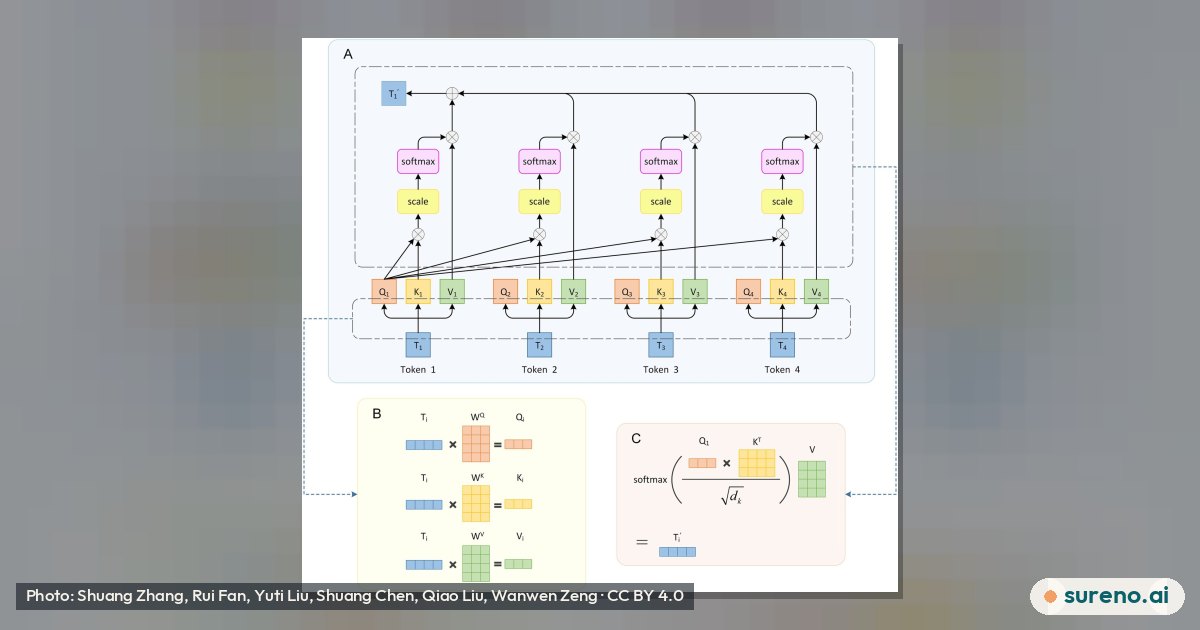
For text, the model first breaks input into tokens. A token may represent a word or part of one. It turns each token into an embedding, a list of numbers used to represent it. The model then processes those representations through layers. 4
At each layer, attention lets tokens take account of other tokens in the input. In plain terms, the model can use surrounding context to give a token’s representation more or less weight. The resulting representations help the model produce an output, such as a prediction about what text comes next. 24
What does attention do in a transformer?
Self-attention is a method for relating parts of an input to one another. A token is not interpreted only on its own: its representation can be updated in light of other tokens available in the context. Transformers commonly use multi-head attention, which applies attention in multiple parallel ways. 4
This offers a useful way to think about how the model handles context. In a sentence, the contribution of one word may depend on other words nearby or elsewhere in the sequence. Attention is a mechanism for making those relationships available to later computation; it does not mean the model understands the sentence as a person does. 4
Why does word order matter?
Attention by itself does not encode the order of tokens. A transformer therefore needs positional information, commonly added through positional encodings or learned position embeddings. This gives the model a way to distinguish the same tokens appearing in different orders. 4
That distinction matters because changing the order of words can change a sentence’s meaning. The source describes positional information as part of the architecture, but does not compare particular methods or say which one is best. 4
Could someone invent a transformer from memory?
The phrase is best treated as a way to approach the design, not as a claim that building a working system is easy. Alex Wang’s explanation begins with a memory-store analogy: model layers can be viewed as storing information and attempting to recall it when needed. It examines linear maps, multilayer perceptrons (MLPs) and self-attention through that lens. 1
A key issue in this account is interference. When a store contains more memories, other stored information can get in the way of retrieving the one being sought. The post uses the relationship between this interference and the intended signal to discuss capacity: how many memories can be stored before retrieval becomes unreliable. 1
This way of thinking can help someone reason about why different components might be useful. But an intuition is not a construction manual. A separate implementation article describes transformer systems as complex and says building one from scratch can take hundreds or thousands of hours. That is a broad statement in that article, not a universal measure for every project. 2
What does the memory analogy explain—and what does it leave out?
The analogy makes one design question easier to picture: a model needs not only to store patterns, but also to retrieve useful information without other patterns interfering too much. Wang’s post presents MLPs as improving on linear layers in both capacity and recall, and then extends the discussion to self-attention. 1
The available description does not give enough detail to calculate the capacity of a particular model or to compare real systems. Nor does it establish that every layer is literally a separate, cleanly organized database. “Memory store” is a mental model for discussing behavior, not a claim about human-like memory.
For readers interested in practical use, the implementation article describes using a pretrained model and a software library rather than building every component from scratch. Its example uses a fill-in-the-blank language task. 2 The sources here do not provide a full tutorial or assess the safety and reliability of any particular model.
What we don't know yet
- The supplied summary of the memory-store article does not provide enough detail to estimate the capacity of a specific transformer layer. 1
- The sources do not establish whether a person could independently derive the complete modern transformer architecture from basic principles.
- The sources do not compare the accuracy, costs or safety of specific transformer models.
Share this explainer
A browser that helps you stay safe
Sureno is a Chromium browser with plain-language privacy settings and an assistant that only reads a page when you ask.
Questions people ask
What is a transformer in AI?
A transformer is a family of neural network architectures built around multi-head attention. It processes tokens represented as numerical vectors and uses context from other tokens to update their representations. 4
How does self-attention work in simple terms?
Self-attention lets each token take account of other tokens in the input when the model processes it. This gives the model a way to use context rather than handling each token in isolation. 4
Why do transformers need positional encoding?
Attention alone does not preserve the order of tokens. Positional information, such as a positional encoding or learned position embedding, helps make the sequence order part of the model’s input. 4
Can you build a transformer from scratch?
It is possible to implement a transformer, but the supplied implementation article describes the systems as complex and says a from-scratch project can take hundreds or thousands of hours. That estimate is not a guarantee for every project; using a pretrained model and software library is another route. 2
Do transformer layers act like memory?
A recent explanation uses memory stores as an analogy for how model layers hold and retrieve information. It focuses on how interference between stored patterns can affect recall, but the analogy does not mean a layer is literally a human-like memory. 1
Sources
- You could have invented transformers from memory — Alex Wang, 2026-10-15
- How to Create a Transformer Architecture Model for Natural Language Processing -- Visual Studio Magazine — Visual Studio Magazine
- Transformer (deep learning) — Wikipedia
Free tools for this
They run in your browser. Nothing is uploaded and there is nothing to sign up for.
More to read
 Tech & Online SafetyWhat Character.AI’s Bankruptcy Reveals About AI StartupsOct 17, 2026 · 4 min read0 views
 Tech & Online SafetyCould Manual Driving Become a Luxury as Self-Driving Cars Spread?Oct 17, 2026 · 3 min read0 views
 Tech & Online SafetyWhat Tesla’s Roadster Reveal Says About Its LaunchOct 16, 2026 · 3 min read0 views
 Tech & Online SafetyApple’s iPhone Duo: Release Date, Price and Who It SuitsOct 16, 2026 · 4 min read0 views
 WorldWho Controls Starshield Speed Limits in Ukraine?Oct 15, 2026 · 3 min read1 view
 Tech & Online SafetyWhat Fortran Is and Why It Is Still Used 70 Years LaterOct 16, 2026 · 3 min read0 views
 Tech & Online SafetyWhat Krea 3’s Image Editing Model Can DoOct 16, 2026 · 3 min read0 views
 Tech & Online SafetySelf-Replicating AI: Could It Spread to Smart Devices?Oct 15, 2026 · 4 min read0 views
 Tech & Online SafetyHow pg_vectorsearch Indexes Vectors in PostgreSQLOct 15, 2026 · 4 min read0 views
 SportsDaniil Medvedev Wins Hangzhou and Eyes Season RevivalOct 3, 2026 · 4 min read1 view