

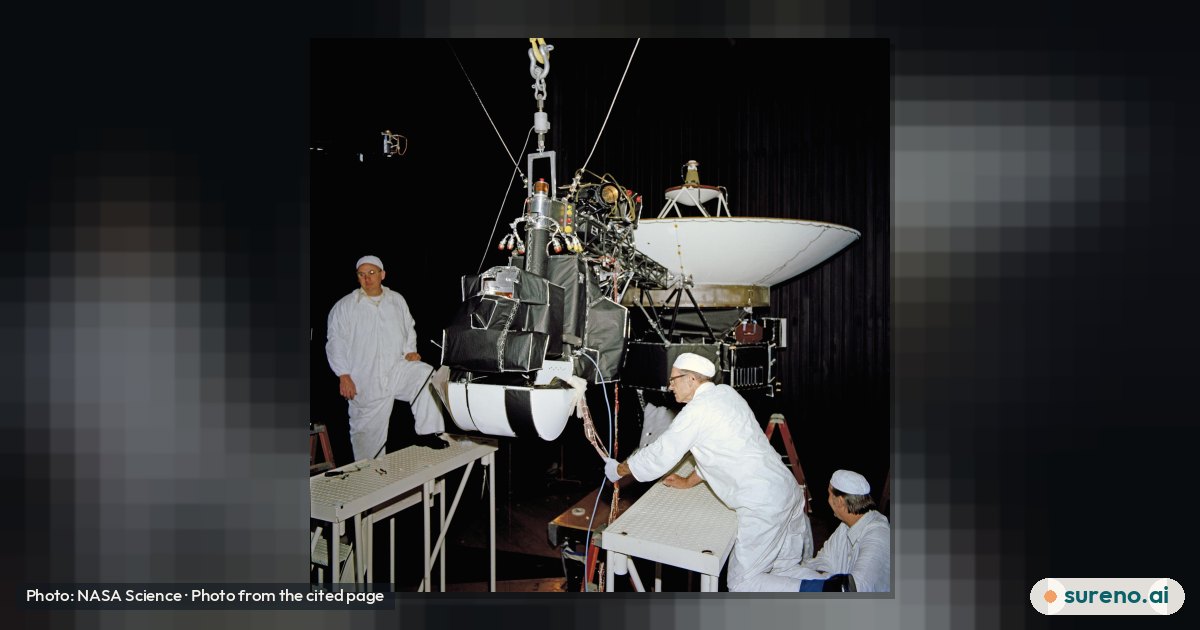
Why Voyager 1 Lost Contact and How NASA Is Saving Power
Voyager 1 resumed sending signals after a brief October pause, while NASA engineers made changes to help its remaining science instruments last longer.
The short version
- Voyager 1 missed two planned check-ins in October 2026, but contact returned on Oct. 20 after about 48 hours. The cause is still unknown. 12
- A set of thrusters shut down, and a backup set took over automatically. The available reports do not establish whether this was connected to the communication pause. 2
- In September, engineers switched off three devices and replaced them with lower-power alternatives, a project NASA calls the “Big Bang.” 1
- Voyager’s generators turn heat from decaying plutonium into electricity. NASA says the probes lose about four watts of power each year. 1
Why did Voyager 1 lose contact with Earth?
Voyager 1 unexpectedly stopped communicating in October 2026. NASA said the spacecraft missed planned check-ins on Oct. 18 and 19, then sent a signal again on Oct. 20. The communication pause lasted about 48 hours. 12
The reason for the interruption is not known. Voyager 1 signaled again before engineers had sent commands to troubleshoot the problem. NASA’s team therefore regained contact, but the available reports do not explain what caused the silence. 12
This was a temporary pause, not a confirmed end to the mission. The reports said communication had resumed and that no further outages had occurred since the spacecraft checked in again. 12
Did a thruster problem cause the outage?
Engineers found that one set of thrusters had shut down. A backup set took over automatically. Thrusters are small engines that help point and steady the spacecraft, and Voyager 1’s computers can switch to backups when they detect a problem with the active set. 2
The reports do not say that the thruster shutdown caused the communication pause. They describe both events, but NASA’s team had not identified the reason for the lost contact. It would be inaccurate to treat the two events as a confirmed cause and effect. 2
How is NASA conserving Voyager 1’s power?
In September, engineers completed a months-long effort to reduce power use. They turned off three devices and replaced their functions with three lower-power alternatives. NASA calls this project the “Big Bang.” The changes are meant to let Voyager 1’s remaining science instruments operate longer than previously expected. 1
The team made a similar equipment change on Voyager 2 about six weeks earlier. These adjustments help the spacecraft use its limited electricity more carefully; they do not replenish its power supply. 1
Where does Voyager 1 get its power?
Voyager 1 gets electricity from radioisotope thermoelectric generators. These devices convert heat from decaying plutonium into electrical power. The plutonium supply gradually declines, so the probes lose about four watts of power each year, according to NASA. 1
After nearly half a century in space, the spacecraft’s power margins are thin. Engineers are therefore reducing power use and deciding how to keep the remaining science instruments operating for as long as possible. 1
What does the communication pause mean for the mission?
The return of Voyager 1’s signal shows that the brief interruption ended, but it does not explain why it happened or tell us whether another pause will occur. The mission is still operating with limited power, and the cause of this specific communication problem remains unknown. 12
Voyager 1 communicates with Earth through NASA’s Deep Space Network, which receives signals and sends commands. The sources provided do not give a precise signal travel time for this incident. 4
As of Nov. 4, 2026, the main facts are clear: contact returned, a backup set of thrusters took over, and NASA completed power-saving changes. The cause of the temporary silence has not been established. 12
What we don't know yet
- What caused Voyager 1’s temporary loss of communication. 12
- Whether the thruster shutdown was related to the communication pause. The reports do not establish a connection. 2
- Exactly how long the remaining science instruments can operate after the power-saving changes. NASA says they should last longer, but the provided report gives no specific end date. 1
Share this explainer
New discoveries on every new tab
Sureno Browser puts explainers like this one on your start page every morning, in plain words.
Questions people ask
Is Voyager 1 back in contact with Earth?
What happened to Voyager 1’s thrusters?
One set shut down, and a backup set took over automatically. Thrusters help point and steady the spacecraft. The reports do not establish that the thruster issue caused the communication pause. 2
How does Voyager 1 make electricity?
Its generators convert heat from decaying plutonium into electricity. NASA says the Voyager probes lose about four watts of power each year as their plutonium supply declines. 1
What is NASA’s Voyager 1 Big Bang project?
It is an effort to reduce power use. In September 2026, engineers turned off three devices and substituted three lower-power alternatives, which NASA says should help the remaining science instruments operate longer. 1
Sources
- NASA’s Voyager 1 Conserves Power, Resolves Brief Communications Pause - NASA Science — NASA Science, 2026-10-29
- NASA's Voyager 1 mysteriously lost touch with Earth — Mashable, 2026-10-30
- Voyager 1 — Wikipedia
Free tools for this
They run in your browser. Nothing is uploaded and there is nothing to sign up for.
More to read
 SpaceNew observations reveal small worlds near Neptune and beyondNov 1, 2026 · 6 min read0 views
 SpaceWhy NASA Is Seeking Ideas to Keep Hubble RunningNov 1, 2026 · 4 min read0 views
 SpaceThree new clues about neutrinos, distant worlds and star chemistryOct 31, 2026 · 5 min read0 views
 SpaceWhat Astronomers Know About Possible Dwarf Planet ED138Oct 30, 2026 · 4 min read0 views
 WorldSupreme Court Rejects Bid to Set Aside California BallotsNov 3, 2026 · 4 min read1 view
 SpaceWhat Perseverance Found About Fine Dust on MarsOct 29, 2026 · 4 min read0 views