

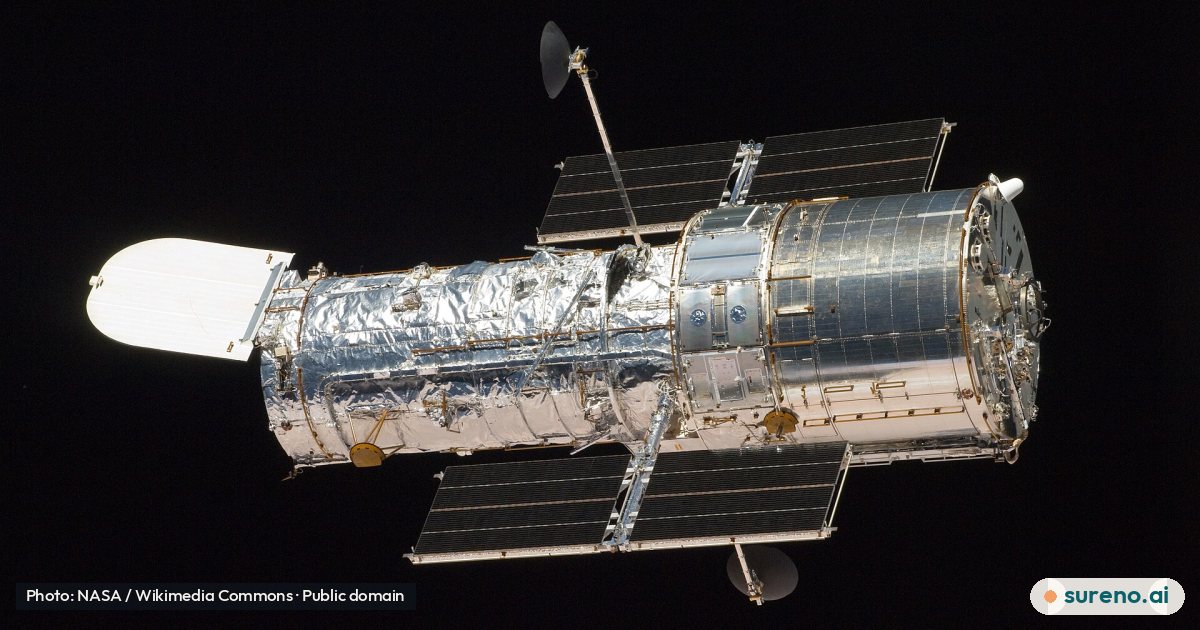
Why NASA Is Seeking Ideas to Keep Hubble Running
NASA is gathering ideas for boosting, servicing or safely disposing of Hubble, but it has not chosen a plan or committed to a mission.
The short version
- NASA is asking companies for ideas to boost Hubble's orbit, service the telescope or guide it into a controlled reentry; this request is for information, not a selected mission. 1
- Without an orbit boost, Hubble is expected to reenter Earth's atmosphere in the early-to-mid-2030s. 1
- NASA wants information about possible capture and a boost to at least 373 miles (600 km), with a mission expected by 2032. 1
- The agency has not announced which, if any, option it will pursue. 1
Why is NASA asking for ideas to extend Hubble's life?
Hubble is still operating, but its orbit is gradually getting lower. Without intervention, the telescope is expected to fall back into Earth's atmosphere in the early-to-mid-2030s. NASA is asking what commercial companies might be able to do before that happens. 1
The request is a Request for Information, or RFI: a way for NASA to learn about companies' capabilities and possible approaches. It does not mean the agency has chosen a company, approved a mission or promised to carry one out. 1
What options is NASA considering for Hubble?
NASA is seeking information about three broad possibilities: raising Hubble's orbit, servicing it, or guiding it into a controlled reentry. A controlled reentry would be a planned way to bring the telescope back through the atmosphere, rather than simply leaving its eventual return unmanaged. The RFI asks about commercial companies' current and near-term capabilities. 1
For a boost, NASA specifies raising Hubble to an altitude of at least 373 miles (600 km). The request also says a boost or servicing mission must not harm the telescope and is expected to occur by 2032. 1
Could a company really boost or service Hubble?
The sources do not identify a chosen company, a spacecraft design or a confirmed mission plan. NASA's request is meant to find out what companies could offer, so it is too soon to say which approaches are practical or whether any will be selected. 1
A previous NASA effort sought ideas for reboosting Hubble four years earlier, but those ideas did not lead to action, according to Ars Technica. That history is a reminder that asking for concepts is not the same as arranging a flight. 1
Why has Hubble's orbit been getting lower?
Hubble travels in low Earth orbit, where the thin outer atmosphere gradually slows spacecraft. The supplied reporting says Hubble has steadily lost altitude since its orbit was last raised in 2002. The final Space Shuttle servicing flight in 2009 did not boost the telescope, and NASA's shuttle fleet later retired. 1
Hubble has not received an orbit boost since that 2002 shuttle visit. NASA is now asking whether commercial capabilities could change the telescope's trajectory or otherwise help manage its end of life. 1
What does this mean for Hubble's science?
For now, NASA's request does not announce a change to Hubble's observing work or say that the telescope is about to stop operating. It is about possible future steps to protect or manage the observatory as its orbit declines. 1
Hubble remains in operation, while NASA's James Webb Space Telescope is also making observations. NASA released a Webb mid-infrared image of the Cat's Head Nebula on October 29, 2026. The supplied sources do not describe Webb as a replacement for Hubble or say that one telescope can fully take over the other's work. 23
When will NASA decide what to do?
Companies' responses to the RFI are due November 30, according to the reporting. NASA has asked for a mission to happen by 2032, but the available sources do not say when the agency will decide whether to proceed or which option it might choose. 1
The practical questions remain open: whether a company can safely capture Hubble, how an operation would work, whether NASA will fund a mission, and whether the agency will select an orbit boost, servicing, controlled reentry or another course. The request is an information-gathering step, not a final decision. 1
What we don't know yet
- Which companies will respond and what capabilities they will describe.
- Whether NASA will select or fund a mission after reviewing responses.
- Whether a boost, servicing, controlled reentry or another approach will be chosen.
- When NASA expects to make a decision.
Share this explainer
New discoveries on every new tab
Sureno Browser puts explainers like this one on your start page every morning, in plain words.
Questions people ask
Is NASA sending a mission to save Hubble?
NASA has asked companies for information about possible ways to boost, service or guide Hubble into a controlled reentry. The request does not announce an approved mission or a selected company. 1
When will Hubble fall back to Earth?
If it is left alone, Hubble is expected to reenter Earth's atmosphere in the early-to-mid-2030s. The sources do not give a more exact date. 1
How high does NASA want Hubble's orbit to be?
NASA's request asks about boosting Hubble to an altitude of at least 373 miles (600 km). It also says a boost or servicing mission should not harm the telescope. 1
When are companies' Hubble proposals due?
Responses to NASA's Request for Information are due November 30, according to the reporting. The available sources do not state when NASA will announce a decision. 1
Will James Webb replace the Hubble telescope?
Sources
- Once again, NASA is asking for ideas to rescue Hubble from certain death — Ars Technica, 2026-10-31
- NASA's James Webb Space Telescope Captures Eerie Cat's Head - NASA — NASA
- Hubble Space Telescope — Wikipedia
Free tools for this
They run in your browser. Nothing is uploaded and there is nothing to sign up for.
More to read
 SpaceThree new clues about neutrinos, distant worlds and star chemistryOct 31, 2026 · 5 min read0 views
 SpaceWhat Astronomers Know About Possible Dwarf Planet ED138Oct 30, 2026 · 4 min read0 views
 SpaceWhat Perseverance Found About Fine Dust on MarsOct 29, 2026 · 4 min read0 views
 SpaceHow a 709 BCE Eclipse Helps Measure Earth’s RotationOct 26, 2026 · 3 min read0 views
 Food & CookingHow Energy Costs Could Raise Canadian Grocery PricesNov 1, 2026 · 4 min read0 views
 SpaceWhat to Know About Tonight’s Full MoonOct 25, 2026 · 3 min read0 views