

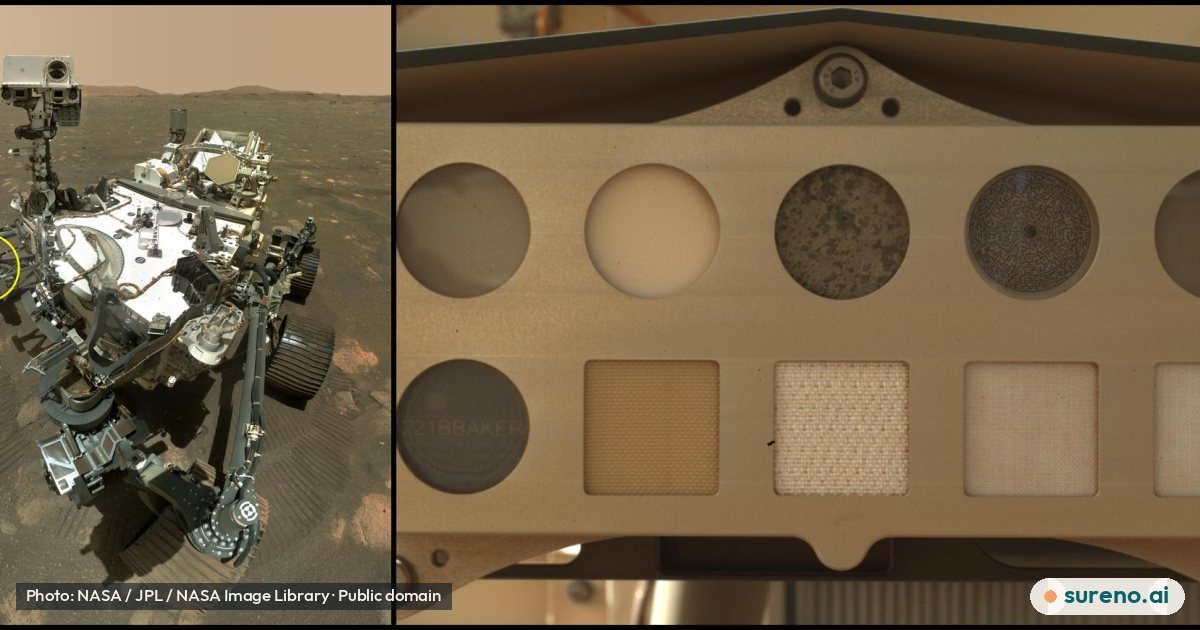
What Perseverance Found About Fine Dust on Mars
Perseverance measured fine and ultrafine dust on suit-material samples, but the findings do not show that astronauts have been harmed.
The short version
- Perseverance found fine and ultrafine dust particles clinging to spacesuit-material samples carried aboard the rover 1.
- Some measured particles were small enough to penetrate the lungs and enter the bloodstream, according to the report 1.
- A second report describes particles as small as 100 nanometers, but the available sources do not provide the study’s full measurements or methods 2.
- The finding may help guide suit and habitat design and dust-removal procedures; it does not establish that Martian dust has caused illness 1.
How fine is the dust Perseverance measured?
NASA’s Perseverance rover measured fine and ultrafine dust particles clinging to samples of spacesuit materials carried aboard the rover. The measurements were made over 1,645 Martian days, according to the report 1. A Martian day is the local day-night cycle; the source does not give a conversion of that period into Earth days.
The report says some particles were small enough to penetrate the lungs and enter the bloodstream 1. A separate article gives a smallest size of 100 nanometers and describes particles at or below 2.5 micrometers as able to reach deep into the lungs 2. A micrometer is one-millionth of a meter; a nanometer is one-billionth. The source summaries do not explain how many particles fell into each size group, so the figures should not be read as describing all Martian dust.
Why could tiny particles matter to astronauts?
Particle size matters because very small airborne particles can travel into the respiratory system. The research summary says some of the Martian particles measured could penetrate the lungs and enter the bloodstream 1. The other report says particles around 100 nanometers may be able to travel by way of the olfactory nerve, which links the nose with the brain 2.
That is a potential route of exposure, not proof that dust on Mars causes a particular illness. The sources do not report that people have been exposed to these measured particles, nor do they give evidence of health effects in astronauts. They also do not establish how much dust a crew might breathe during a mission. It is important to separate a possible hazard from a demonstrated medical outcome.
What did Perseverance actually test?
The rover examined dust that had collected on samples of spacesuit material carried on board 1. This makes the result useful for thinking about dust and suit surfaces, but it is not the same as a medical study of people or a direct test of how a spacesuit would protect a crew during a Mars mission.
The available summaries do not describe the instruments, sampling locations, dust composition, or how the researchers checked the measurements. They also do not explain whether dust on the carried samples behaves like dust on a worn suit. The report says the findings appeared in the Proceedings of the National Academy of Sciences, but the supplied material does not include the paper’s full results 1.
Could spacesuit fabric make a difference?
The reports point to spacesuit and habitat design as possible uses for the findings, along with procedures for removing dust 1. The second article says different suit fabrics can attract different particle sizes through electrostatic charging—the attraction or repulsion of particles because of electrical charge 2.
That possibility could matter when engineers choose materials and plan ways to keep dust from being carried into living areas. But the available source summaries do not identify which fabrics were tested, how large the differences were, or whether one material is safer. They also do not show that a particular suit design or cleaning method has been selected.
What does this mean for a future Mars crew?
The practical message is that dust size and dust control deserve attention in planning for human exploration. The reporting says the measurements could inform spacesuit and habitat design, dust-removal procedures, and health standards for future NASA missions to Mars 1. It does not say that a crewed mission is scheduled, or that any specific protection system has been approved.
For now, the finding is an engineering clue rather than a complete assessment of risk. The summaries do not provide a safe exposure level, a medical risk estimate, or evidence that dust particles reach the brain in people exposed on Mars. Those questions would need more evidence than the brief reports provide. The most accurate conclusion is that some measured particles are small enough to raise questions about exposure, and that the research may help engineers investigate how to limit it 12.
What we don't know yet
- How many particles were measured at each size, and what were the full measurement methods?
- What are the health effects, if any, of repeated exposure to Martian dust?
- How do the tested suit-material samples compare with materials used in a future crewed mission?
- Which dust-removal methods or protective designs, if any, will be adopted?
Share this explainer
New discoveries on every new tab
Sureno Browser puts explainers like this one on your start page every morning, in plain words.
Questions people ask
Can Mars dust get into astronauts’ lungs?
The reported measurements found some particles small enough to penetrate the lungs and enter the bloodstream 1. The sources do not give a human exposure study or show that astronauts have been harmed.
Can Martian dust reach the brain?
One report describes particles as small as 100 nanometers and says particles of that size may travel by way of the olfactory nerve 2. The supplied information does not establish that this has happened in people exposed to Mars dust.
Did Perseverance measure dust directly on Mars?
Perseverance measured particles clinging to spacesuit-material samples carried aboard the rover, over 1,645 Martian days 1. The summaries do not give further details about the sampling method.
How could this finding help protect astronauts?
The findings could inform spacesuit and habitat design, dust-removal procedures, and health standards for future missions 1. The reports do not identify a final design or a proven cleaning method.
Does the study prove Mars dust is dangerous?
It identifies particles small enough to raise concerns about possible exposure 1. The available summaries do not demonstrate illness, set a safe exposure limit, or quantify the risk to astronauts.
Sources
- Perseverance offers clues to protect crews from ultrafine Mars dust — Phys.org, 2026-10-27
- Perseverance Finds Mars Dust Fine Enough to Reach Astronaut Lungs and Brain — Tech Times, 2026-10-28
More to read
 SpaceHow a 709 BCE Eclipse Helps Measure Earth’s RotationOct 26, 2026 · 3 min read0 views
 SpaceWhat to Know About Tonight’s Full MoonOct 25, 2026 · 3 min read0 views
 SpaceNew clues from a small planet, Mars and fireballsOct 24, 2026 · 6 min read0 views
 SpaceWhat NASA’s Updated Moon Lander Plans Mean for ArtemisOct 23, 2026 · 4 min read0 views
 Tech & Online SafetyWhy a Foldable iPhone Screen Could Crack at the HingeOct 28, 2026 · 4 min read0 views
 SpaceThree space studies reveal clues about planets and cosmic structureOct 23, 2026 · 5 min read0 views
 SpaceWhat the Artemis II Orion Cabin Warning MeantOct 22, 2026 · 3 min read0 views
 SpaceWhat Falcon 9’s Planned Retirement Could Mean for U.S. LaunchesOct 22, 2026 · 4 min read0 views
 Nature & AnimalsCould a Weak Polar Vortex Affect Canada’s Winter?Oct 28, 2026 · 3 min read0 views