

How a 709 BCE Eclipse Helps Measure Earth’s Rotation
A corrected location for an ancient Chinese capital helped researchers reconstruct a total eclipse and refine estimates of Earth’s past rotation.
The short version
- A record of a total solar eclipse on July 17, 709 BCE helps scientists estimate how Earth’s rotation has changed over time 1.
- Researchers corrected an eight-kilometer error in the location used for the ancient capital before reconstructing how the eclipse appeared from Qufu 1.
- Eclipse records can test historical calculations because the predicted path depends on how Earth was turning at the time 1.
- The researchers also examined a possible ancient description of the Sun’s corona, but its interpretation is uncertain 1.
How can an ancient eclipse reveal Earth’s rotation?
An eclipse is not just a sight in the sky. Its path across Earth depends on where the Moon’s shadow falls, and that calculation depends in part on Earth’s position and rotation. When researchers compare a dated account of an eclipse with modern astronomical calculations, the record can help constrain how Earth was turning at the time.
Earth’s rotation means its spin around its axis. The 709 BCE record is useful because researchers identify it as one of the oldest precisely dated records of a total solar eclipse. Matching the written account to a reconstructed event offers a historical check on estimates of Earth’s past rotation 14.
What did researchers correct about the 709 BCE eclipse?
The researchers revisited the eclipse dated July 17, 709 BCE, which was recorded by observers at the court of the Lu Duchy. They reconstructed how it would have looked from Qufu, the ancient capital, using historical geography alongside astronomical calculations 1.
A key change was correcting an eight-kilometer error in the location of the ancient capital. Even a modest location error matters when researchers are trying to match a historical observation with the narrow path of a total eclipse. The corrected location allowed a more accurate reconstruction and, in turn, more precise evidence about Earth’s rotation speed at the time 1.
Why does the capital’s location matter?
A historical record describes what observers could see from a particular place. If that place is plotted incorrectly, the calculated view of the eclipse may not match the account. Researchers therefore need to check both the astronomical event and the location attached to the record.
In this case, correcting the capital’s position helped the team work out how the total eclipse would have appeared from Qufu. The report says the improved reconstruction provides more precise evidence about ancient rotation, but it does not give a numerical rotation rate in the available account 1.
What else might the eclipse record tell us about the Sun?
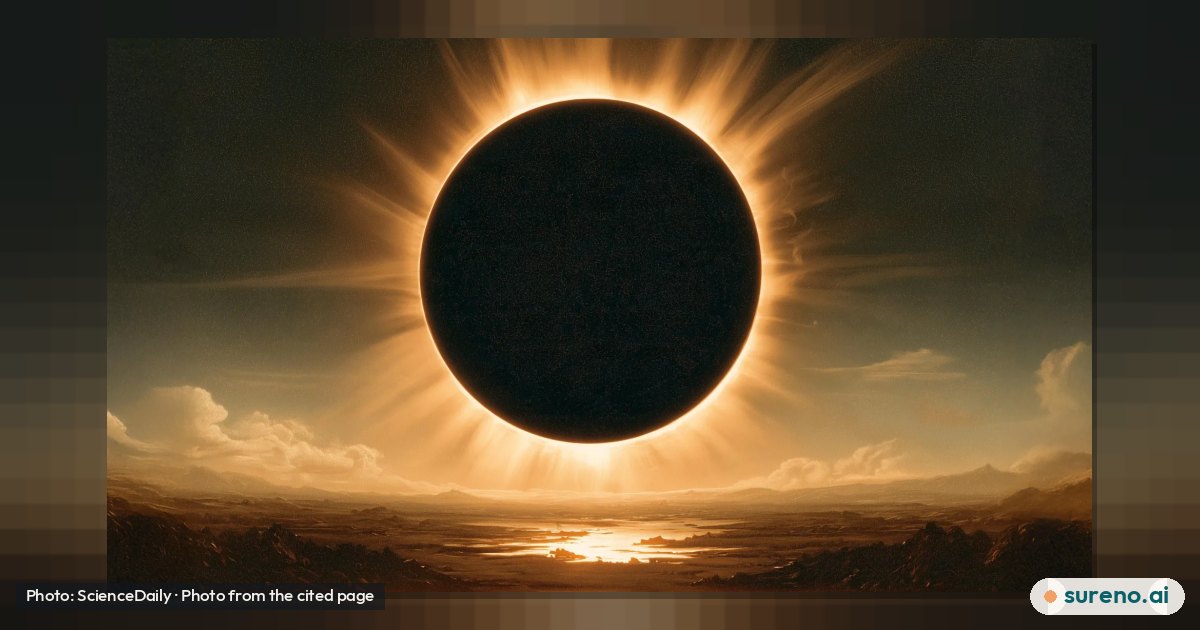
During a total solar eclipse, the Moon blocks the bright face of the Sun, making the faint outer atmosphere, called the corona, visible to the unaided eye. The researchers examined an early account that may describe the corona and considered what its possible shape could mean 1.
Their analysis suggests the Sun may have been returning to a more active phase after an extended period of unusually low activity. That is a proposed interpretation, not a direct measurement of the ancient Sun. The researchers say the reading could also offer independent support for earlier reconstructions of solar activity based on radiocarbon measurements 1.
What does this tell us, and what remains uncertain?
The main takeaway is that a carefully checked historical observation can improve scientific estimates of conditions long before modern instruments existed. The eclipse does not, by itself, provide a complete account of how Earth’s rotation changed. It adds evidence that researchers can compare with other records and calculations 1.
There are limits to what the available report establishes. The description of the corona is presented as a possible interpretation, and the supplied summary does not provide the original wording of the ancient record, the full calculation method, or a numerical estimate for Earth’s rotation. Those details would be needed to assess the findings more fully.
What we don't know yet
- The available source summary does not state the numerical estimate of Earth’s rotation speed derived from the eclipse.
- The ancient account’s possible description of the corona is an interpretation; the supplied material does not include enough detail to assess its wording.
- The research summary does not explain the full calculation method or how the result compares numerically with other historical estimates.
Share this explainer
New discoveries on every new tab
Sureno Browser puts explainers like this one on your start page every morning, in plain words.
Questions people ask
What happened during the 709 BCE solar eclipse?
Observers at the court of the Lu Duchy recorded a total solar eclipse dated July 17, 709 BCE. Researchers reconstructed how it would have appeared from Qufu, the ancient capital 1.
How do scientists use old eclipse records?
They compare the dated account and its location with astronomical calculations of the eclipse. When the event and place are reconstructed carefully, the record can provide evidence about Earth’s rotation in the past 1.
Why was an eight-kilometer correction important?
The location of the ancient capital was used to determine how the eclipse would have appeared to observers. Correcting its position helped researchers make a more accurate reconstruction of the event 1.
Did the ancient record prove the Sun was becoming more active?
No. Researchers considered whether an early account described the solar corona and said its possible shape suggested the Sun was returning to a more active phase. The source presents this as an interpretation that may support earlier reconstructions, not as proof 1.
Sources
- A 2,700-year-old solar eclipse just revealed something surprising about Earth — ScienceDaily
- Earth's rotation — Wikipedia
Free tools for this
They run in your browser. Nothing is uploaded and there is nothing to sign up for.
More to read
 SpaceHow Perseverance Set a Mars Driving RecordOct 21, 2026 · 4 min read1 view
 SpaceWhat to Know About Tonight’s Full MoonOct 25, 2026 · 3 min read0 views
 SpaceNew clues from a small planet, Mars and fireballsOct 24, 2026 · 6 min read0 views
 SpaceWhat NASA’s Updated Moon Lander Plans Mean for ArtemisOct 23, 2026 · 4 min read0 views
 Tech & Online SafetyThree limits of today’s AI: confidence, decisions and languageOct 25, 2026 · 5 min read1 view
 SpaceThree space studies reveal clues about planets and cosmic structureOct 23, 2026 · 5 min read0 views
 SpaceWhat the Artemis II Orion Cabin Warning MeantOct 22, 2026 · 3 min read0 views
 SpaceWhat Falcon 9’s Planned Retirement Could Mean for U.S. LaunchesOct 22, 2026 · 4 min read0 views
 SpaceWhat Causes a Rocket Launch’s Colorful “Space Jellyfish”?Oct 21, 2026 · 3 min read0 views
 MoneyJackdaw Gasfield Approval: What It Means for UK EnergyOct 21, 2026 · 4 min read3 views