NASA Experimental Facilities Explore Ways to Reduce Aircraft Engine Noise
Facilities for engine research
NASA Glenn teams conduct experiments in several specialized facilities, including a low-speed wind tunnel, an aero-acoustic laboratory and multiple jet test rigs. The facilities support studies of aircraft engine aerodynamics and acoustics.
The 9- by 15-Foot Low-Speed Wind Tunnel provides controlled conditions for studying engines during takeoff and landing. Modifications completed in 2019 improved airflow and reduced background noise, while a five-sensor microphone rake measures sound from scale experimental propulsors.
The work is intended to help reduce noise in communities near airports. Researchers also use the Aero-Acoustic Propulsion Laboratory to test aircraft engines and engine components.
Inside the acoustic dome
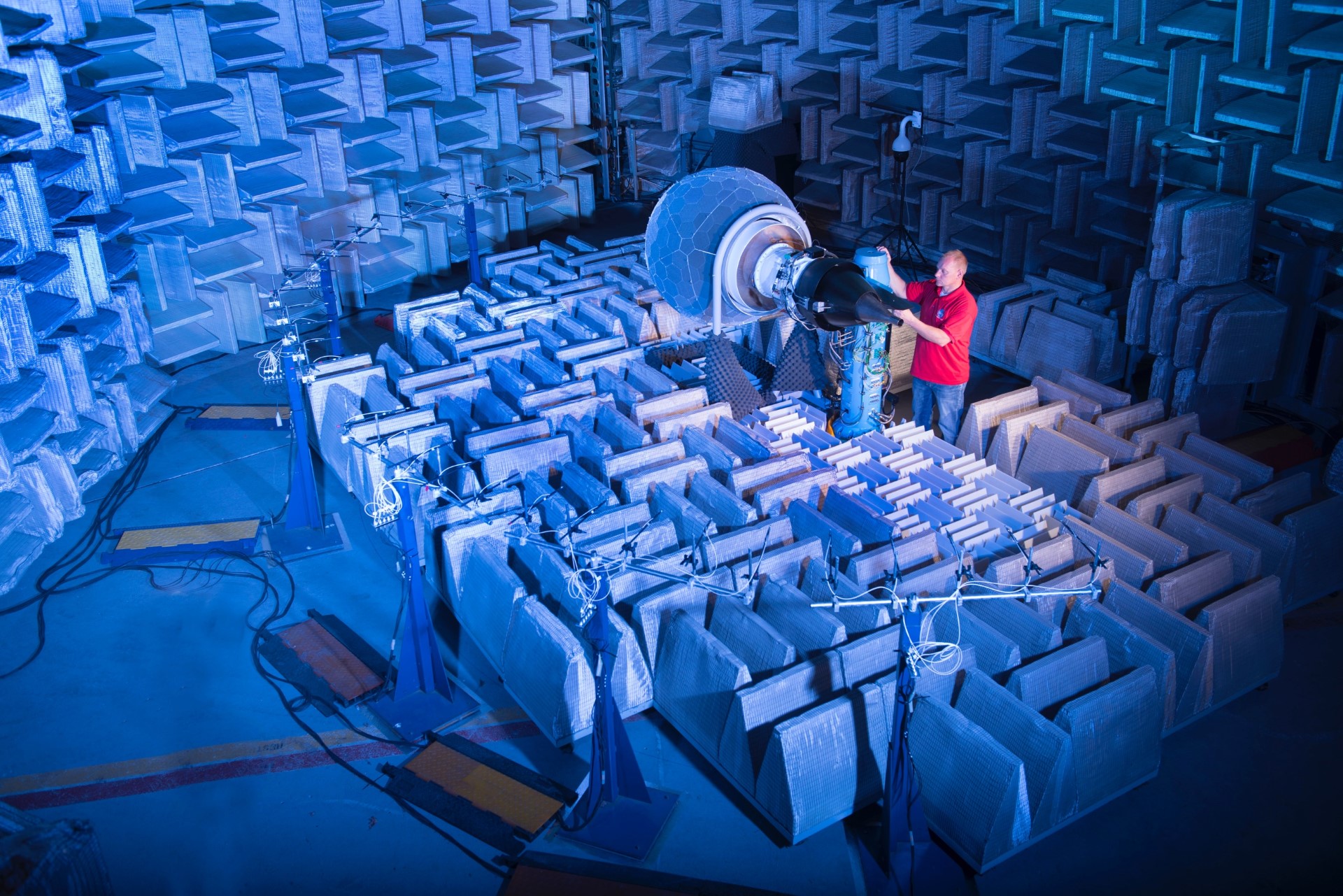
The Aero-Acoustic Propulsion Laboratory is a 65-foot-radius geodesic dome that can be configured as either a hemi-anechoic or anechoic chamber. Fiberglass wedges on its walls, floor and around test rigs absorb sound and limit reflections.
Built in 1993, the dome was the first known free-standing geodesic structure designed both to reduce sound transmission through its walls and absorb sound inside. It houses the Nozzle Acoustic Test Rig, the Small Hot Jet Acoustic Rig and the DGEN 380 Aeropropulsion Research Turbofan.
Testing jets and measuring noise
The Small Hot Jet Acoustic Rig tests single-stream nozzles up to 5 centimeters in diameter, Mach 2.0 and 800 K. Researchers use it to examine links between nozzle shape, jet flow and noise, including how a jet plume interacting with aircraft wings, flaps or a tail changes the sound produced.
The rig has supported advanced measurement methods, including Rayleigh and Raman scattering, digital Schlieren and real-time particle image velocimetry. Researchers have also used microphone arrays to locate noise sources and studied turbulent temperature and velocity fluctuations in hot jets.
Many measurement techniques and noise findings first developed on the SHJAR have since been used on the higher-fidelity Nozzle Acoustic Test Rig, which is located in the same laboratory. The NATR is a free-jet wind tunnel used to evaluate jet-noise reduction concepts.
Key points
- NASA Glenn facilities study aircraft engine aerodynamics, acoustics and jet noise.
- The 9- by 15-Foot Wind Tunnel examines engine conditions during takeoff and landing.
- The Aero-Acoustic Propulsion Laboratory uses sound-absorbing wedges to limit reflections.
- Techniques developed on the SHJAR have also been used on the NATR.