

What New Recordings Reveal About Omura’s Whale Habitat
Long-term recordings point to warm, food-rich waters off northwest Australia, while drone footage offers a rare look at an Omura’s whale feeding.
The short version
- Omura’s whale is a baleen whale in the rorqual group; it was recognised as a species in 2003. 1
- Recordings from 35 sites off northwest Australia, collected from 2005 to 2023, detected its calls throughout the year. 13
- Researchers found the whales were more likely to be detected in warm, food-rich waters, but the recordings do not provide a complete picture of where every whale goes. 13
- Drone footage from a March 2026 sighting in the Dampier Strait showed an Omura’s whale feeding. 2
What is an Omura’s whale?
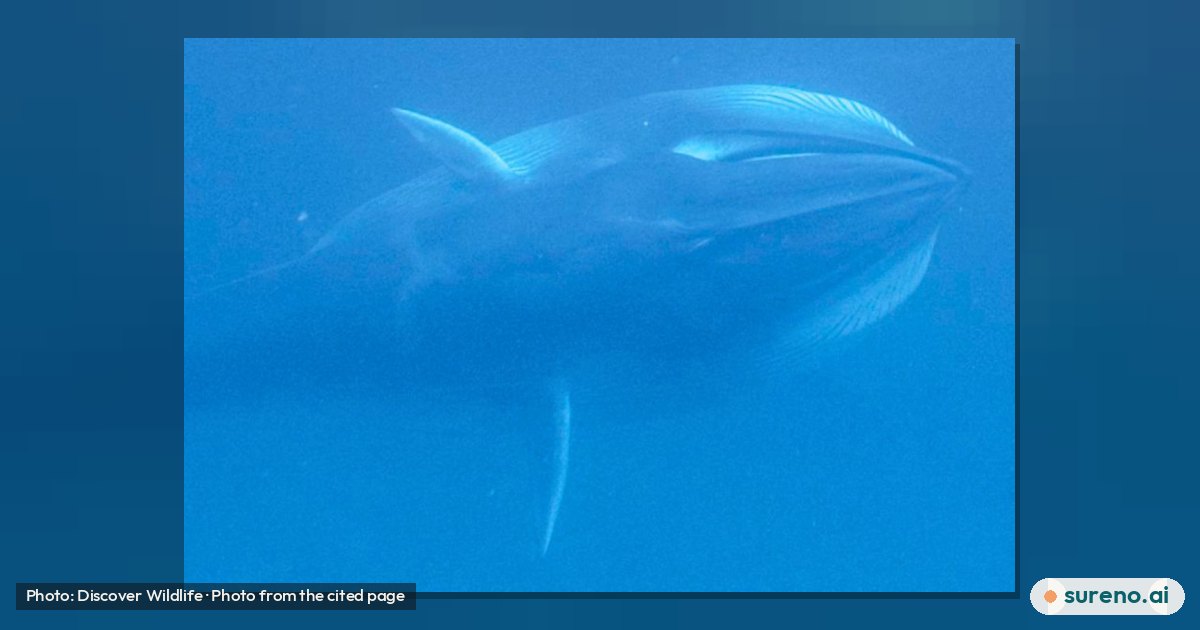
Omura’s whale is a type of baleen whale. Baleen whales feed using plates of baleen in their mouths, rather than teeth. It belongs to a group called rorquals, which also includes the blue whale. Researchers recognised Omura’s whale as a distinct species in 2003. 1
It is a relatively small rorqual, growing to around 10 metres long, according to the long-term habitat research report. 1 The species is still poorly understood. It is sometimes mistaken for Bryde’s whale, which can look similar from a distance. The source describing the drone footage says Omura’s whale has one ridge along the top of its head, while Bryde’s whale has more than one. 2
What did the recordings reveal about its habitat?
Researchers at Curtin University analysed underwater acoustic recordings collected off northwest Australia between 2005 and 2023. The recordings came from 35 sites spread across about 1,800 kilometres of ocean in the North-west Marine Region. 13
They detected Omura’s whale calls throughout the year. The analysis also found that calls were more likely in warm, food-rich waters. That gives researchers a useful clue about conditions associated with the whales’ presence in this region. 13
Sound recordings are a way to study whales that are difficult to see. They can reveal when calls are detected at monitored sites. They do not, on their own, show how many individual whales are present or where each animal travels. The available research summaries do not give a population estimate or identify every place the species uses.
What does the new drone footage show?
A separate report describes drone footage of an Omura’s whale feeding in the Dampier Strait, a remote area of the Pacific. The sighting took place in March 2026. The report presents it as a rare chance to see the species feeding. 2
The footage adds a direct visual observation to what researchers can learn from sound recordings. It confirms that the whale was feeding at the time and place filmed. The source summary does not specify what the whale was eating or describe enough of the footage to establish how often it feeds in this way. 2
Why do these findings matter for conservation?
The International Union for Conservation of Nature lists Omura’s whale as Data Deficient. This means there is not enough information to assess its extinction risk accurately. 13
Finding the waters where calls are more likely to be detected can help researchers identify habitat that may matter to the species. The long span of recordings is valuable because the whale is rarely seen and remains little studied. But habitat clues are not the same as a full assessment of its numbers, health, or conservation needs. 13
What is still unknown about Omura’s whale?
The research reports provide new information about likely habitat off northwest Australia, and the footage captures one feeding event. They do not settle how many Omura’s whales exist, how far they travel, or whether the same habitat patterns apply across the species’ full range. 123
Researchers also need more observations to understand the whale’s feeding habits and how its use of particular waters changes over time. The available summaries do not provide enough detail to answer those questions yet.
What we don't know yet
- How many Omura’s whales exist, and how that number changes over time.
- How far individuals travel and whether the Australian habitat pattern applies elsewhere.
- What the whale in the drone footage was eating and how typical that feeding behavior is.
Share this explainer
Get this every day, on every new tab
Sureno Browser brings the day's stories, explained simply, to your start page.
Questions people ask
Where do Omura’s whales live?
How big is an Omura’s whale?
The habitat research report says Omura’s whales grow to around 10 metres long. 1
What did the Omura’s whale drone footage capture?
A report describes footage of an Omura’s whale feeding in the Dampier Strait during a March 2026 sighting. The available source summary does not say what it was eating. 2
Why is Omura’s whale listed as Data Deficient?
Sources
- Underwater recorders capture sound of mysterious, 10m-long giant off Australian coast | Discover Wildlife — Discover Wildlife, 2026-10-21
- Nobody Had Ever Filmed an Omura's Whale Eating, Then This Drone Did — A-Z Animals, 2026-10-21
- Eighteen years of whale call research reveals key habitat of mysterious species — Phys.org, 2026-10-20
Free tools for this
They run in your browser. Nothing is uploaded and there is nothing to sign up for.
More to read
 Nature & AnimalsPolar Vortex Forecast: What Early Winter Signs Can Tell UsOct 26, 2026 · 4 min read0 views
 Nature & AnimalsWhy October Snow Is Affecting Parts of AlbertaOct 24, 2026 · 3 min read0 views
 Nature & AnimalsWhat a Delay to EU Methane Rules Could ChangeOct 23, 2026 · 4 min read0 views
 Nature & AnimalsWhat New Wind Turbines Mean for New Zealand’s Power SupplyOct 22, 2026 · 3 min read0 views
 Tech & Online SafetyThree limits of today’s AI: confidence, decisions and languageOct 25, 2026 · 5 min read1 view
 Nature & AnimalsWhy Bogong Moths Can Look Like Rain on Weather RadarOct 22, 2026 · 3 min read0 views
 Nature & AnimalsWhy Southern Ontario’s First Snow May Arrive LateOct 21, 2026 · 3 min read0 views
 MoneyJackdaw Gasfield Approval: What It Means for UK EnergyOct 21, 2026 · 4 min read3 views