

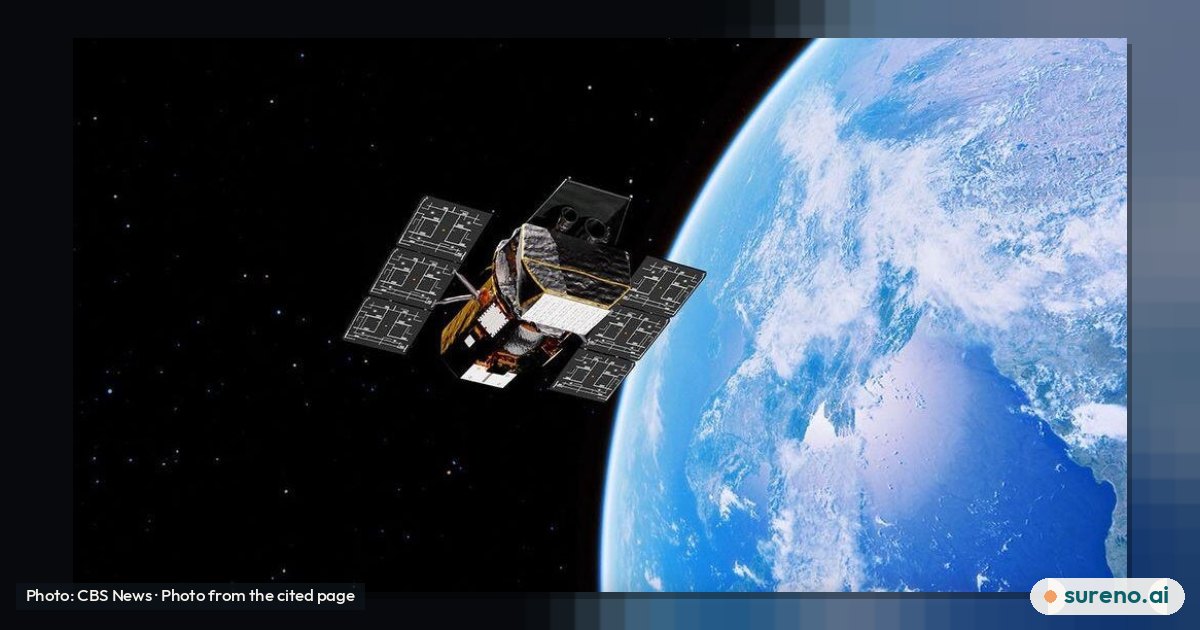
NASA’s Swift Telescope Returns to Earth After 22 Years
The Swift Observatory reentered over Indonesia on November 4, 2026, after a long mission studying powerful events across the universe.
The short version
- NASA reported that Swift entered Earth’s atmosphere at 7:39 a.m. Eastern Time on November 4, 2026, above North Sumatra, Indonesia. 1
- The observatory launched in 2004 for a planned two-year mission and remained active for almost 22 years. 12
- Swift investigated gamma-ray bursts and other energetic cosmic events, including supernovas and stars disrupted by black holes. 2
- NASA said most of the spacecraft was expected to burn during reentry, although some pieces might reach the ground; the stated danger to people was low. 1
What was the Swift space telescope?
The Neil Gehrels Swift Observatory was a NASA space telescope built to spot sudden, powerful events in the universe and quickly turn toward them. Its research included gamma-ray bursts, intense flashes linked to distant cosmic explosions. 1
Swift was launched into low Earth orbit on November 20, 2004. Its original plan called for a two-year mission, but the spacecraft continued working for nearly 22 years. It was still operating until the month before it returned to Earth, according to CBS News. 1
When and where did Swift reenter Earth’s atmosphere?
NASA said Swift entered the atmosphere at 7:39 a.m. Eastern Time on November 4, 2026, above North Sumatra in Indonesia. NASA and the U.S. Space Force monitored its descent. 1
Earlier predictions allowed for considerable uncertainty about the timing. The reported entry point does not establish where any pieces that survived may have landed. 1
Why did the telescope come back to Earth?
Swift orbited relatively close to Earth. Even the thin atmosphere at that height can slow a spacecraft, and CBS News reported that solar activity increased the drag on Swift and lowered its orbit. 1
A separate report says the observatory lacked fuel to maintain or change its path. NASA hired Katalyst Space for a rescue attempt, but the attempt did not work. 13 The sources provided do not explain the technical reasons the rescue failed.
What did Swift help scientists study?
Swift observed gamma-ray bursts, supernovas, and tidal disruption events. The last term refers to cases in which a black hole pulls a nearby star apart. Popular Science says Swift examined more than 2,000 gamma-ray bursts and over 1,400 supernovas. 2
Its observations also became source material for scientific research. Popular Science estimates that roughly 7,000 published papers use Swift data; the supplied material does not provide an independent check of that figure. 2 The end of the spacecraft’s operations does not remove the value of the records it already gathered.
Was Swift’s return dangerous to people on Earth?
NASA characterized the chance of harm to someone on Earth as low. CBS News reported the agency’s estimate as about one chance in 2,100. NASA expected most of the spacecraft to burn up, while acknowledging that some components might remain intact. 1
A Jalopnik report questioned how the assessed risk compared with NASA’s standard for uncontrolled reentries. It reported NASA’s statement that the risk had met agency requirements at the time of Swift’s launch. 3 The supplied reports do not include a full explanation that resolves the difference in emphasis.
What is still unknown about Swift’s return?
The provided sources do not confirm whether any pieces reached the ground or were found, or where they might have come down. NASA had warned that some components could survive the passage through the atmosphere. 1
The sources also do not give a detailed account of the failed rescue or fully explain the risk calculations. NASA and the U.S. Space Force tracked the spacecraft, so their statements are the most direct sources for updates. 1
What we don't know yet
- Whether any parts of Swift survived reentry or were recovered.
- Where any surviving pieces may have landed.
- How NASA’s risk estimate relates to its technical standard for uncontrolled reentries.
- Why the attempt to rescue Swift failed.
Share this explainer
New discoveries on every new tab
Sureno Browser puts explainers like this one on your start page every morning, in plain words.
Questions people ask
Did the Swift telescope crash into Earth?
Swift entered Earth’s atmosphere above North Sumatra, Indonesia, at 7:39 a.m. Eastern Time on November 4, 2026. NASA said most of the spacecraft was expected to burn up, but some pieces could have survived. 1
Why did NASA’s Swift Observatory fall from orbit?
Was anyone hurt when Swift reentered?
The supplied reports do not say anyone was hurt. NASA described the risk to people as low and gave an estimate of about one chance in 2,100. 1
What did the Swift telescope look for?
How long was the Swift telescope in orbit?
Swift launched on November 20, 2004, with a planned mission of two years. It continued operating for nearly 22 years before its return to Earth. 1
Sources
- 3,200-pound space telescope plunges back to Earth after 22 years in orbit — CBS News
- A NASA telescope will likely plummet to Earth on Wednesday — Popular Science, 2026-11-02
- NASA — Jalopnik, 2026-11-04
Free tools for this
They run in your browser. Nothing is uploaded and there is nothing to sign up for.
More to read
 SpaceWhat NASA’s Swift Telescope Did Before Returning to EarthNov 5, 2026 · 4 min read0 views
 SpaceWhy Voyager 1 Lost Contact and How NASA Is Saving PowerNov 4, 2026 · 3 min read0 views
 SpaceNew observations reveal small worlds near Neptune and beyondNov 1, 2026 · 6 min read0 views
 SpaceWhy NASA Is Seeking Ideas to Keep Hubble RunningNov 1, 2026 · 4 min read0 views
 Food & CookingWhy Rice Krispies Are Changing Their Rice IngredientsNov 5, 2026 · 3 min read0 views
 SpaceThree new clues about neutrinos, distant worlds and star chemistryOct 31, 2026 · 5 min read0 views
 SpaceWhat Astronomers Know About Possible Dwarf Planet ED138Oct 30, 2026 · 4 min read0 views
 SpaceWhat Perseverance Found About Fine Dust on MarsOct 29, 2026 · 4 min read0 views
 Tech & Online SafetyIs Google disabling Search for schools that opt out of AI?Nov 4, 2026 · 4 min read0 views