JPL Marks 90 Years as NASA Looks to Next Frontiers in Innovation and Exploration
From Pasadena to NASA missions
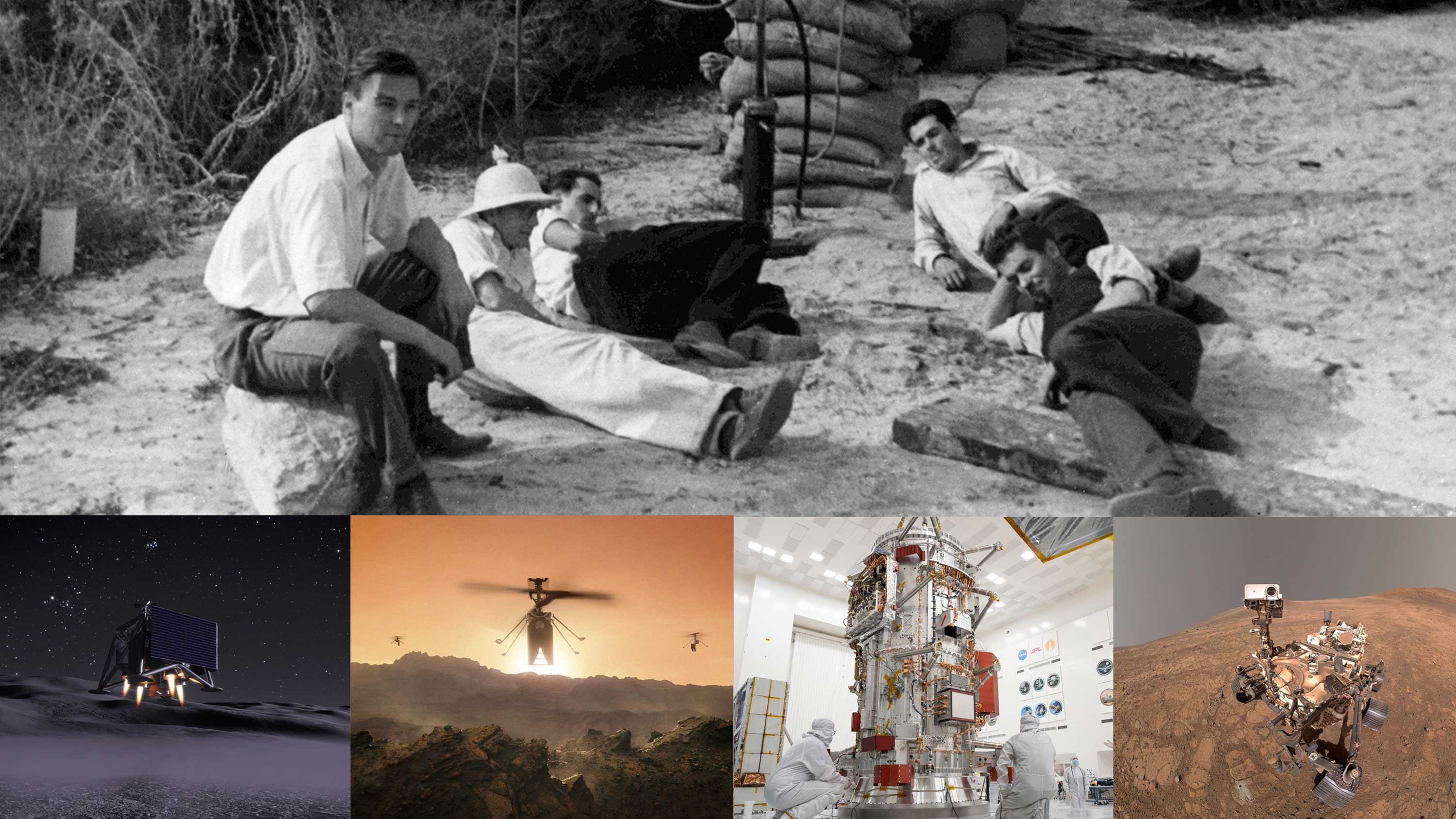
Caltech graduate students and enthusiasts tested rocket propulsion in Pasadena’s Arroyo Seco on Oct. 31, 1936. The effort marked the beginning of the Jet Propulsion Laboratory, now managed by Caltech for NASA.
JPL launched Explorer 1 in 1958, America’s first satellite. Its Geiger counter detected the radiation belts around Earth, making it the first spacecraft to conduct science. JPL joined part of the newly formed NASA that year and sent the first U.S. mission to the Moon, Ranger 7, in 1964. The lab later led missions and projects including the first planetary flyby, the first probe to visit all four gas giants, the first infrared telescope, Mars rovers and the first rotorcraft to fly on Mars.
A slate of missions ahead
JPL-managed SkyFall is targeting a 2028 launch. It will deploy three helicopters over Mars to search for hidden ice deposits and map them, while analyzing weather patterns. That same year, MoonFall is planned to land large propulsive drones at the lunar South Pole to help advance NASA’s Moon Base.
SunRISE, scheduled for launch in 2027, will use six small satellites flying in formation to create a miles-wide radio antenna dish and study solar activity. The findings could help make space exploration safer for humans.
The NEO Surveyor mission will search for potentially hazardous asteroids that other telescopes cannot find. Once an object is detected, NASA can assess the threat and plan accordingly.
Studying Earth and the universe
JPL’s AVIRIS instruments, flown on airplanes, can detect rare Earth elements important to modern technology. The sensors were developed at the lab’s Microdevices Laboratory, which invented camera-on-a-chip technology used in cellphones.
The Microdevices Laboratory is also developing detectors for PRIMA, a newly announced NASA mission. It will study radiant energy visible only in the far-infrared to improve understanding of the universe.
Leadership and the lab’s legacy
JPL director Dave Gallagher, who has led the lab since 2025, said its missions have changed understanding of the universe and humanity’s place in it. He joined as an engineer and led the team that built and tested a camera for NASA’s Hubble Space Telescope.
Caltech president and astronomy professor Ray Jayawardhana said collaboration between Caltech and JPL advances NASA’s priorities and supports American space leadership. The lab’s anniversary looks both to its record of discoveries and to missions still ahead.
Key points
- JPL began with rocket-propulsion tests in Pasadena in 1936.
- Explorer 1 discovered Earth’s protective radiation belts in 1958.
- SkyFall and MoonFall are planned for 2028; SunRISE is set for 2027.
- JPL missions study threats in space, Earth’s changing systems and the far-infrared universe.