APOD October 21, 2026: NASA Science Reveals New Ghosts in Cassiopeia
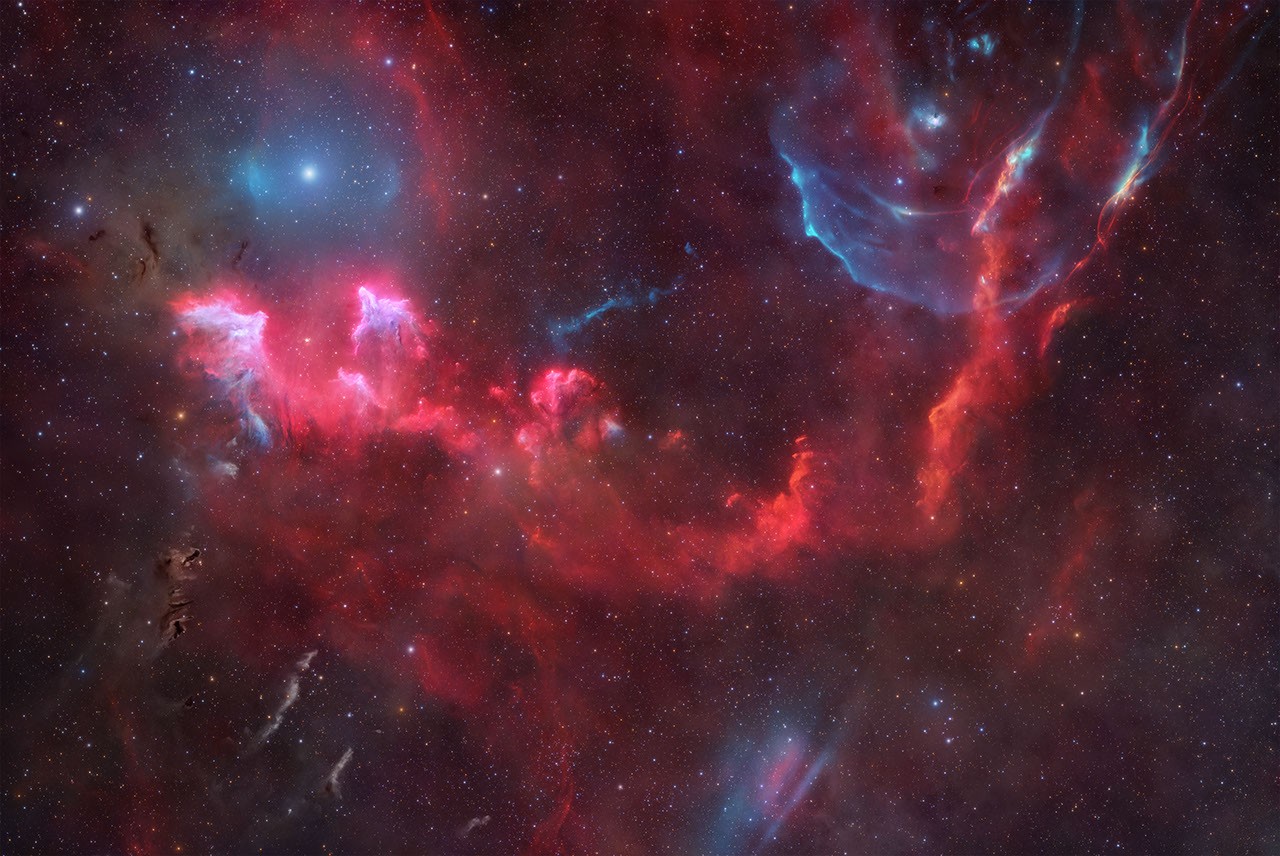
A long look at Cassiopeia
The featured image captures three faint nebulae in Cassiopeia, detected after 100 hours of observation with a special oxygen filter. The region also contains IC 59 and IC 63, known as the Ghosts of Cassiopeia, near the multi-star system γ Cassiopeia.
Light from γ Cassiopeia makes hydrogen gas in IC 59 and IC 63 glow red. Their dust also reflects and scatters some blue-white starlight.
Three new blue objects
Newly identified Objects 1, 2 and 3 appear as blue phantoms, indicating ionized oxygen. What produced that ionization is not known. The explanation proposes that γ Cassiopeia may be pushing through interstellar gas and dust, gathering material much like a boat’s bow. Object 3 could be oxygen compressed and heated in that bow shock.
Possible origins remain open
Object 1 may be a planetary nebula if astronomers identify a central white dwarf. The explanation does not establish the origin of the newly observed objects. The source text ends while introducing the origins of the objects, leaving that discussion incomplete.
Key points
- The image reveals three faint nebulae in Cassiopeia after 100 hours of observation.
- A special oxygen filter helped capture the newly identified objects.
- Objects 1, 2 and 3 appear blue, indicating ionized oxygen.
- Object 3 may be bow-shock material; Object 1 could be a planetary nebula.