

What Ramses II’s Newly Found Statue Remains Reveal
The remains point to a large royal monument in the Nile Delta, but archaeologists are still working out what stood at the site.
The short version
- Archaeologists found remains of two large royal statues on a farmer’s property in Behbeit El-Hagar, in Egypt’s Nile Delta; one has been identified as Ramses II. 123
- A stone head about five feet tall may have belonged to a statue that stood nearly 28 feet tall, including its base. 12
- The head’s double crown and an inscription bearing Ramses II’s royal title support the identification. 2
- The finds may point to an important building site, but the full purpose and history of the location have not yet been established. 23
What did archaeologists find?
The discovery began when farmer Khaled al-Shahat came across a pink stone while working on his land in Behbeit El-Hagar, in Egypt’s Nile Delta. The stone appeared to carry hieroglyphic writing. He contacted authorities, and archaeologists later excavated the site. 2
The Egyptian Ministry of Tourism and Antiquities announced that the team had uncovered remains of two colossal statues. Archaeologists have identified one as Ramses II. The second is also thought to depict the pharaoh, but that identification is less certain. 123
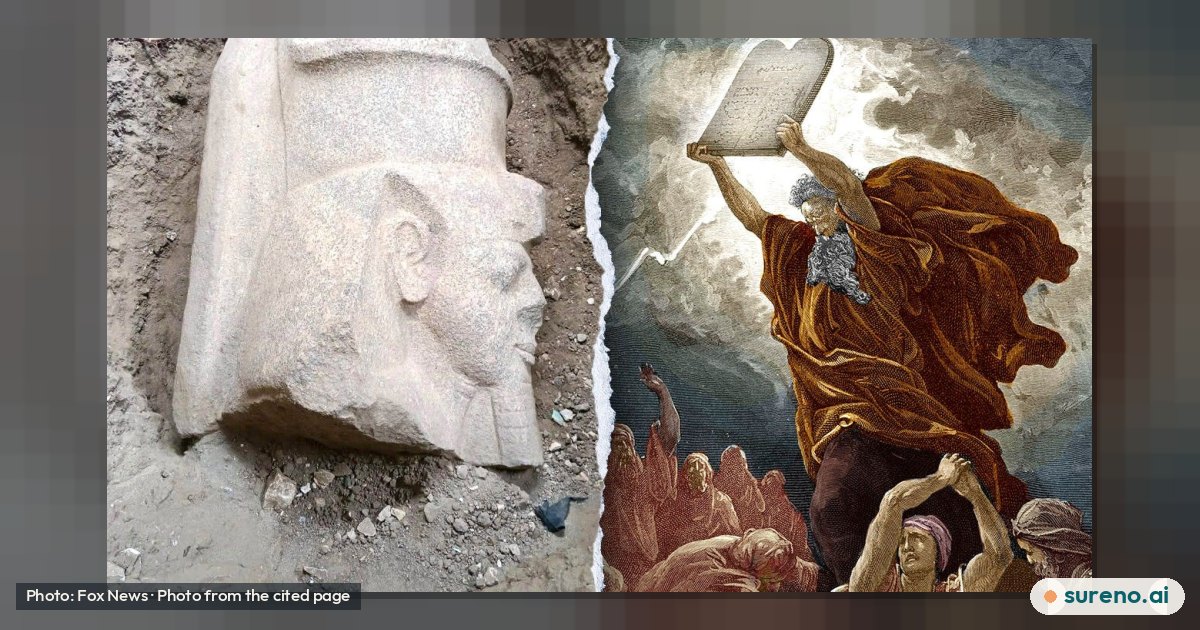
Among the finds was a stone head about five feet tall, along with part of the upper back pillar of a statue. These are fragments, not complete sculptures. The discovery report does not establish that both statues have been fully recovered. 2
How tall was the Ramses II statue?
Based on the size of the recovered head, officials estimate that the complete statue may have stood nearly 28 feet tall, including its base. That is an estimate, not a measured height: the statue is incomplete, and its full form has not been found. 12
The distinction matters. The surviving head gives archaeologists a basis for estimating scale, but it cannot by itself show every detail of the statue or how it was positioned. The reports describe remains of a second statue as well, but do not give a comparable height estimate for it. 12
What do the crown and inscription tell us?
The recovered head shows Ramses II wearing a double crown, a royal headpiece that symbolized authority over Upper and Lower Egypt. The upper part of the statue’s back pillar also carries his formal royal title, reported as “Hor Ka Nakht Mery Maat.” Together, these details support the identification of the statue as Ramses II. 2
An inscription can help connect a monument to a ruler. Here, the title is evidence tied to the statue itself, rather than only to the place where it was found. Still, the reports do not give a full translation or wider interpretation of the inscription, so it would be premature to draw more specific conclusions from it. 2
Why might the discovery matter?
The scale of the statue suggests that the site may have been connected to a substantial royal building or monument. Smithsonian Magazine reports that officials think the remains could point to a major building site commissioned by Ramses II. That is a possibility to investigate, not a confirmed description of what once stood there. 2
The location is also important to the ongoing work of understanding the area’s past. Euronews reports that archaeologists are investigating how the finds fit into the history of the Nile Delta site. More excavation and study will be needed to explain the statues’ original setting and what other structures, if any, were nearby. 3
Ramses II ruled ancient Egypt from 1279 to 1213 BCE, according to the report on the discovery. The fragments therefore provide evidence of royal imagery associated with his reign, while leaving open questions about the local history of the monument. 2
What is still uncertain about the statues?
The reports do not say exactly when the statues were made, how they came to be buried, or what building they belonged to. They also do not establish that the second statue depicts Ramses II; it is described as a likely possibility. 123
The biblical connection in some headlines needs care. Ramses II is sometimes linked by scholars to the pharaoh in the Exodus story, but the discovery reports do not present the statues as evidence that confirms that connection. The find is archaeological evidence about royal statues and their location, not proof of a biblical event. 1
As of October 29, 2026, the public reports describe an ongoing investigation. Readers can follow updates from Egypt’s Ministry of Tourism and Antiquities or established reporting on the excavation. 13
What we don't know yet
- What structure or monument the statues originally belonged to.
- Whether the second statue can be definitively identified as Ramses II.
- How the statues came to be buried and what other remains may be at the site.
- Whether further excavation will clarify the site’s role in the area’s history.
Share this explainer
Get this every day, on every new tab
Sureno Browser brings the day's stories, explained simply, to your start page.
Questions people ask
Where were the Ramses II statue remains found?
They were found on a farmer’s property in Behbeit El-Hagar, in Egypt’s Nile Delta. The farmer contacted authorities after finding a pink stone that appeared to have hieroglyphic writing. 2
What did the farmer find first?
Farmer Khaled al-Shahat came across a pink inscribed stone while working on his land. Archaeologists later excavated the site and uncovered remains of two colossal statues. 2
Was the second statue also Ramses II?
That has not been confirmed. Officials have identified one statue as Ramses II and say the other is also believed to depict him. 1
Sources
- Giant statues of pharaoh with Moses link discovered after farmer finds inscribed stone — Fox News
- A Farmer in Egypt Stumbled Upon a Pink Stone and Called the Authorities. They Found the Remains of Two Colossal Statues of Ramses II Beneath the Property — Smithsonian Magazine
- Ramses II statue fragments found on Egyptian farmer’s land — euronews, 2026-10-20
More to read
 HistoryWhy People Wear Poppies for Remembrance DayOct 23, 2026 · 3 min read0 views
 HistoryHow Divers Identified the Missing U-672 SubmarineOct 22, 2026 · 3 min read0 views
 SportsWhat a Sports Equinox Is—and Why Leagues OverlapOct 29, 2026 · 3 min read0 views
 SpaceWhat Perseverance Found About Fine Dust on MarsOct 29, 2026 · 4 min read0 views