Bernard Palissy's Platter: A Pond You Can Hang on a Wall
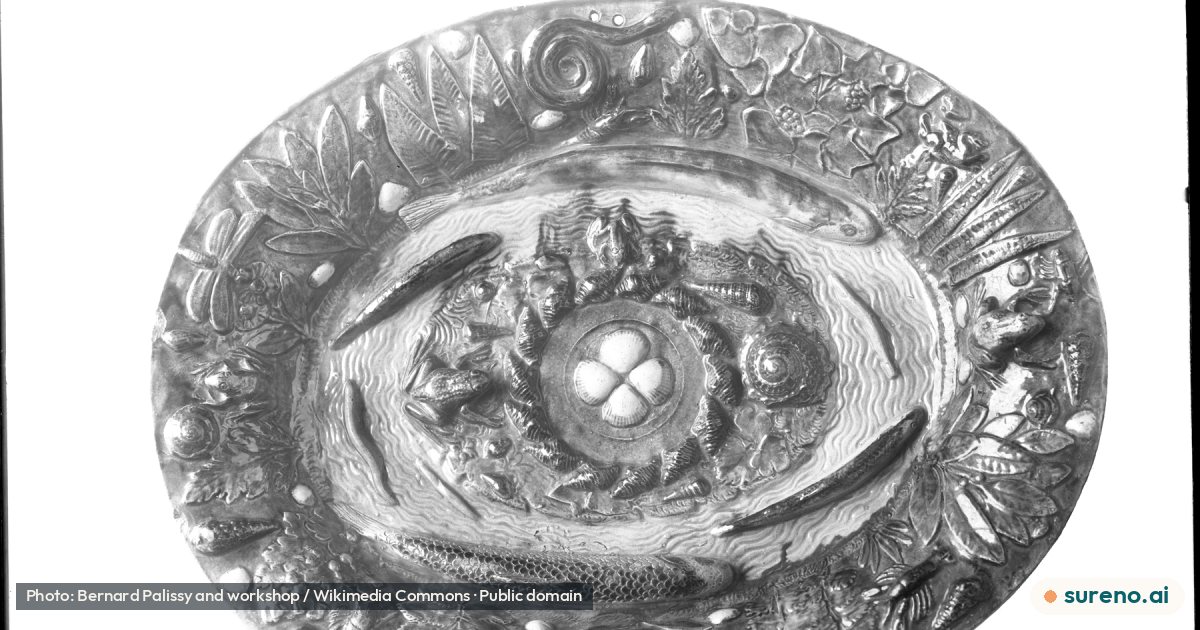
This large French platter holds a whole pond scene in clay, made to be looked at closely.
At a glance
- Artwork
- Platter
- Artist
- Bernard Palissy (French, Agen, Lot-et-Garonne 1510–1590 Paris)
- Date
- last quarter 16th century
- Medium
- Lead-glazed earthenware
- Size
- Overall: 20 1/2 x 15 5/8 x 2 13/16 in., 5.5 lb. (52.1 x 39.7 x 7.1 cm, 2472.5 g)
- Where to see it
- The Metropolitan Museum of Art, New York, gallery 544
The short version
- The Platter is by Bernard Palissy, dated to the last quarter of the 16th century 1.
- It is made of lead-glazed earthenware and measures about 52.1 x 39.7 cm 1.
- It is a large oval rusticware platter with small animals in relief among plants 2.
- You can see it at the Metropolitan Museum of Art in New York, gallery 544 1.
What am I looking at?
You are looking at a large oval platter by Bernard Palissy, a French potter who lived from about 1510 to 1590 1 2. The Met dates this example to the last quarter of the 16th century 1.
It is made of lead-glazed earthenware 1. It measures 20 1/2 x 15 5/8 inches and weighs 5.5 pounds 1. That is about 52.1 x 39.7 cm 1.
Palissy is best known for this kind of work, called rusticware 2. These are typically large, highly decorated oval platters with small animals in relief among plants 2. Look for fish, snakes, lizards, shells, ferns, and leaves crowded together like a small pond or riverbank.
How was it made, and who was Palissy?
Palissy was a French Huguenot potter, hydraulics engineer, and craftsman 2. He spent about sixteen years trying to imitate Chinese porcelain 2. He never found that secret, but he created his own rustic pottery style instead 2.
The animals were apparently often moulded from casts taken of dead specimens 2. That is why they can look very lifelike. Analysis shows he used coloured lead glazes with metal oxides for green, blue, brown, black, and yellow, with a little tin for opacity in some glazes 2.
Palissy lived through the French Wars of Religion 2. As a Protestant, he was protected for a time by powerful patrons, then imprisoned and sentenced to death 2. He died in the Bastille in 1589 2.
What should I look for when I see it?
First, look closely and slowly. The glaze gives wet-looking shine to the animals and leaves. Each creature sits slightly raised from the surface, so shadows help you see the shapes.
Second, notice that it was made for display, not for dinner. The uneven surface would be hard to eat from. It was meant to surprise guests and show skill with nature and fire.
It is on view at the Metropolitan Museum of Art in New York, in gallery 544 1. One thing most people do not know is that it is often hard to tell work from Palissy's own workshop from work by followers who copied his style 2. Copies continued in France until about 1800 and were revived in the 19th century 2. In the 19th century, his pottery inspired Victorian majolica made by Mintons Ltd, shown in 1851 as Palissy ware 2.
What we don't know yet
Share this explainer
Get this every day, on every new tab
Sureno Browser brings the day's stories, explained simply, to your start page.
Questions people ask
Where can I see the Bernard Palissy Platter?
It is in the collection of the Metropolitan Museum of Art in New York, in gallery 544 1. As of October 2026, check the Met website before you visit, since gallery displays can change.
Sources
- Platter — The Met — The Metropolitan Museum of Art
- Bernard Palissy — Wikipedia
Free tools for this
They run in your browser. Nothing is uploaded and there is nothing to sign up for.
More to read
 TV, Film & CultureMarcello Hernández: Why His Amy Poehler Interview Is TrendingOct 7, 2026 · 3 min read0 views
 TV, Film & CultureGood Hang with Amy Poehler: What the Podcast IsOct 7, 2026 · 2 min read0 views
 TV, Film & CultureMichael Sheen takes over House of Games: what to knowOct 7, 2026 · 3 min read0 views
 TV, Film & CultureMaura Higgins’ Instagram Post: What We Know So FarOct 7, 2026 · 3 min read0 views
 WorldFormer Prince Andrew's Action Against Police ExplainedOct 5, 2026 · 2 min read3 views
 TV, Film & CultureKirk Douglas: Why Michael Douglas’s Memoir Is in the NewsOct 6, 2026 · 3 min read0 views
 TV, Film & CultureDeath in Paradise: what it is and why searches are risingOct 6, 2026 · 4 min read0 views
 TV, Film & CultureRory Kinnear as Keynes: what The Standard of Living isOct 6, 2026 · 3 min read0 views
 TV, Film & CultureLena Martell: the Scottish singer and her best-known songOct 6, 2026 · 3 min read0 views
 SportsLakers Preseason Opener: What to Know About the Kings GameOct 5, 2026 · 4 min read2 views