

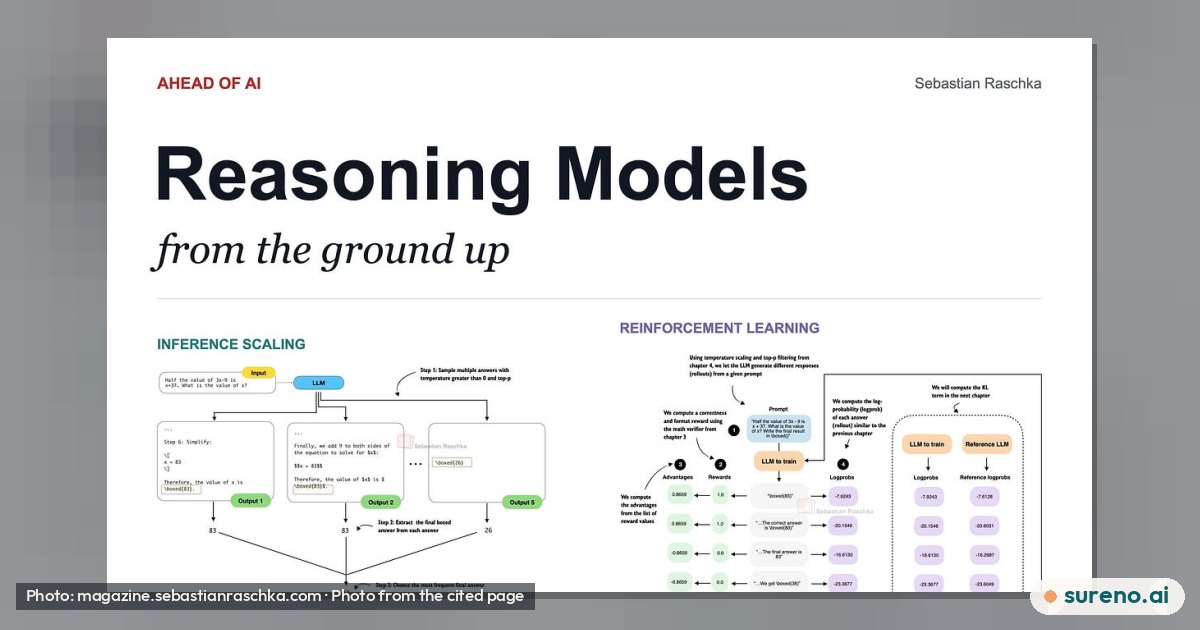
How Sebastian Raschka Teaches Reasoning Models From Scratch
The course starts with a pretrained language model and shows how to evaluate and improve it using Python and PyTorch.
The short version
- Sebastian Raschka’s course teaches how to evaluate and improve a pretrained language model by coding methods in Python and PyTorch. 1
- The course has eight videos and more than 11 hours of lessons on evaluation, inference-time scaling, reinforcement learning and distillation. 1
- Raschka says learners can take the course without completing his earlier course on coding language models. 1
- The lessons focus on building and testing methods, rather than promising a particular model’s performance. 1
What does the course teach?
Sebastian Raschka’s course, “Build Your Own Reasoning Model,” is a set of eight coding videos lasting more than 11 hours. It begins with a pretrained large language model, then demonstrates ways to evaluate and improve it using Python and PyTorch. 1
The subjects include evaluation, inference-time scaling, reinforcement learning and distillation. Inference-time scaling means using additional computation while a model is responding; distillation is a way of transferring capabilities from one model to another. The course description identifies these topics, but does not provide enough detail to assess every lesson’s depth or exercises. 1
How can you build a reasoning model from scratch?
Here, “from scratch” describes implementing methods in code to understand how they work. The course does not say that learners train a large language model from entirely untrained parameters. Instead, it starts with a model that has already been pretrained and shows how to evaluate and improve it. 1
That distinction matters. Pretraining a model and building methods around a pretrained model are different tasks. Raschka’s description is about the latter: coding and testing approaches that may help a model reason more effectively. 1
What concepts should learners understand?
Evaluation is the process of checking how a model performs on tasks. It helps learners compare versions or approaches rather than relying on an impression that a model seems better. The course lists evaluation as one of its main subjects. 1
Reinforcement learning is a way to train systems using feedback about their actions. Distillation transfers useful behaviour or capability from one model to another. Inference-time scaling explores how giving a model more computation while it generates an answer affects its output. These are broad descriptions; the available course summary does not specify all the techniques or training setups covered. 1
More generally, reasoning in AI can involve representing information in a form a computer can use to work through tasks. That broad idea is not the same as a detailed account of how a particular language model’s reasoning works. 4
Do you need to take Raschka’s earlier course first?
According to Raschka, the reasoning-model videos can be watched without first completing his earlier “Coding LLMs from the Ground Up” course. He presents the new material as a sequel, but says it does not require that earlier course as a prerequisite. 1
The lessons use Python and PyTorch, so learners should expect to follow code rather than only watch general explanations. The source does not give a formal list of required programming skills, provide a syllabus for each video, or say what hardware is needed. 1
What can learners take away, and what remains unclear?
The course offers a way to study several methods by implementing them. That can make technical ideas more concrete than a description alone, but the source does not report independent assessments of the course or evidence that completing it guarantees a particular skill level or model result. 1
A separate educational project offers an example of a different approach to reasoning models: an implementation of a hierarchical model applied to finding paths through a board with obstacles. It describes two recurrent modules operating at different frequencies and includes a performance study, but it is not part of Raschka’s course. 2
The practical takeaway is to treat the videos as a coding course on methods for evaluating and improving a pretrained model, not as a promise that learners will produce a state-of-the-art system. The available description leaves details about lesson-by-lesson content, costs, access conditions and outcomes unanswered. 1
What we don't know yet
- The available course description does not list the full contents of each of the eight videos. 1
- It does not specify the course price, access conditions, required hardware or formal programming prerequisites. 1
- The source does not report independent evaluations of learner outcomes or claim that the lessons produce a particular level of model performance. 1
Share this explainer
A browser that helps you stay safe
Sureno is a Chromium browser with plain-language privacy settings and an assistant that only reads a page when you ask.
Questions people ask
What is Sebastian Raschka’s reasoning model course?
It is a set of eight coding videos, with more than 11 hours of material. The lessons use Python and PyTorch to demonstrate ways to evaluate and improve a pretrained language model. 1
Does the course train an AI model from zero?
The course description says it starts with a pretrained language model. It focuses on implementing methods to evaluate and improve that model, rather than describing training a model from untrained parameters. 1
What topics are covered in the course?
The listed topics are evaluation, inference-time scaling, reinforcement learning and distillation. The course description does not spell out the complete syllabus for each video. 1
Do I need Raschka’s earlier LLM course?
Raschka says the reasoning-model videos can be watched without taking his earlier course on coding language models. He describes the new course as a sequel, but says the earlier course is not a prerequisite. 1
What programming tools does the course use?
The course uses Python and PyTorch for its coding lessons. The available description does not state specific hardware requirements or a formal list of programming skills learners need. 1
Sources
Free tools for this
They run in your browser. Nothing is uploaded and there is nothing to sign up for.
More to read
 Tech & Online SafetyThree limits of today’s AI: confidence, decisions and languageOct 25, 2026 · 5 min read1 view
 Tech & Online SafetyWhat Microsoft’s Employee Buyouts Could Mean for WorkersOct 27, 2026 · 3 min read0 views
 Tech & Online SafetyAnthropic’s Planned IPO: What Public Investors Should KnowOct 27, 2026 · 5 min read0 views
 Tech & Online SafetyMicrosoft’s Buyout Offer: Who Qualifies and What It MeansOct 26, 2026 · 4 min read0 views
 MoneyJackdaw Gasfield Approval: What It Means for UK EnergyOct 21, 2026 · 4 min read3 views
 Tech & Online SafetyWhy iPhone Duo Screens May Crack—and What Owners Can DoOct 26, 2026 · 3 min read0 views
 Tech & Online SafetyWhat Anthropic’s IPO Filing Reveals About Its BusinessOct 26, 2026 · 4 min read0 views
 Tech & Online SafetyWhat Neocloud Companies Do—and Why They May ConsolidateOct 26, 2026 · 5 min read0 views
 Tech & Online SafetyWhat iFixit’s iPhone Duo Teardown Found About Screen FailuresOct 26, 2026 · 4 min read0 views
 SpaceHow Perseverance Set a Mars Driving RecordOct 21, 2026 · 4 min read1 view