How Astronomers Found a Galaxy Behind a Distant Radio Flash
A brief signal’s journey through space offered clues, while Webb helped researchers identify the galaxy it came from.
The short version
- Astronomers trace a fast radio burst by measuring how its radio frequencies arrive at different times, then locating a host galaxy to confirm its distance. 23
- MeerKAT detected FRB 20240304B on March 4, 2024; Webb later identified a galaxy at the burst’s position. 2
- The burst travelled for more than 10 billion years from a time when the universe was about 3 billion years old. 12
- Identifying the galaxy helps researchers study the burst’s setting, but does not reveal for certain what caused it. 23
How can a radio flash reveal where it came from?
A fast radio burst, or FRB, is a short flash of radio waves from space. Some last only milliseconds. Although astronomers can measure the signal, they still do not know for certain what kind of object or event produces these bursts. 12
The signal itself carries clues about its journey. Different radio frequencies can reach Earth at slightly different times. Astronomers call this difference dispersion. It happens as radio waves pass through electrically charged material in space. 3
What did the signal tell astronomers?
Researchers measure how much the frequencies are spread out in arrival time. That measurement helps estimate how much material the signal crossed, which can help indicate how far it travelled. For FRB 20240304B, the radio data suggested the source was extremely distant. 23
That estimate was not the final step. To confirm the distance, astronomers needed to find the galaxy associated with the burst. A burst’s exact position can guide observations, but the galaxy may be too faint for some telescopes to see. 2
How did Webb help identify the galaxy?
MeerTRAP, a system built to catch short-lived radio signals in real time, detected FRB 20240304B with the MeerKAT radio telescope in South Africa on March 4, 2024. The team knew the burst’s position precisely, but ground-based telescopes could not see a galaxy there. 23
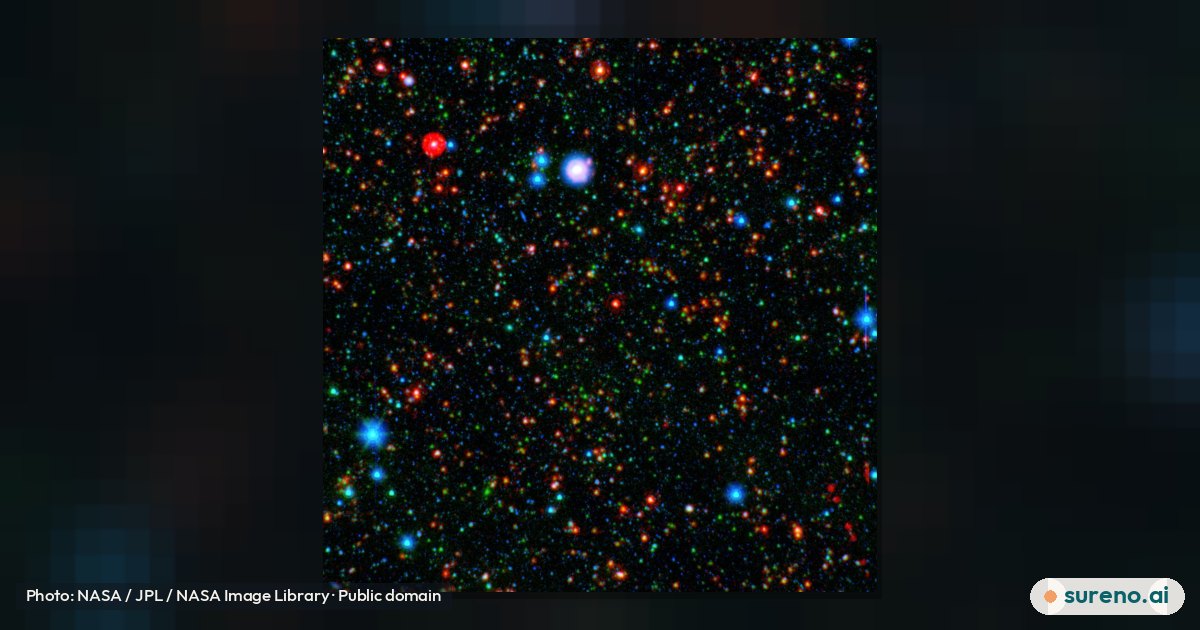
Researchers turned to NASA’s James Webb Space Telescope. Its NIRCam instrument, which observes near-infrared light, detected a galaxy at the right location. That identification let the team confirm the burst’s distance. 2
What makes this burst notable?
The researchers reported FRB 20240304B as the most distant fast radio burst with an identified host galaxy. Its signal had travelled for more than 10 billion years. It came from a period when the universe was about 3 billion years old, roughly one-fifth of its current age according to the research account. 123
The host was described as a small galaxy with many young stars. Knowing the setting gives astronomers a place to investigate and compare with other FRBs. It does not, by itself, prove what produced the radio flash. 3
What remains uncertain about its source?
The central question is still open: what physical event creates fast radio bursts? Astronomers have ideas about possible sources, but researchers say they do not have conclusive proof. 2
Many FRBs are seen once and never again, making them hard to study. A single burst and its host galaxy can add useful evidence, but the sources do not establish that all bursts have the same cause. Further observations are needed to understand how they arise. 23
What we don't know yet
- What specific object or event produced FRB 20240304B?
- Do all fast radio bursts arise from the same kind of source?
- How often can astronomers identify a burst’s host galaxy?
Share this explainer
New discoveries on every new tab
Sureno Browser puts explainers like this one on your start page every morning, in plain words.
Questions people ask
How do scientists locate a fast radio burst?
What is dispersion in a radio signal?
Dispersion is the difference in arrival times between frequencies in a radio signal. It occurs as the signal travels through electrically charged material in space, and its measurement helps estimate how much material the signal crossed. 3
What did Webb find near FRB 20240304B?
Webb’s NIRCam detected a galaxy at the burst’s position. Identifying that host galaxy helped researchers confirm the burst’s distance. 2
How far away was FRB 20240304B?
Do astronomers know what causes fast radio bursts?
No confirmed cause is known. Scientists have theories about what objects might produce FRBs, but they do not yet have conclusive proof. 2
Sources
- Astronomers detect mysterious burst of energy from a galaxy far, far away — the Guardian, 2026-10-08
- Webb Measures Distance to Farthest Fast Radio Burst, Suggesting Origin - NASA Science — NASA Science, 2026-10-08
- Astronomers pinpoint the origin of a 10 billion-year-old millisecond signal from space — The Conversation, 2026-10-08
Free tools for this
They run in your browser. Nothing is uploaded and there is nothing to sign up for.
More to read
 SpaceWhy NASA Is Seeking Plans for Commercial Space StationsOct 9, 2026 · 3 min read0 views
 SpaceSpaceX Crew-13: What the Crew Is Doing at the ISSOct 7, 2026 · 3 min read0 views
 Space2027 Total Solar Eclipse: When and Where to See ItOct 6, 2026 · 3 min read0 views
 SpaceWorld Space Week 2026: What It Is and Why It MattersOct 6, 2026 · 3 min read0 views
 Food & CookingChar Siu Explained: Cantonese Barbecued Pork at HomeOct 3, 2026 · 3 min read1 view
 SpaceSaturn at Opposition: What to Know About the Ringed PlanetOct 6, 2026 · 4 min read0 views
 SpaceExoplanets: What They Are and Why New Finds MatterOct 6, 2026 · 3 min read0 views
 WorldSpain Housing Vote Explained: Why Bills Failed and Next StepsOct 3, 2026 · 6 min read1 view