International Space Station: Our Lab Above Earth
A shared home in orbit where crews live, work, and study life without gravity.
At a glance
- Orbits
- Earth
- Mass
- 419,725 kg
- Orbital period
- 92.88 minutes
- Launched
- November 20, 1998
The short version
- The International Space Station is a research base in low Earth orbit, managed by five space agencies 1.
- It circles Earth about every 92.88 minutes and its first part left Earth on 20 November 1998 2.
- People have lived on board without a break since 2 November 2000 1.
- Crews study low gravity, space conditions, and human health 1.
What is the International Space Station?
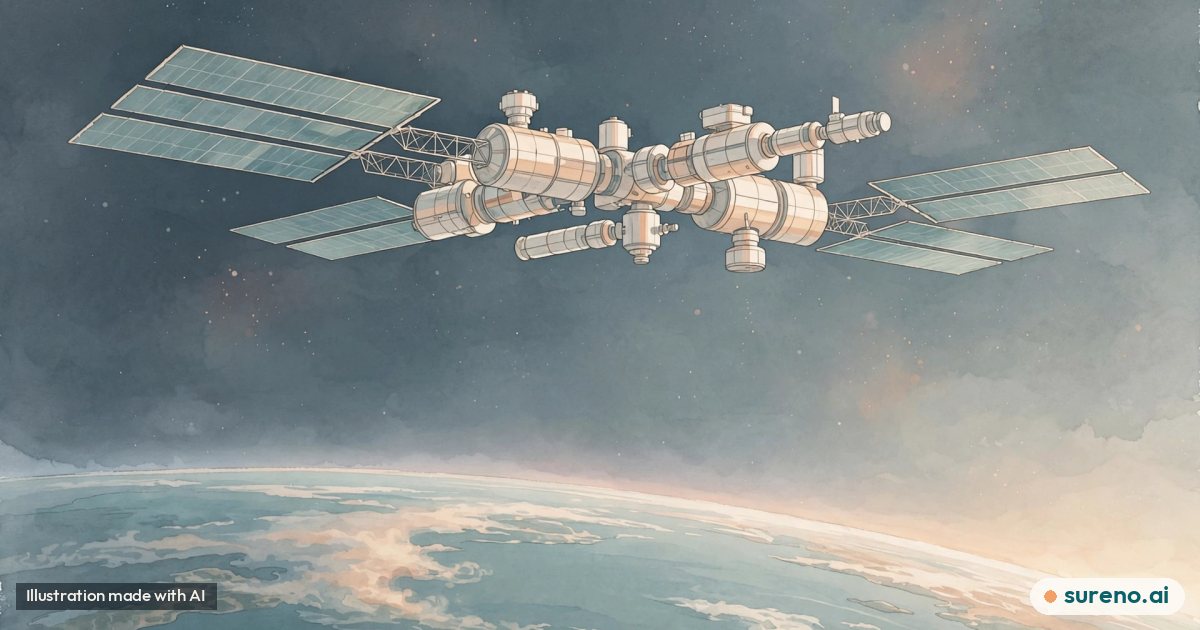
The International Space Station, often called the ISS, is a research base that travels around Earth in a low orbit 12. Low orbit means it stays fairly close to Earth, far nearer than the Moon. People live and work on board for months at a time.
Five agencies manage it together. They are NASA from the United States, Roscosmos from Russia, ESA from Europe, JAXA from Japan, and CSA from Canada 1. No earlier crewed station was built and run in this shared way, and no other crewed craft has been as large 1.
It was sent up in parts and put together in space. One side was developed by Russia and the other side was built by the United States and its other partners 1. A long frame joins the parts and carries the solar panels and heat panels 1. The whole craft weighs 419,725 kg 2. With panels spread out, it is about as long and wide as a soccer field 1. Inside, crews have labs, sleeping areas, storage space, control areas, and exits for spacewalks 1. There are also ports where visiting crew and cargo ships can connect 1.
Where is it, and how does it move?
The station flies about 400 kilometres above Earth 1. Its path runs from far north to far south across much of the planet 1. This height keeps it below zones of strong trapped radiation and below much tracked debris 1.
It moves very fast, about 7.67 kilometres each second 1. A full loop takes about 93 minutes, listed more exactly as 92.88 minutes, so it goes around Earth about 15.5 times each day 12.
The first piece was launched on 20 November 1998 2. Regular living started when the Expedition 1 crew arrived on 2 November 2000, and people have been on board ever since 1. Crews now arrive on Soyuz and Crew Dragon ships 1. Supplies come on freight ships such as Progress, Cargo Dragon, and Cygnus 1. As of August 2025, 290 people from 26 countries had visited 1.
Why does it matter, and what have we learned?
The main job of the station is study 1. It offers power, data links, cooling, and crew help for tests that need months or years in near-weightlessness 1. Near-weightlessness means people and objects float because the station is always falling around Earth.
Fields of study include living things, sky science, physics, materials, space weather, weather on Earth, and human health 1. Scientists on the ground can receive data soon after it is taken and ask the crew to adjust a test 1. New tools can arrive on routine supply flights 1. A crew of six can give about 160 hours of work per week, although upkeep takes much of that time 1.
One known device is the Alpha Magnetic Spectrometer, which records particles from space to learn more about the universe and the unseen material called dark matter 1. In April 2013, researchers said early readings showed an odd surplus of high-energy particles that might relate to dark matter 1. Health studies have tracked changes during long flights, such as weaker muscles, thinner bones, and fluids moving toward the head 1. That work helps planners judge the limits of long trips beyond Earth 1.
What we don't know yet
Share this explainer
New discoveries on every new tab
Sureno Browser puts explainers like this one on your start page every morning, in plain words.
Questions people ask
How much room is inside the International Space Station?
Sources
- International Space Station — Wikipedia
- Wikidata: International Space Station — Wikidata
Free tools for this
They run in your browser. Nothing is uploaded and there is nothing to sign up for.
More to read
 SpaceSpaceX Crew-13: What the Crew Is Doing at the ISSOct 7, 2026 · 3 min read0 views
 Space2027 Total Solar Eclipse: When and Where to See ItOct 6, 2026 · 3 min read0 views
 SpaceWorld Space Week 2026: What It Is and Why It MattersOct 6, 2026 · 3 min read0 views
 SpaceSaturn at Opposition: What to Know About the Ringed PlanetOct 6, 2026 · 4 min read0 views
 WorldFormer Prince Andrew's Action Against Police ExplainedOct 5, 2026 · 2 min read3 views
 SpaceExoplanets: What They Are and Why New Finds MatterOct 6, 2026 · 3 min read0 views