

NASA's DAVINCI Venus Probe Explained: Built to Survive Heat
NASA warmed a test model of its DAVINCI craft to Venus-like heat to get ready for a future drop through thick air.
The short version
- NASA plans to send both a circling craft and a drop craft to Venus 2.
- The full title refers to deep air, noble gases, chemistry, and pictures 1.
- A practice model about as wide as an exercise ball was warmed to 465 C in roughly an hour 1.
- The goal is to learn how Venus began and changed, and if it once held water 1.
What is the DAVINCI probe?
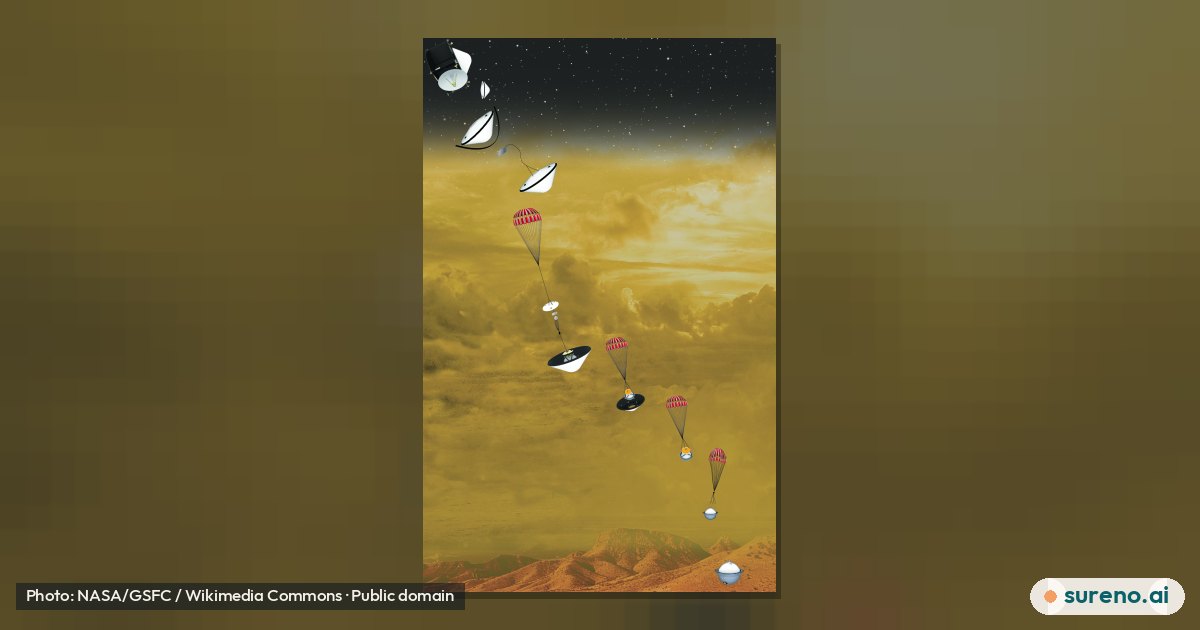
NASA is preparing a two-part trip to Venus called DAVINCI. One part will remain above the planet and circle it. The other part will sink into the thick air to take close-up readings 2. This pairing lets scientists compare wide views from orbit with direct samples from inside the atmosphere.
The long name spells out the focus. It points to the deep air of Venus, plus rare stable gases, chemical study, and pictures 1. Stable gases of this type mix very little with other matter. That steadiness can preserve hints about how a planet was born and how its air shifted across long ages.
NASA picked this idea in early June 2021 for a line of small, focused planet missions 2. The line is called Discovery. It backs efforts with clear science aims and tight budgets. The name DAVINCI also nods to the famed Italian thinker Leonardo da Vinci and his early work on science and flight ideas 2.
The hardware now in testing is not the final flight model. It is a practice build made to prove methods and spot flaws 1. Engineers use such models to learn before they lock in a design that must work far from Earth. As of October 2, 2026, the trip itself is still listed as planned 2.
Why must it resist such strong heat?
Venus is wrapped in dense air that traps warmth. A craft falling through that blanket will grow hotter as it drops lower. NASA shaped its recent trial to copy that warming speed 1. The point was to see if seals, wiring, and tools could keep working while heat climbs.
The trial peak was 465 C, which equals 869 F 1. At that level, many plastics melt, batteries fail, and lenses can warp. A Venus craft needs thick shielding, careful cooling, and parts rated for heat. Without that care, it could go silent before it finishes its task.
Shape and size add to the test. The trial vessel was about as broad as a large exercise ball 1. That small round body must hold sensors, power, insulation, and a radio link. Each item must fit tightly and still work as the shell grows hot.
Heat also affects timing. Readings must be taken, stored, and sent upward during a fairly quick fall. If heat slows or stops any link in that chain, data are lost. So proving heat tolerance is not extra. It is central to getting any science back.
What did engineers do in the recent test?
Staff placed the practice vessel inside a special heat room. The room walls use a fire-proof ceramic cover and show dark marks from past high-heat runs 1. That kind of room lets staff raise heat in a steady, controlled way and watch what happens to the hardware.
They lifted the inside warmth to 465 C in roughly sixty minutes 1. That hour-long climb was chosen to reflect the warming curve expected when the true craft moves down toward the ground 1. A slow climb and a fast climb can stress joints in different ways. Matching the expected curve gives a more true check.
Photos were taken before the main heat run 1. A heat run of this type is often called a thermal check. During such checks, staff look for bent metal, weak seals, fogged optics, false sensor values, and drops in radio strength. They also note how fast the inside of the vessel warms compared with the outside.
The public note does not share full scores or charts. It frames the event as a major step in proving the design 1. That means readers should see it as progress, not as final clearance to fly. More trials, fixes, and reviews will likely follow before launch.
What does NASA hope to learn on Venus?
The broad aim is a fresh, close look at how Venus started, how it shifted over time, and how it stands today 1. Start covers birth and early air. Shift covers loss of water, growth of clouds, and change in surface heat. Today covers gases, winds, and land forms now present.
One big puzzle is water. Earth has oceans and rain. Venus is now dry and searing. Scientists ask if Venus once held seas or rain and later lost them 1. An answer would help explain why two near-neighbor worlds took such unlike paths.
To tackle that, the team will probe rare gases, test what chemicals fill the clouds and low air, and snap views on the way down 1. Rare gases act like time tags. Cloud chemistry shows what cycles move heat and matter. Pictures can reveal cloud bands, haze layers, and ground shapes where light breaks through.
These sources do not name each tool or state how long the drop craft may live after landing. They also do not map the exact path or target zone. So the public picture is still broad. The clear takeaway is a plan for much sharper detail than past flybys, from high clouds down to near the ground 12.
How does DAVINCI relate to other Venus plans?
DAVINCI is one of two Venus efforts picked by NASA in early June 2021 2. The other is called VERITAS. It will also examine Venus, but as its own project with its own craft and aims 2. Picking two at once shows strong interest in our cloud-covered neighbor.
The two roles differ. DAVINCI pairs a circling craft with a unit that enters the air 2. That entry unit can taste gases and record heat, pressure, and views in place. An orbiter alone must judge those traits from afar. Direct sampling can thus ground-truth what orbit data suggest.
The short sources give no full sketch of VERITAS tools or orbit plan. They only note that it too will study Venus 2. Readers should not merge the two in their minds. Think of them as partners with separate jobs whose results can later be set side by side.
For now, public facts are few: the kind of craft, the pick date and program, the naming nod, the heat-room setup, and the wide science aim 12. People who want launch dates, cost, or team rosters will need to wait for later NASA notes. As of October 2, 2026, the safest view is that work is moving from design toward hard proof trials.
What we don't know yet
- The launch date, cruise length, and drop date are not stated in these sources.
- Full test scores and any fixes that followed the heat run are not stated in these sources.
- The full tool list, landing zone, and live time on or near the ground are not stated in these sources.
Share this explainer
New discoveries on every new tab
Sureno Browser puts explainers like this one on your start page every morning, in plain words.
Questions people ask
What does the name DAVINCI mean?
How hot was the recent test?
Will DAVINCI land on Venus?
Could Venus once have had water?
That is a key open puzzle. NASA wants new detail on how Venus formed and changed, and if it once held water and life-friendly states as Earth does 1. Current sources give the aim, not the answer.
Sources
- NASA's DAVINCI Probe Can Stand the Heat - NASA — NASA
- DAVINCI — Wikipedia
Free tools for this
They run in your browser. Nothing is uploaded and there is nothing to sign up for.
More to read
 SpaceDid NASA’s DART impact change Dimorphos’s orbit?Nov 27, 2026 · 3 min read0 views
 SpaceFrom a Polish Meteorite to Jupiter’s Icy MoonsNov 26, 2026 · 6 min read1 view
 SpaceWhat SpaceX’s Plan for Orbital AI Data Centers MeansNov 26, 2026 · 4 min read1 view
 SpaceWhat the FCC’s SpaceX Satellite Authorization AllowsNov 26, 2026 · 3 min read1 view
 Nature & AnimalsWhy Lagos and Alexandria Are Sinking—and What It MeansNov 28, 2026 · 3 min read1 view
 SpaceWhat SpaceX’s Proposed Space Data Centers Could MeanNov 26, 2026 · 4 min read2 views
 SpaceNew measurements sharpen views of asteroids, planets and dark matterNov 25, 2026 · 6 min read1 view
 Home & LifeWhy Black Friday Shoppers Still Queue Outside StoresNov 28, 2026 · 3 min read0 views