

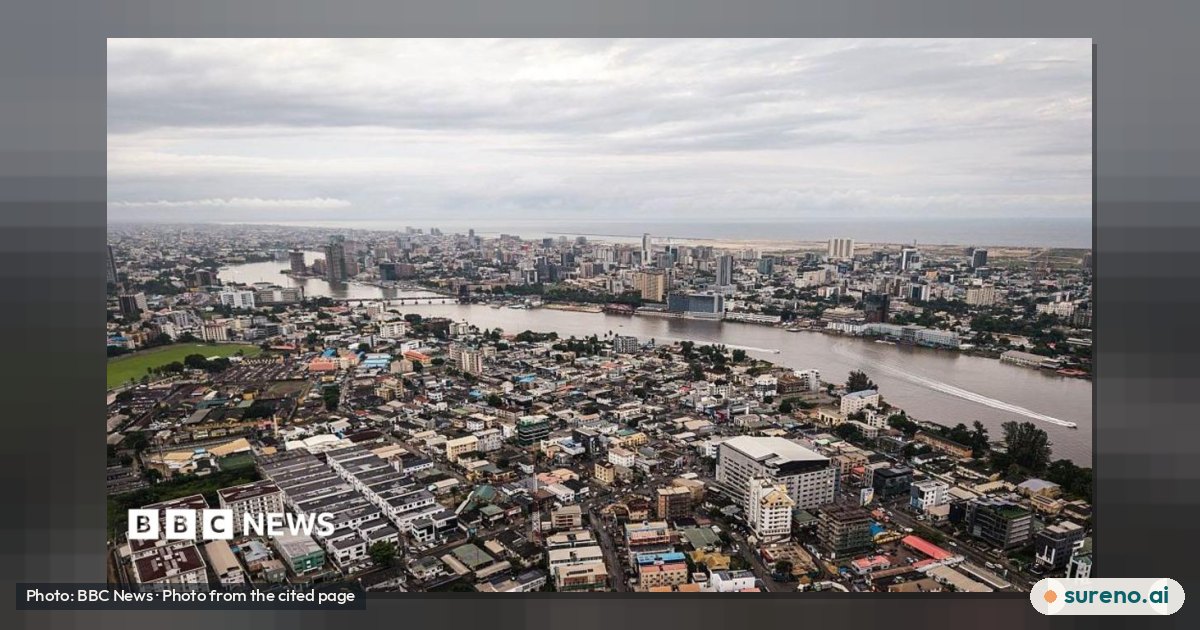
Why Lagos and Alexandria Are Sinking—and What It Means
Land sinking can add to the rise of the sea, increasing flood exposure over time, but the effects differ from place to place.
The short version
- Lagos and Alexandria are sinking because of downward land movement, called subsidence; some causes are natural, while human activities such as groundwater extraction can also contribute 1.
- Researchers used radar observations from Sentinel-1 satellites to map vertical land movement in 20 African coastal cities 12.
- When land sinks, the ocean sits higher relative to it, adding to the flood risk from climate-driven sea-level rise 13.
- A study estimate cited by BBC puts seven million people, one billion buildings and $180 billion in assets at flood risk by 2050; it is an estimate, not a count of future losses 1.
Why are Lagos and Alexandria sinking?
The term for land gradually moving downward is subsidence. A study of 20 African coastal cities found that some, including Lagos in Nigeria and Alexandria in Egypt, are sinking faster than earlier estimates suggested 1.
The reasons are not identical everywhere. Some subsidence happens naturally. Human activity can contribute too: the BBC report identifies groundwater extraction, which means pumping water from below the ground, as one cause 1. The research coverage does not establish how much each cause accounts for in either city.
How did scientists measure the sinking?
Researchers used radar measurements from the European Space Agency’s Sentinel-1 satellites to track changes in land height. The team produced maps of vertical land movement across 20 African coastal cities, using thousands of satellite observations, according to the study report 12.
Satellite observations help address a problem noted by the study’s lead author: a lack of monitoring stations has made it difficult to get recent, local information about subsidence in Africa 1. The results make land movement easier to assess, but they do not by themselves explain every local cause or predict exactly what will happen on a particular street.
What does sinking land mean for flood risk?
Flood exposure depends on more than the sea’s height. If the ground moves downward, the sea becomes higher relative to that land. When subsidence occurs alongside climate-related sea-level rise, both changes can increase coastal flood exposure 13.
That does not mean every neighbourhood will flood, or that sinking land alone determines when flooding happens. The Gulf of Guinea coastline is low-lying and densely populated, and its exposure also includes coastal erosion. The Agence Française de Développement describes the combined effects of sea-level rise and subsidence as a regional concern 3.
How many people could be affected?
The BBC report says the research estimated that seven million people, one billion buildings and $180 billion in assets could face flood risk by 2050 1. It also reports a separate estimate that four million people in Lagos may be exposed to extreme sea levels by the end of the century 1.
These are projections, not statements that those people or properties will definitely be flooded. The sources provided do not give the assumptions or neighbourhood-level details needed to interpret each estimate more closely. They do show why measuring both sea level and land movement matters for planning.
What is still uncertain about the risks?
The available reports do not provide precise sinking rates for Lagos and Alexandria, nor do they explain how rates vary across each city. They also do not quantify the share of subsidence caused by groundwater extraction or other activities in each place.
Risk estimates depend on more than a citywide land-motion map. Local elevation, future sea-level change and where people and infrastructure are located all matter. The sources describe the findings as a reason to improve understanding and cooperation, not as a precise forecast for individual residents 23.
What we don't know yet
- The exact subsidence rate in each neighbourhood of Lagos and Alexandria is not provided in the available reports.
- The sources do not quantify how much of the sinking in either city comes from groundwater pumping versus natural processes or other human activities.
- The assumptions behind the 2050 flood-risk estimate and its distribution across particular places are not detailed in the supplied material.
Share this explainer
Get this every day, on every new tab
Sureno Browser brings the day's stories, explained simply, to your start page.
Questions people ask
Are Lagos and Alexandria actually sinking?
Yes. A satellite-based study found that both cities are among African coastal cities sinking faster than earlier estimates suggested 1. The reports do not give enough detail here to describe the rate in every neighbourhood.
Does land subsidence make sea levels rise?
Could Lagos face more flooding by 2050?
The study estimated that seven million people, one billion buildings and $180 billion in assets could be at flood risk by 2050 1. That is a projection of exposure, not a claim that all will be flooded.
What causes land to sink in coastal cities?
Causes can be natural or linked to human activity. The BBC report names groundwater extraction as one human cause, but the supplied reports do not say how much it contributes in Lagos or Alexandria 1.
Sources
- Satellite imagery shows how fast Lagos and Alexandria are sinking — BBC News
- African coastal cities projected to sink by several millimeters in next two decades — Courthouse News Service, 2026-11-27
- Relative Sea-Level Rise in the Gulf of Guinea: What Are the Implications for Coastal Exposure? — AFD - Agence Française de Développement
More to read
 Nature & AnimalsWhy Australia Is Retrieving Fuel from Macquarie IslandNov 22, 2026 · 3 min read0 views
 WorldWhat the Proposed U.S. Tariffs Could Mean for Trade and PricesNov 26, 2026 · 3 min read1 view
 SpaceFrom a Polish Meteorite to Jupiter’s Icy MoonsNov 26, 2026 · 6 min read1 view
 SpaceWhat the FCC’s SpaceX Satellite Authorization AllowsNov 26, 2026 · 3 min read1 view