

Climate research links heat deaths, power risks and wellbeing
Recent studies point to serious heat risks, possible strains on power systems and potential wellbeing gains from climate policies, with important limits.
The short version
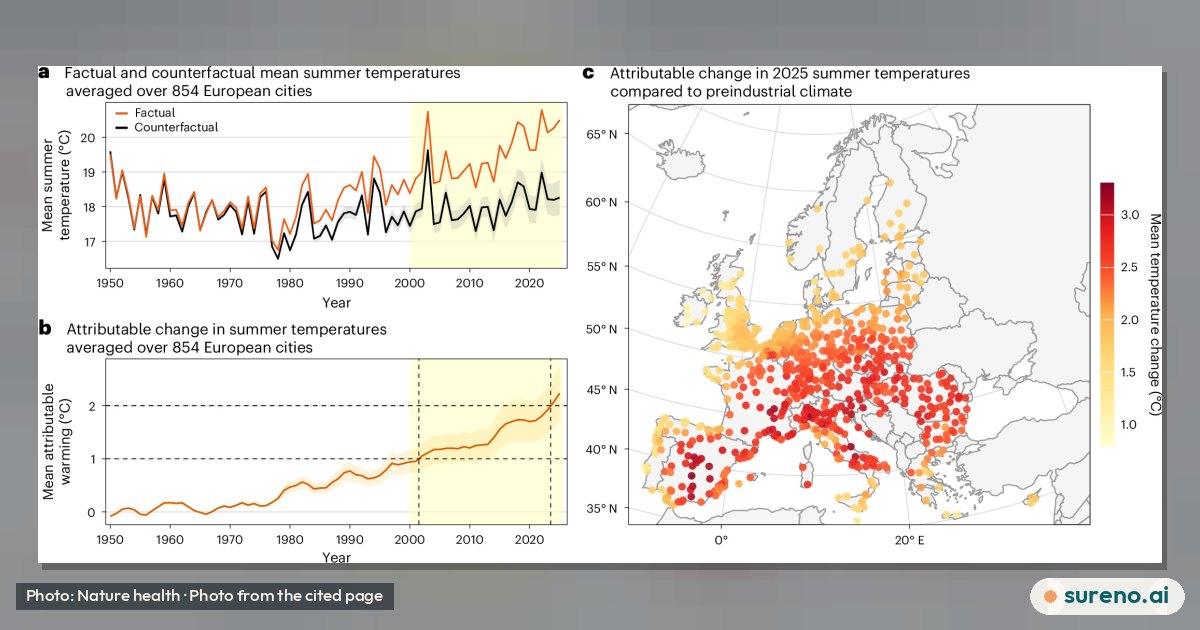
- Researchers estimated 50,391 heat-related excess deaths in 854 European cities in summer 2026; about two-thirds were attributable to human-caused warming in their analysis 1.
- A computer-model study projects more frequent and longer periods of low wind and high temperatures by 2100, which could challenge power systems 2.
- A review of 21 studies found climate policies were associated with some psychosocial benefits, including better wellbeing and social cohesion, but results varied 3.
- These are different kinds of research, and none settles the wider questions on its own 123.
The studies at a glance
A climate-attribution and mortality modelling study
Researchers estimated 50,391 excess heat-related deaths, with around two-thirds attributable to human-caused warming in their analysis [1].
- Who or what was studied
- 854 European cities, using city- and age-specific temperature–mortality relationships for June to August 2026
- The catch
- These are model-based estimates, not direct identification of the cause of each person's death [1].
A computer-model study using downscaled climate projections
The models project that low-wind, high-temperature events may become more frequent and longer by 2100 [2].
- Who or what was studied
- Daily outputs from 27 climate models, covering global land areas and multiple carbon-dioxide scenarios
- The catch
- The study projects climate conditions rather than actual outages, and its ranges vary across scenarios and models [2].
A systematic review of earlier research
Some policies were associated with improved wellbeing, mental health and social cohesion, though effects differed by context [3].
- Who or what was studied
- 21 studies of psychosocial effects associated with climate policies
- The catch
- The evidence was varied and methodologically limited, so the review does not establish that policies caused every reported benefit [3].
Three studies examine climate risks and possible benefits
Three peer-reviewed studies published in the past two weeks look at different parts of the climate question: heat-related deaths in European cities, possible future risks to electricity systems, and whether climate policies may support mental and social wellbeing 123. Together, they offer evidence about harms and potential benefits, but they do not provide a complete account of climate change or its effects.
The studies use different methods. One estimates deaths by combining climate attribution with city-level temperature and mortality patterns. Another uses climate-model projections. The third reviews earlier research. Each method can help answer particular questions, but each has limits. One study rarely settles a question: results may depend on assumptions, data and the places or people studied, and findings often need further testing.
Researchers attribute about two-thirds of estimated city heat deaths to human-caused warming
The first study asked how many heat-related deaths occurred in European cities during the summer of 2026, and how many might not have occurred in a climate without human-caused warming. It was a modelling and attribution study, not a count of individual death certificates. The researchers combined climate attribution with city- and age-specific relationships between temperature and mortality across 854 cities 1.
They estimated 50,391 excess heat-related deaths across those cities during June to August. Their analysis attributed around two-thirds of that estimated total to human-caused climate change 1. In everyday terms, that is roughly two of every three deaths in the study's estimate, not a direct identification of the cause of each individual death.
The finding points to a substantial health toll during an unusually hot summer and supports the importance of both reducing emissions and preparing for heat, as the study authors note 1. But the estimate depends on statistical methods and the climate comparison used. It does not establish the exact number for every city, explain every death, or show that the same toll will occur in future summers.
Models project more frequent and longer low-wind heat events
The second study asked how often periods of low wind and high temperatures might occur in a warming climate, and how those combined conditions could affect power-system stability. Such a combination is called a compound event: two conditions happening at the same time. The researchers analysed daily output from 27 downscaled climate models, at about 25-kilometre resolution, and examined multiple carbon-dioxide scenarios 2.
Across global land areas, the models projected that by 2100 the frequency of these events could rise by 100% to 750%, while their duration could increase by 80% to 300% 2. Those are wide ranges, reflecting different scenarios and model outcomes. The study links the projected intensification mainly to warming and a broad tendency toward weaker winds, with other regional factors also contributing 2.
These projections raise a planning concern: hot periods can coincide with weak wind, potentially making it harder for power systems to maintain supply. The study does not report actual power outages or estimate how much electricity would be unavailable in a particular country. It is a climate-model assessment of future weather conditions, not a forecast of a specific grid failure. The authors also report that a method using historical trends reduced differences between model projections, but uncertainty remains 2.
A review finds possible wellbeing gains from some climate policies
The third study asked whether climate policies may bring psychosocial benefits: effects on mental wellbeing and social life, as well as environmental gains. It was a systematic review, meaning researchers searched for and assessed earlier studies rather than running a new policy trial. The review included 21 studies and combined their findings in a narrative synthesis 3.
The authors found that measures such as air-pollution controls, environmental taxes and nature-based urban interventions were associated with improvements in subjective wellbeing, mental health and social cohesion 3. The review did not give one overall effect size, so it is not possible to translate the findings into a single percentage or number of people who benefit.
The results varied by social and local circumstances, including age, socioeconomic status and whether interventions were in schools, rural areas or cities. Access to and actual use of an intervention also appeared relevant, but the review says these mechanisms have not been studied enough. Some included studies pointed to unevenly shared benefits or unintended social effects 3. Because the evidence was heterogeneous and methodologically limited, the review does not show that every climate policy improves wellbeing, or that policy alone caused each observed change.
The findings point to risks and benefits, with uncertainty still present
Taken together, the studies describe three distinct issues: a model-based estimate of the health toll from one hot European summer, projections of weather conditions that could strain electricity systems, and a review suggesting some climate policies may support wellbeing 123. The evidence is not interchangeable: the first estimates past deaths, the second projects future climate conditions, and the third synthesises studies of policy effects.
The research adds weight to the case that climate change has consequences for health and infrastructure, while suggesting that some policies may bring benefits beyond reducing emissions. It does not tell readers exactly how future power systems will perform, which policies will work best in every setting, or how benefits and costs will be distributed. Those questions remain open, and the studies' findings need to be considered alongside further research and local evidence.
What we don't know yet
- How accurately the 2026 mortality estimate reflects deaths in each individual city and age group.
- How future climate conditions will translate into electricity supply risks in particular countries and grids.
- Which climate policies produce lasting wellbeing benefits, for whom, and how fairly those benefits are shared.
- How much the findings will change as more observations and research become available.
Share this explainer
New discoveries on every new tab
Sureno Browser puts explainers like this one on your start page every morning, in plain words.
Questions people ask
How many heat-related deaths were estimated in European cities in summer 2026?
A study estimated 50,391 excess heat-related deaths across 854 European cities from June to August 2026. It estimated that around two-thirds were attributable to human-caused climate change. These figures come from modelling, not a count that identifies the cause of each individual death 1.
Can climate change put electricity supplies at risk?
A climate-model study projects that periods combining low wind and high temperatures could become more frequent and longer by 2100. The study discusses potential implications for power-system stability, but it does not predict specific outages or measure future electricity shortages in a particular place 2.
Can climate policies improve mental wellbeing?
A review of 21 studies found that some policies were associated with better wellbeing, mental health or social cohesion. Results varied by setting and population, and the evidence has limitations. The review does not show that every climate policy will produce these effects 3.
What is a compound wind drought and heatwave event?
In the study, it means low wind speeds happening at the same time as high temperatures. The researchers examined how often these combined conditions may occur under different climate scenarios 2.
Sources
- Heat-related urban mortality attributable to human-induced climate change in Europe in summer 2026. — Nature health, 2026-10-14
- Intensification of compound wind drought and heatwave events under climate change. — Proceedings of the National Academy of Sciences of the United States of America, 2026-11-09
- What Is There to Gain? A Systematic Review on Psychosocial Co-Benefits of Climate Policies. — Journal of health monitoring, 2026-11-04
Free tools for this
They run in your browser. Nothing is uploaded and there is nothing to sign up for.
More to read
 SpaceWhy Starship’s Tower Catch Matters for Rocket ReuseNov 15, 2026 · 3 min read0 views
 SpaceWhat Starship’s First Orbital Catch Means for ReuseNov 15, 2026 · 3 min read0 views
 SpaceHow SpaceX Caught Starship After Its Return From OrbitNov 15, 2026 · 3 min read0 views
 Tech & Online SafetyWhy Older Air Traffic Control Systems Can Disrupt FlightsNov 14, 2026 · 4 min read0 views