

Scientists Create a Remarkable Material That Gets Stronger Where It’s Used
A polymer inspired by biology
The patented material combines sugar crystals with polyethylene glycol, a substance used in some health products. The blend forms a water-absorbing hydrogel that remains flexible and is compatible with 3D printing.
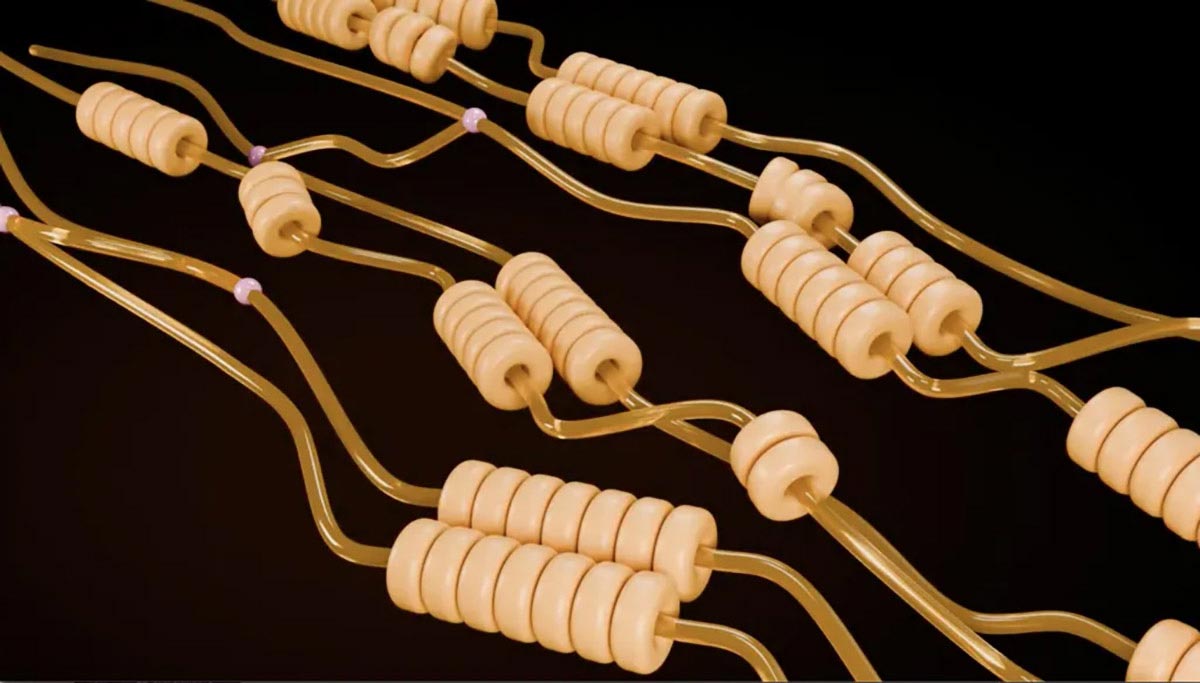
Its behavior relies on cyclodextrin, a sugar-based ingredient that forms rings. As the polymer moves, the rings shift and reinforce areas under the most strain.
Repeated movement builds strength
The research team tested the hydrogel through 10,000 bends. Ke said it performed as expected, with its polymers becoming more organized and uniform in heavily strained areas. That localized reinforcement means the material can strengthen where movement puts pressure on it, while other parts remain pliable. Ke said the team drew inspiration from smart materials found in biology.
Potential uses in medicine
Ke sees possible medical applications, including support for artificial joints and repair of damaged tissue. He said implanted materials do not always need to be rigid throughout.
Production and research team
The study, published online in Nature Materials, included graduate students Yufei Chen and Mingliang Bai, as well as postdoctoral researcher Dan Zheng. Production is currently limited to batches of tens of grams, though Ke believes it could be scaled up.
The research received support from the National Science Foundation and the U.S. Department of Energy. Ke said the work demonstrates that smart materials can be made using a 3D printer and suitable chemistry.
Key points
- The hydrogel reinforces the areas that experience repeated bending or stretching.
- Its ingredients include sugar crystals, polyethylene glycol and cyclodextrin.
- Researchers tested the material through 10,000 bends.
- Possible medical uses include artificial-joint support and tissue repair.