

Europe’s Hera mission returns to the chaotic cosmic smashup scene for answers
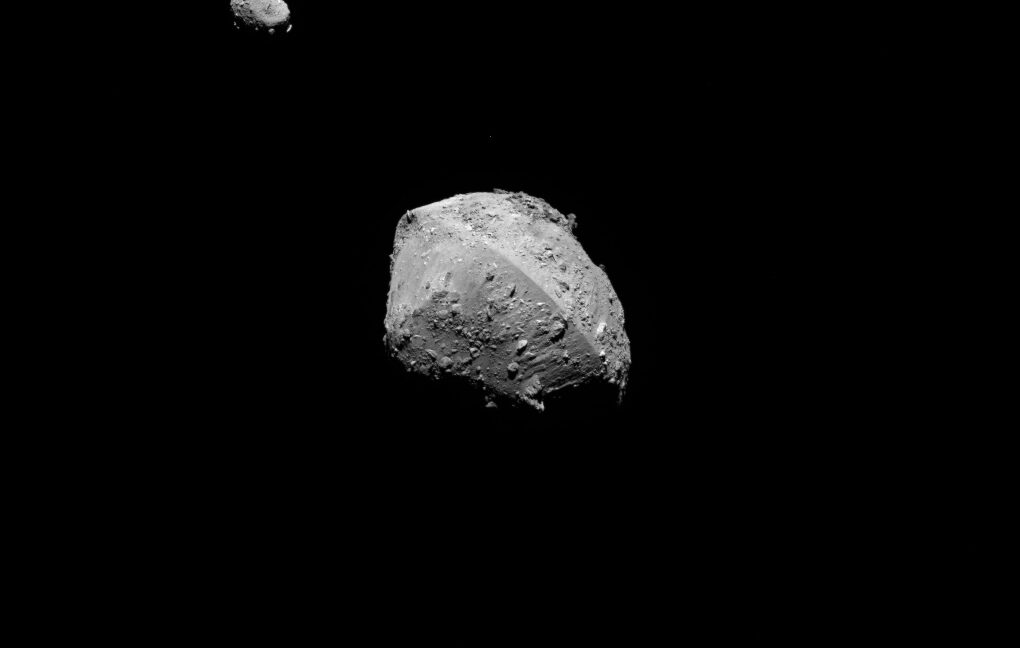
DART changed Dimorphos
NASA’s DART spacecraft deliberately hit Dimorphos at more than 13,700 mph in September 2022. The collision released about 10 billion joules of energy and shortened the asteroid’s roughly 12-hour orbit around Didymos by about 33 minutes.
The impact achieved a much larger orbital change than the most conservative expectation. But DART was destroyed, leaving scientists to rely on telescopes and a CubeSat that briefly detected the flash to study what followed.
Hera examines the aftermath
The European Space Agency’s Hera spacecraft reached the asteroid pair after a two-year journey from Florida. Its first released images show a crater nearly as large as Dimorphos, a rocky body about 500 feet across.
Hera found that the larger asteroid, Didymos, was still rotating as DART had observed during its approach. Dimorphos, by contrast, is now tumbling, according to ESA mission scientist Michael Kueppers.
The initial images also revealed hundreds of boulders around the pair. Scientists had seen material trailing the asteroids in a Hubble Space Telescope image after the collision, but the extent of the debris surprised them.
What the crater reveals
Researchers had considered two possible outcomes: DART might excavate a crater, or it might reshape the asteroid. Hera’s findings indicate both occurred, because the crater was large enough to alter Dimorphos’s shape.
Scientists are still working to understand how the collision produced that result. Hera’s closer observations over the next six months are intended to provide more detail about the impact’s effects.
A test for planetary defense
Hera will deploy two small sub-satellites that will attempt to land on Dimorphos. They are expected to gather information about its composition, internal structure and mass. Scientists plan to use those measurements to reconstruct the DART collision and improve computer models of asteroid deflection. Because near-Earth asteroids vary in size, shape, density and makeup, understanding Dimorphos could help predict how different targets respond.
Didymos and Dimorphos pose no risk of striking Earth. They were chosen because they resemble many near-Earth asteroids, making the experiment useful for studying potential planetary-defense techniques.
Key points
- DART shortened Dimorphos’s orbit around Didymos by about 33 minutes.
- Hera’s first images show a crater nearly as large as Dimorphos.
- The smaller asteroid is tumbling, and hundreds of boulders surround the pair.
- Hera’s measurements are intended to improve models of asteroid deflection.