

ISS power upgrades will reach 215 kilowatts as spacewalkers begin final phase of multi year space station power system upgrade
First blanket installation begins
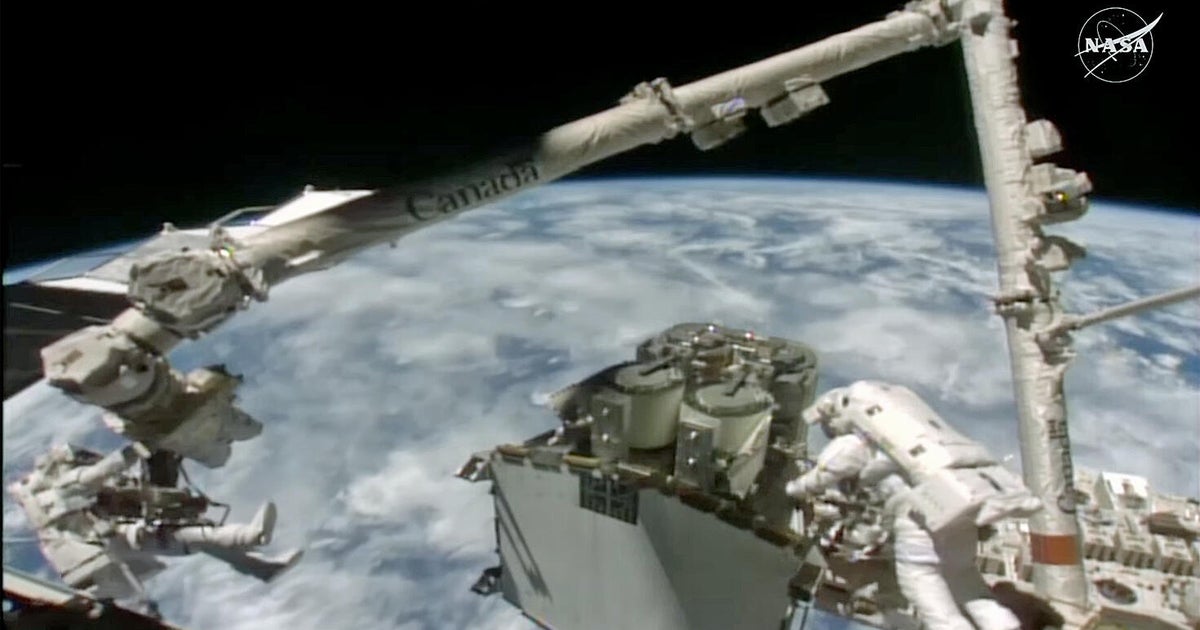
The spacewalk began Thursday in orbital darkness. Canadian astronaut Jeremy Hansen Kutryk remarked, “the night is dark and full of wonders.” Menon, a veteran of three spacewalks earlier this year, and Kutryk, undertaking his first spacewalk, planned to install the seventh roll-out solar array, or IROSA, on a support fixture beside a left-side solar wing. The station’s robot arm, controlled by flight controllers at Johnson Space Center in Houston, had moved the blankets from the Dragon spacecraft to the power truss.
Menon was to ride the 58-foot robot arm while carrying the folded array to its mounting point. The blankets weigh about 750 pounds and measure about 10 feet long when folded, spacewalk flight director Garrett Hehn said.
Power capacity set to rise
Before the first IROSA was installed, the station’s original arrays produced about 152 kilowatts. Six installed blankets have raised output to about 200 kilowatts; the final two are expected to bring it to about 215 kilowatts. That power is intended to sustain the laboratory through its planned retirement and de-orbiting in 2030, while supporting life support systems, research and visiting vehicles.
Final spacewalk planned Nov. 5
After attaching the blanket to its support frame, the astronauts planned to unfold its two halves, bolt them together and connect it to power channel 2A. They would make the electrical connections while the station was on Earth’s night side, when the arrays were not generating power, then unroll the blanket.
Menon and Kutryk planned to return outside Nov. 5 to install the eighth and final IROSA at the far-right end of the power truss. Because the robot arm cannot reach that location, they will pass the folded blanket between them as they move it to the support frame.
Gaurang Patel, a senior manager in NASA’s Low Earth Orbit Program, said the Nov. 5 work would install and deploy the final set of IROSAs and complete the power augmentation upgrades.
Key points
- The first of two spacewalks began Thursday to install the final pair of solar blankets.
- Station power output is expected to reach about 215 kilowatts after both blankets are installed.
- The upgraded system is intended to support the station through its planned 2030 retirement and de-orbiting.