Food prices: Why some items rise while others go down—here are stories behind 5 everyday items
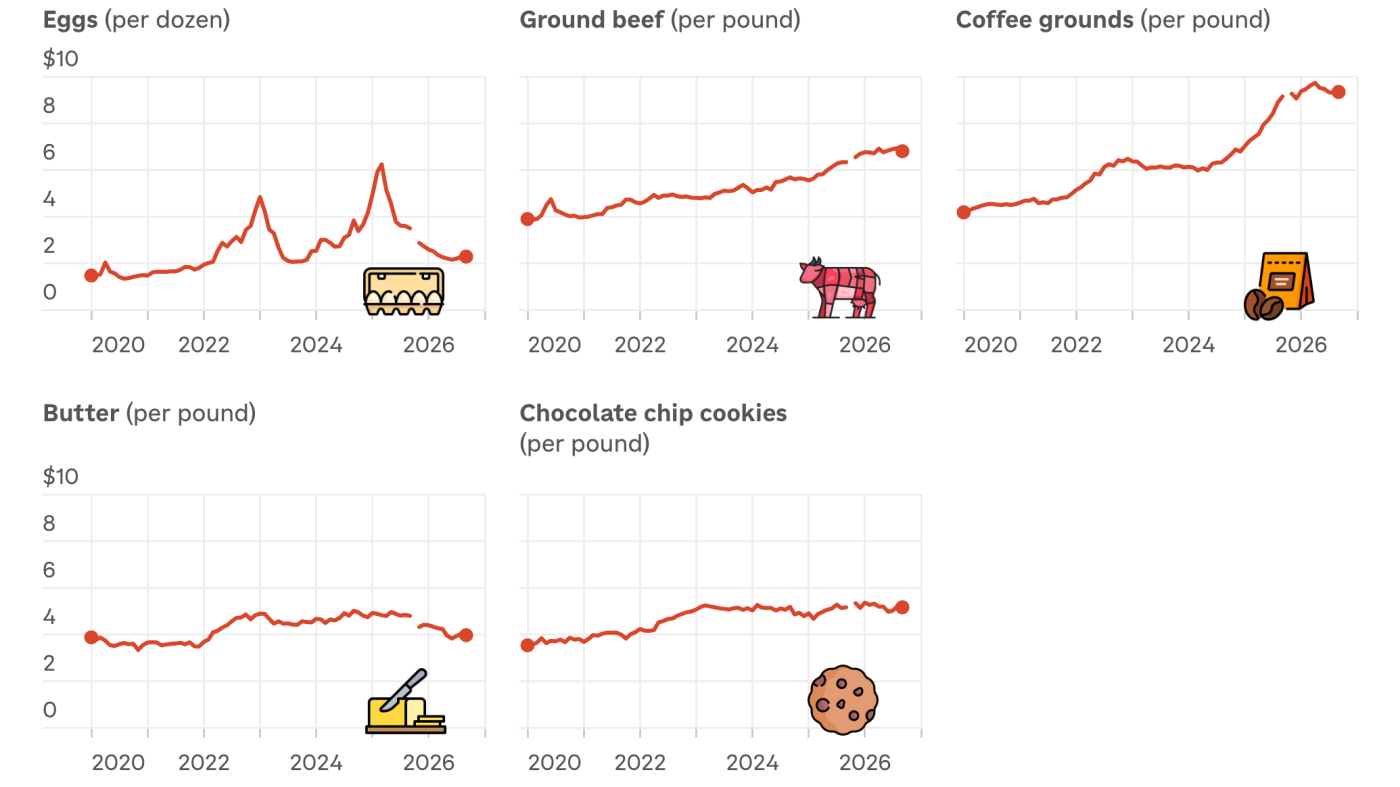
Grocery costs remain elevated
In April 2020, grocery prices jumped 2.6% from the previous month, their biggest leap in decades, as COVID-related lockdowns led people to eat at home more often. Food prices rose 11.4% in 2022 as shoppers returned in large numbers and retailers faced pent-up demand, alongside shocks including avian flu and Russia's invasion of Ukraine.
The rapid inflation eased in 2023, but grocery costs did not return to earlier levels. Ricky Volpe, a Cal Poly San Luis Obispo agribusiness professor, said consumers are sensitive to further increases because prices are already high.
Overall grocery prices have risen on average since Trump returned to office, despite some individual items becoming cheaper. Systemwide pressures include higher labor costs, tariffs and energy prices linked to the war with Iran.
Beef faces supply pressures
A typical pound of ground beef cost $6.79 last month, up 85% from a decade earlier, according to the Bureau of Labor Statistics. Weather and financial pressures on producers have contributed to the long-running increase.
Recent droughts have hurt cattle herds, which can take years to recover. Producers also face higher equipment and fuel costs, limited grazing land and a consolidated meatpacking industry; the number of U.S. cattle farms has been shrinking, according to the most recent Census of Agriculture.
The U.S. cattle herd is at its smallest level in 75 years. The Trump administration has allowed more tariff-free ground beef imports, but U.S. ranchers argue that imports could make it harder and more expensive for domestic farms and ranches to operate.
Egg prices swing with outbreaks
Avian flu is the main force behind recent swings in egg prices. When outbreaks lead farms to cull chickens, domestic supply falls and prices can rise; the disease drove spikes in 2022 and 2024.
A typical dozen eggs reached a record $6.23 in March of last year, when avian flu depleted stocks. Last month, the typical U.S. price was $2.27 per dozen.
Tariffs can add other costs for poultry operations. The Trump administration's tariffs on foreign goods have raised the price of packaging materials such as cardboard used in egg cartons.
Other foods follow distinct paths
The five everyday foods considered include ground beef, eggs, coffee, butter and chocolate chip cookies. Their prices can be shaped by different pressures affecting a crop, animal species or region, so an item's movement may diverge from broader inflation.
The U.S. imports more than 99% of the coffee it consumes. The article's account of coffee ends as it begins describing tariffs on countries that supply it, so it does not provide further details about coffee prices.
Key points
- Grocery prices rose 11.4% in 2022 and have continued increasing more slowly.
- Ground beef cost $6.79 per pound last month, 85% more than a decade earlier.
- Egg prices reached $6.23 per dozen in March of last year, then fell to $2.27 last month.
- The U.S. imports more than 99% of its coffee.