NASA Science Traces the Human Fingerprint on Earth’s Water Cycle
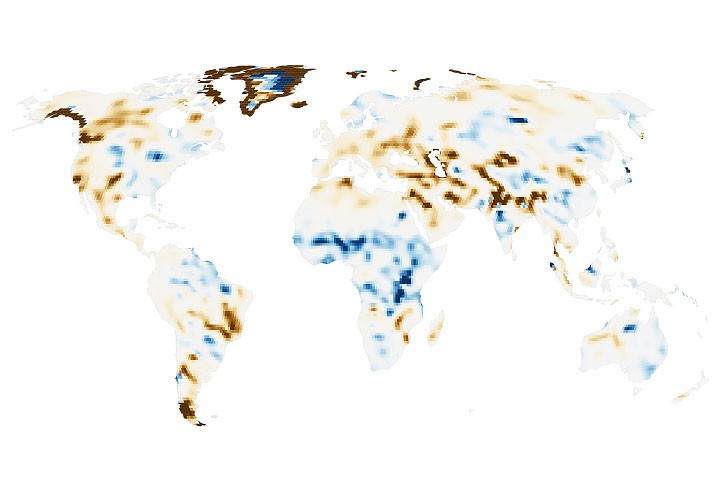
A sharper map of water change
Researchers combined observations from the GRACE and GRACE-FO satellite missions to examine terrestrial water storage from April 2002 to November 2025. Their analysis identified 40 regions where changes aligned with human activities, in addition to climate variability. Those links appeared on every nonpolar continent except Australia.
By combining satellite passes gathered over more than 20 years, the team mapped long-term trends at five to 10 times the spatial detail of earlier analyses. The approach sacrificed temporal detail compared with the monthly maps typically made from the data.
Where people’s influence stood out
In four continental regions, a human-related factor had a stronger relationship with storage trends than any climate factor, according to lead author Mary Michael O’Neill, a hydrologist at NASA’s Goddard Space Flight Center. Co-author Matthew Rodell said the finer resolution revealed some effects that had not been detected before and showed some known trends were stronger than previously understood.
The satellite pairs detect small changes in the distance between them as shifts in gravity tug on the leading spacecraft. Because water and ice have mass and move over time, scientists use those measurements to infer gains and losses in water storage.
Groundwater withdrawals and declines
Groundwater-irrigated farmland was strongly associated with falling water storage in several regions. These included California’s Central Valley, the southern High Plains of the United States, and Chihuahua, Mexico, where long droughts increased farmers’ reliance on groundwater.
Pumping was also linked to declines in northern India. The refined analysis found a steeper downward trend there than earlier estimates showed; retreating Himalayan glaciers accounted for 15 percent of the decline, consistent with previous findings.
Some farming areas saw increases
In parts of sub-Saharan Africa, water storage increased in some locations where rainfed cropland expanded. Native savanna was replaced by millet cultivation during the study period, and water tables rose despite below-average precipitation.
Key points
- The study identified 40 regions where human activities aligned with terrestrial water-storage trends.
- Researchers used GRACE and GRACE-FO measurements spanning April 2002 to November 2025.
- Groundwater pumping was linked to declines in several farming regions, including northern India.
- Some areas with expanding rainfed agriculture saw rising water tables despite below-average precipitation.