APOD 2026 October 18: Hear the Sonified Eagle Nebula Pillars | NASA Science
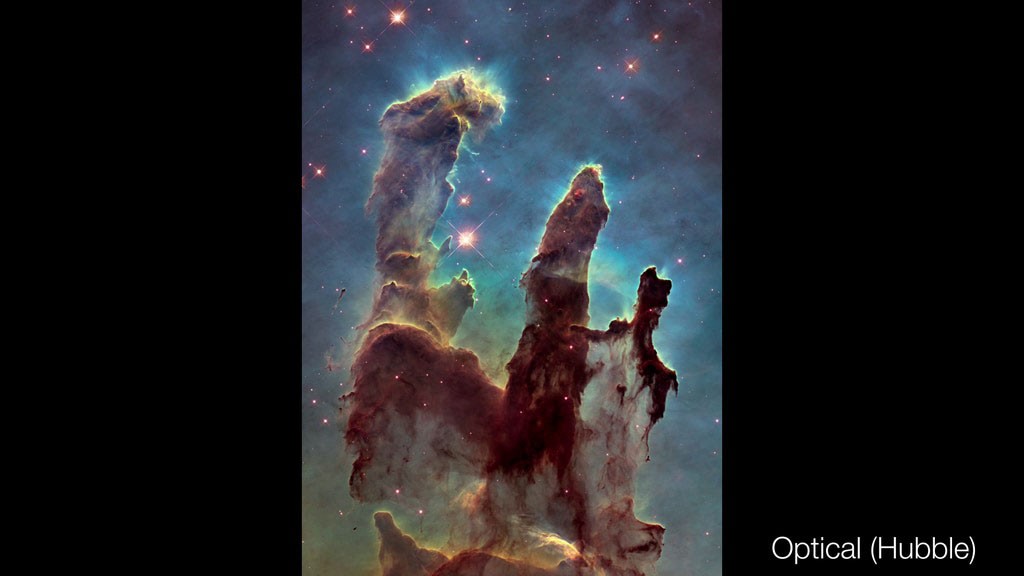
A nebula known for its pillars
M16, the Eagle Nebula, is famous for bright young stars forming among towering structures of dark gas and dust. The columns stretch for light-years and are located toward Serpens, the constellation of the Serpent.
Ultraviolet light and strong winds from a cluster of massive stars have sculpted and eroded the pillars. The structures are destined to be destroyed.
Listening across the image
The featured video turns the nebula image into sound. Its sonification line travels from left to right, with stars and dust sounding off as it moves. The image combines visible-light observations from Hubble with X-ray observations from Chandra, revealing details of M16’s star-forming environment.
A familiar kind of star formation
The turbulent conditions in M16 may resemble those in the environment where our own Sun formed. The nebula is about 6,500 light-years from Earth.
Key points
- The Eagle Nebula, M16, is about 6,500 light-years away toward Serpens.
- Its towering gas-and-dust pillars are shaped by radiation and winds from massive stars.
- The sonification moves left to right across a combined Hubble and Chandra image.
- M16’s star-forming environment may resemble the one that formed our Sun.