Ken Kesey
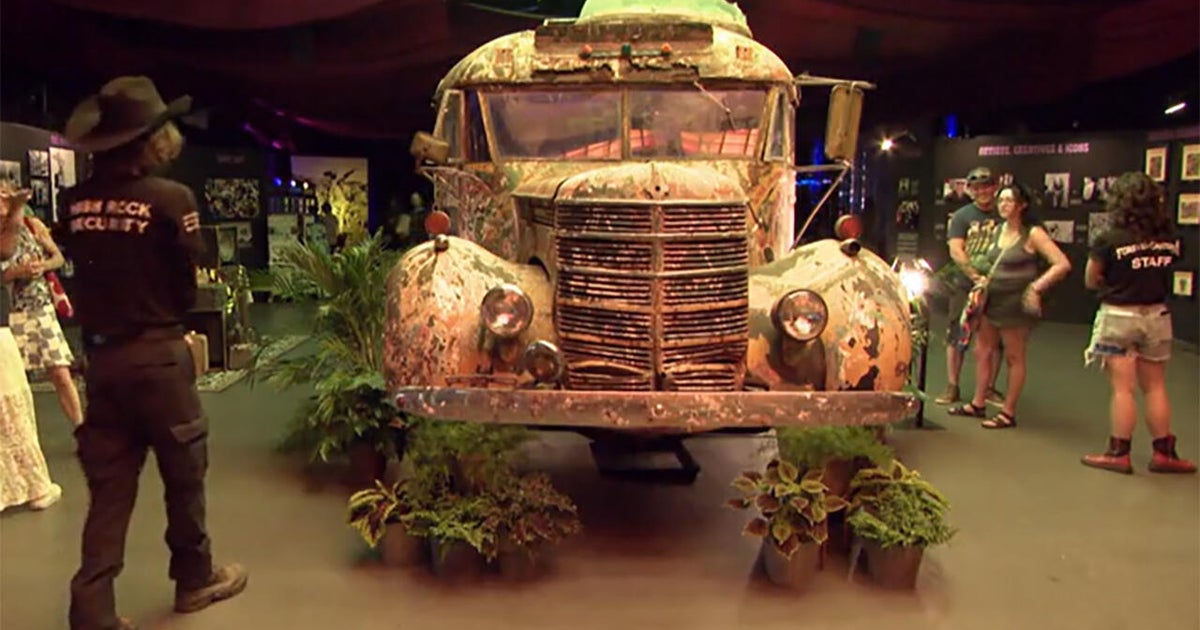
It's some 37 feet of rusted steel, peeling paint, and shattered glass. But even at rest, this 1939 International Harvester school bus, called "Furthur," conjures a sense of motion. "Furthur really is a call to action," said Kelly Harris, director of the Haight Street Art Center in San Francisco. "It reminds us to never stop creating, never stop exploring, and keep pushing further."
"I do believe that Furthur is meant to go further," Harris said. "So, the journey is just beginning. And there should be an opportunity for generations to feel inspired by the bus."
The man behind the bus was author Ken Kesey. In the early 1960s, as a Stanford creative writing student, Kesey was a willing test subject for U.S. government experiments using LSD. His 1962 novel, "One Flew Over the Cuckoo's Nest," drew upon Kesey's drug-induced visions. At the time, LSD was legal for public use.
"Very much a social experiment, fueled by alcohol and LSD," said Ben Marks, curator of the bus exhibit. "It was obviously not this kind of perfect experiment where all the outcomes were positive. A lot of people were emotionally damaged by the whole thing. There's accounts of some of the people who suffered psychologically for not being able to kind of navigate all of this."
Kesey's influence continued to grow, most notably when he invited a local band to play at Prankster parties. They became known as the Grateful Dead. Six decades later, the Dead's music still inspires new fans, as well as pilgrims to see Furthur. "This is a religious experience for us, because we just love the music so much," said Stephanie Koziol.
Eddie Wilson said being at the exhibit was "Magic. That's it. This is pure magic."
His son, Zane Kesey, said, "'Nothing Lasts' was their motto, and that's, as Dad would say, why they would try to achieve nothing, because that would last."
Zane is the keeper of Furthur's flame. "It's in sad shape; it's going to need a lot of help," he said. "We're going to work hard to save as much of the magic and as much of the bus as possible, which will be expensive."
The Keseys hope public exhibits will fuel fundraising to preserve and display the bus; and Haight Street's Kelly Harris agrees that it's high time to save Furthur for the future.
Exhibition: "Forever Grateful" (Haight Street Art Center), at Golden Gate Park, San Francisco (through Oct. 25)
"The Electric Kool Aid Acid Test" by Tom Wolfe (Picador), in Trade Paperback, eBook and Audio formats, available via Amazon, Barnes & Noble and Bookshop.org
Dive deeper
- It's some 37 feet of rusted steel, peeling paint, and shattered glass. But even at rest, this 1939 International Harvester school bus, called "Furthur," conjures a sense of motion. "Furthur really is a call to action," said Kelly Harris, di
- "I do believe that Furthur is meant to go further," Harris said. "So, the journey is just beginning. And there should be an opportunity for generations to feel inspired by the bus."
- The man behind the bus was author Ken Kesey. In the early 1960s, as a Stanford creative writing student, Kesey was a willing test subject for U.S. government experiments using LSD. His 1962 novel, "One Flew Over the Cuckoo's Nest," drew upo
- "Very much a social experiment, fueled by alcohol and LSD," said Ben Marks, curator of the bus exhibit. "It was obviously not this kind of perfect experiment where all the outcomes were positive. A lot of people were emotionally damaged by
- Kesey's influence continued to grow, most notably when he invited a local band to play at Prankster parties. They became known as the Grateful Dead. Six decades later, the Dead's music still inspires new fans, as well as pilgrims to see Fur