

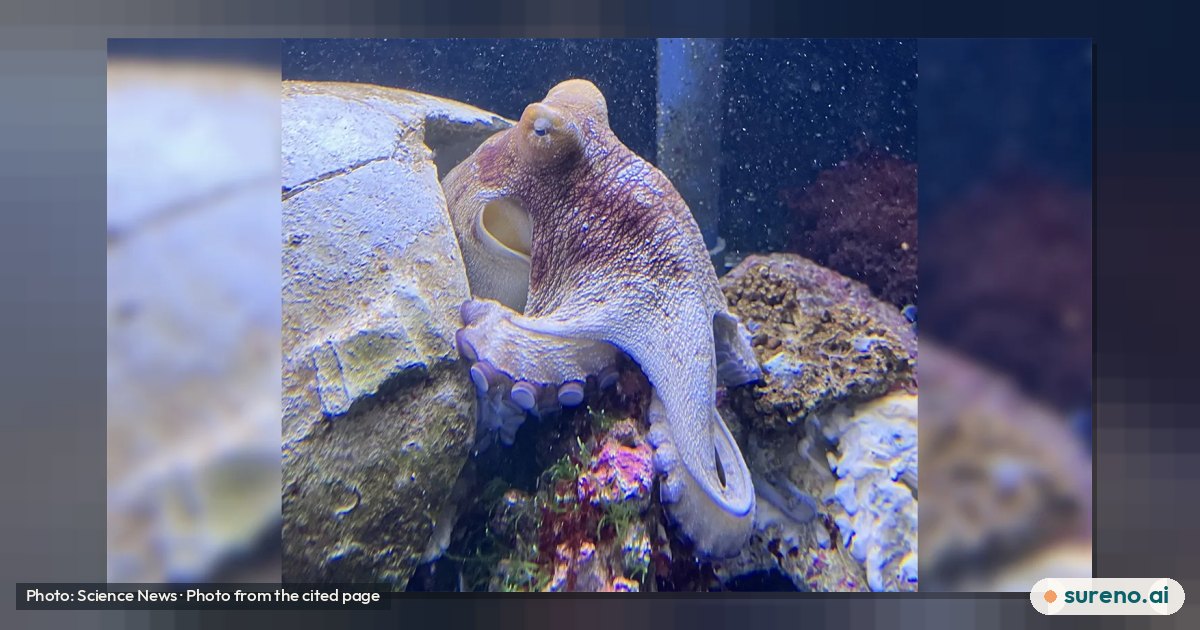
How Octopuses Squeeze Through Tiny Openings
A lab study tracked the sequence some octopuses use to pass through openings narrower than their bodies.
The short version
- An octopus can squeeze through a small opening by changing its shape and moving its arms and body through in a sequence; the exact movements can vary with the opening 1.
- Researchers studied Mayan octopuses and young common octopuses using clear tanks connected by openings of different sizes 2.
- The distance between an octopus’s eyes was used to estimate the width of its firm cartilage case, a possible limit on how narrow an opening it can pass through 2.
- The research may help inspire designs for soft robots, but it does not show that every octopus uses precisely the same sequence 12.
How does an octopus get through a tiny hole?
It changes its shape and feeds its arms and body through the opening in stages. In laboratory observations, researchers saw a consistent sequence of movements, with three or four moves depending on the opening’s size 1.
The key is that an octopus is mostly soft muscle. Its arms and much of its body can bend and deform, unlike a body built around a rigid skeleton 13. But it is not entirely without firm parts, so squeezing has limits.
What happens during the squeeze?
The study describes a step-by-step escape rather than the animal passing through all at once. The reported number of moves varied with hole size, so there is not one fixed sequence that applies to every opening 1.
In broad terms, the octopus must direct its flexible arms through the gap and then bring the rest of its body after them. The available source summaries do not spell out each movement in enough detail to describe a precise, universal choreography. The main finding is that the animals used repeatable sequences in the researchers’ tests 1.
How small can an opening be for an octopus?
There is no single size limit given in the available source material. The answer depends at least in part on the animal and the opening. Researchers tested holes that were slightly wider or narrower than the distance between each octopus’s eyes 2.
That eye-to-eye distance served as an estimate of the width of the cartilage case around the central nervous system. Earlier assumptions treated this firm structure as a guide to the smallest gap an octopus could pass through, but the supplied reports do not establish a universal minimum opening size 2.
Which octopuses were studied?
Researchers tested Mayan octopuses, also known as Octopus maya, and young common octopuses, Octopus vulgaris 2. They placed the animals in clear plastic aquarium boxes connected by holes of different sizes 2.
The findings describe these animals in laboratory tests. They do not, by themselves, establish that all octopus species or individuals behave in exactly the same way.
Why does this research matter?
Octopuses’ ability to change shape is familiar, but researchers have not often studied systematically how they pass through very small openings 1. Tracking the movements gives scientists a clearer account of how this kind of escape works.
The work could also inform soft robotics: machines made with flexible materials rather than only rigid parts 1. That is a possible application, not evidence that the study has already produced a robot with an octopus’s abilities.
What we don't know yet
- The available source summaries do not give a universal minimum opening size for an octopus.
- It is not clear from these summaries how much the sequence varies among individuals, species, or conditions outside the laboratory.
- More detail would be needed to describe every movement in the three- or four-step sequences.
Share this explainer
Get this every day, on every new tab
Sureno Browser brings the day's stories, explained simply, to your start page.
Questions people ask
Can an octopus fit through a hole smaller than its body?
It can change its shape and pass through an opening narrower than its body by moving through in stages. Researchers observed sequences of three or four moves, depending on the hole’s size 1.
What part of an octopus sets the limit for squeezing through a gap?
The cartilage case around the central nervous system is a firm part of the body that may help set a limit. Researchers estimated its width using the distance between the animal’s eyes, but the supplied reports do not establish one universal limit 2.
Do all octopuses squeeze through holes the same way?
Why are octopuses able to change shape?
Could octopus movement help engineers make robots?
The researchers’ findings could inspire designs for soft robots, which use flexible materials 1. The reports describe a possible direction for engineering, not a finished robot or a demonstrated practical application.
Sources
- How octopuses squeeze through tiny openings, step by step — Science News, 2026-11-05
- How do octopuses squeeze through tiny holes? — Popular Science, 2026-11-05
- Octopus — Wikipedia
Free tools for this
They run in your browser. Nothing is uploaded and there is nothing to sign up for.
More to read
 Nature & AnimalsHow Forecasters Track Possible Atlantic Storm DevelopmentNov 6, 2026 · 3 min read0 views
 Nature & AnimalsHow El Niño Shapes Atlantic Hurricane SeasonsOct 31, 2026 · 4 min read0 views
 SpaceWhat NASA’s Artemis Changes Mean for Returning to the MoonNov 6, 2026 · 3 min read0 views
 Food & CookingWhy Rice Krispies Are Changing Their Rice IngredientsNov 5, 2026 · 3 min read0 views