

How El Niño Shapes Atlantic Hurricane Seasons
El Niño can hinder Atlantic storm formation, but this season’s lower activity does not tell us what next year’s hurricane season will bring.
The short version
- El Niño can strengthen winds high above the Atlantic, making it harder for tropical storms to develop and strengthen 1.
- The 2026 Atlantic season has been unusually quiet by some measures, though tropical storms still affected parts of the Gulf Coast and Texas 34.
- A quiet season does not establish what the following year will bring; the sources provided do not include a forecast for next season.
- As of October 31, 2026, the season is not over: the conventional Atlantic season ends November 30, and a source mentions possible western Caribbean development in mid-November 14.
How does El Niño affect Atlantic hurricanes?
El Niño is a climate pattern that can influence weather far beyond the tropical Pacific. In the Atlantic, it is commonly linked with fewer tropical cyclones, the broad group that includes tropical storms and hurricanes 1.
One reason is stronger winds high in the atmosphere over the Atlantic. Those winds can disrupt the conditions a storm needs to grow. In general, calmer winds aloft are more favorable for tropical development 1. This influence changes the odds; it does not make storms impossible.
Was the 2026 Atlantic hurricane season unusually quiet?
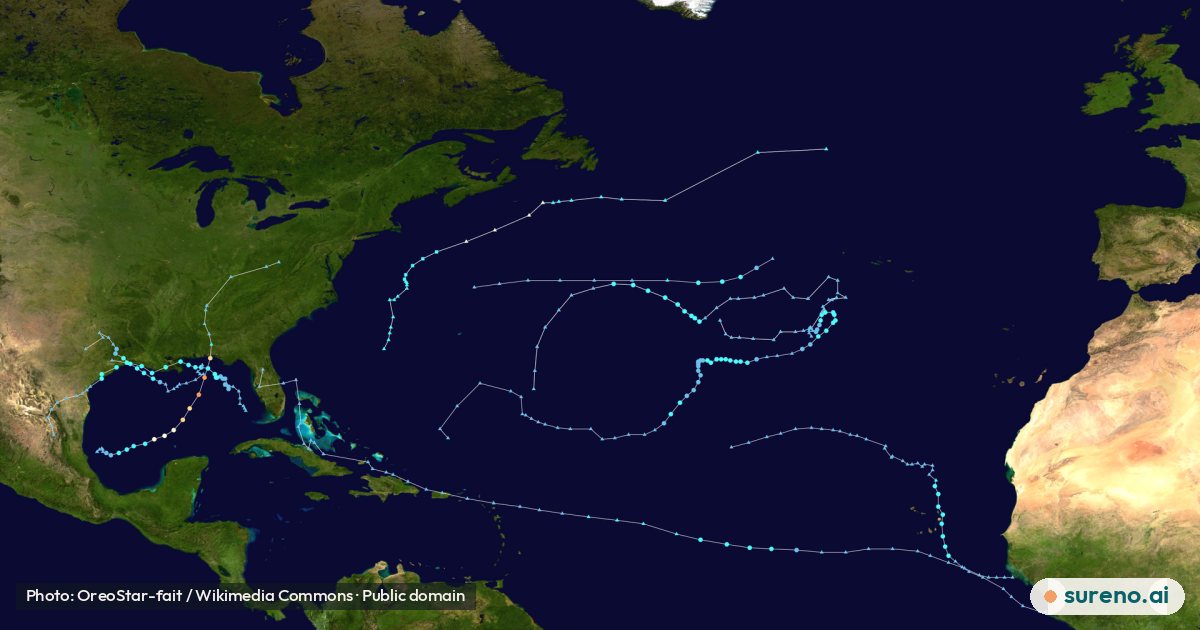
The available reporting describes the Atlantic as unusually quiet during 2026. A report published in late October said the basin’s accumulated cyclone energy, or ACE, was 19.5, compared with a typical 113 to 115.3 around that point in the season 3. ACE is a measure that adds values based on a storm’s sustained wind speed at six-hour intervals. Stronger and longer-lasting storms contribute more to the total 3.
The same report said the Atlantic went longer without a hurricane than at any point since the modern satellite era began in 1966. Its account says that stretch ended when Isaias became a hurricane late on October 7, then reached Category 3 strength on October 9 3. These figures describe the season at the time of reporting; they are not a prediction for the next year.
Does a quiet season mean Texas was unaffected?
No. Lower activity across the Atlantic basin does not mean every coastal area avoids tropical weather. The reporting says Tropical Storms Arthur, Bertha and Edouard brought wind, rain or rough surf to Southeast Texas earlier in 2026; Arthur made landfall nearby 3. The season summary also says Arthur affected the northwestern Gulf Coast, Bertha affected parts of the Gulf Coast, and Edouard came ashore near the Texas–Louisiana border 4.
This is an important distinction: a season can be quiet overall while individual storms still affect communities. Basin-wide measures describe the whole Atlantic, not the local impacts of every storm.
Could there still be a storm before the season ends?
Yes, tropical activity remains possible during the season’s final weeks. The Atlantic hurricane season conventionally runs from June 1 through November 30 4. A late-October report said longer-range forecasts pointed to possible development in the western Caribbean heading into mid-November, while also describing the season as strongly suppressed by El Niño 1.
That report describes a possibility, not a confirmed storm or a guarantee of development. A separate October 31 report said no tropical activity was expected for the following week 2. Conditions and forecasts can change, so these reports should be read with their dates in mind.
What could a quiet season mean for next year?
By itself, a quiet season does not tell us whether next year will be quiet or active. The sources provided explain how El Niño can hinder Atlantic storm development and describe the 2026 season, but they do not give a forecast for the next Atlantic season or establish that this year’s activity determines next year’s.
The useful takeaway is narrower: El Niño can shift the conditions that storms face in the Atlantic, but it is not a guarantee that storms will not form or that a particular place will be spared. A next-season outlook would need current information about the climate pattern and other relevant conditions, which are not supplied in these sources.
What we don't know yet
- Whether the possible western Caribbean development mentioned for mid-November will occur 1.
- How the full 2026 Atlantic season will end, since the season continues through November 30 4.
- What climate conditions and storm activity will shape the following Atlantic hurricane season; the sources provided do not include a next-season forecast.
Share this explainer
Get this every day, on every new tab
Sureno Browser brings the day's stories, explained simply, to your start page.
Questions people ask
Does El Niño stop Atlantic hurricanes?
No. El Niño is typically associated with reduced Atlantic tropical cyclone activity, partly because stronger winds high in the atmosphere can hinder development 1. That influence lowers the odds; it does not rule out storms.
Why can strong winds high in the atmosphere affect hurricanes?
The winds can make conditions less favorable for tropical development. The source explains that calmer conditions are generally more supportive of hurricane formation 1.
Was the 2026 Atlantic hurricane season quiet?
Does a quiet Atlantic season mean Texas is safe from tropical storms?
No. Texas experienced effects from Arthur, Bertha and Edouard in 2026, including wind, rain or rough surf, according to the reporting 3. Lower basin-wide activity does not prevent individual storms from affecting a place.
Sources
- Late-season tropical trouble brews in Caribbean as El Niño driven hurricane season enters final stretch — FOX Weather
- 32 days left of hurricane season — FOX 13 Tampa Bay
- El Niño kept the Atlantic hurricane season quiet. What could next year bring for Texas? — Yahoo News
- 2026 Atlantic hurricane season — Wikipedia
Free tools for this
They run in your browser. Nothing is uploaded and there is nothing to sign up for.
More to read
 Nature & AnimalsCould a Weak Polar Vortex Affect Canada’s Winter?Oct 28, 2026 · 3 min read0 views
 Nature & AnimalsHow the SS United States Could Become an Artificial ReefOct 27, 2026 · 3 min read0 views
 Nature & AnimalsPolar Vortex Forecast: What Early Winter Signs Can Tell UsOct 26, 2026 · 4 min read0 views
 Nature & AnimalsWhy October Snow Is Affecting Parts of AlbertaOct 24, 2026 · 3 min read0 views
 WorldWhat the U.S. Patriot Missile Sale Means for UkraineOct 31, 2026 · 4 min read0 views