

Ponds, rivers and clear words change how we read nature
New studies suggest that small ponds matter, river trends need fair comparisons, and familiar language can affect public responses.
The short version
- A survey experiment with 7,338 U.S. adults found that familiar wording about nature loss or extinction generally drew stronger responses than the technical term biodiversity loss. 1
- Across 206 European ponds, greater biodiversity was associated with more ecosystem functions, while higher nutrient levels were linked with declines in several functions. 2
- An analysis of 4,062 river-invertebrate time series found that biodiversity trends varied with how impacted communities were at the outset. 3
- These studies show why wording and comparison methods matter, but none alone settles how nature is changing everywhere.
The studies at a glance
Randomized survey experiment
The phrases “extinction of plants and animals” and, with context, “nature loss” generally received stronger responses than “biodiversity loss.”
- Who or what was studied
- 7,338 U.S. adults assigned different nature-related terms, with or without context and photographs.
- The catch
- The study measured survey responses, not real-world action, and the terms differ in meaning; results may not generalize beyond English-speaking U.S. adults.
Standardized field survey
Greater biodiversity was positively associated with multiple ecosystem functions, while higher nutrient concentrations were negatively related to several functions.
- Who or what was studied
- 206 European ponds, with 2,500 observations of aquatic biodiversity and ecosystem functions.
- The catch
- The survey found associations, not proof of cause, and the reported summary does not provide a single effect size or establish that the pattern applies to every pond.
Analysis of river time series
Biodiversity trends differed with communities’ initial impacts, supporting comparisons among communities with similar conditions relative to reference sites.
- Who or what was studied
- 4,062 river-invertebrate time series from 23 European countries, covering 1971 to 2024.
- The catch
- The analysis does not explain every local change or show that one trend applies to all rivers.
Three studies ask how we describe and measure nature
These recent studies look at nature from different angles. One tested how wording affects public responses to biodiversity loss. Another measured biodiversity and ecosystem functions in European ponds. A third examined river records and asked whether trends make sense when rivers begin in different conditions. 123
The shared lesson is that what we measure, compare or call something can shape what we learn. But each paper is one piece of evidence. One study rarely settles a broad question, and results from one setting may not apply everywhere.
Clearer nature language drew stronger responses in a U.S. survey
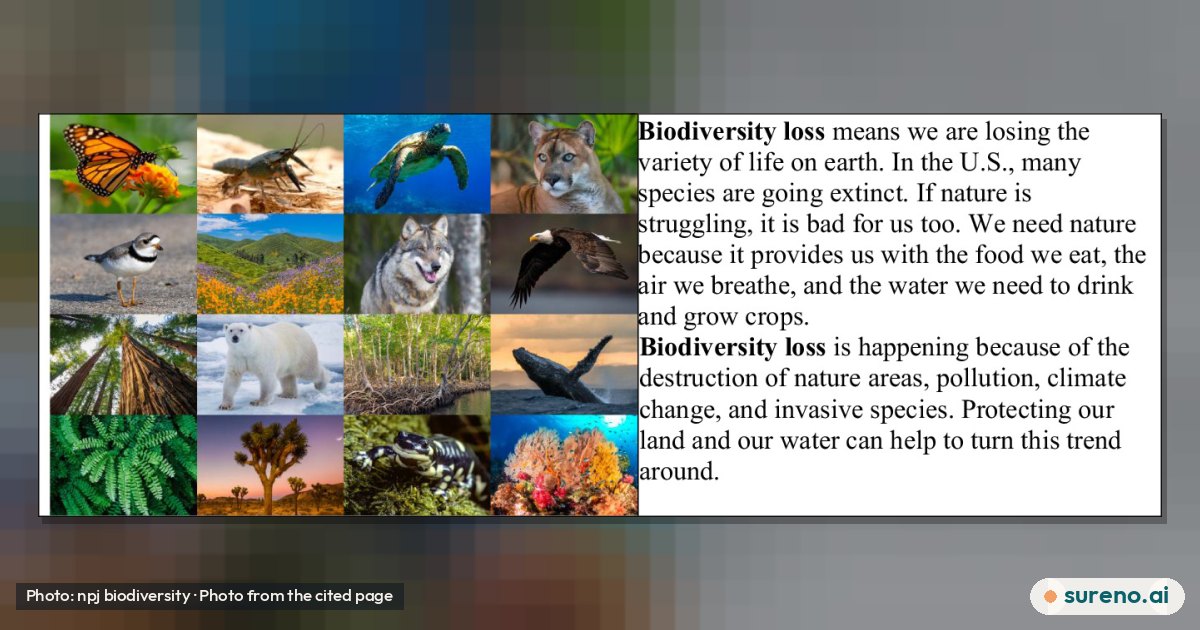
Researchers wanted to know whether people respond differently to terms such as “biodiversity loss,” “nature loss” and “extinction of plants and animals,” and whether adding crisis language changes those responses. They ran a randomized survey experiment: 7,338 U.S. adults were assigned different terms, with or without an explanation and photographs of plants and animals. 1
The technical phrases “biodiversity loss” and “biodiversity crisis” received the lowest ratings for familiarity, concern, urgency and support for conservation. “Extinction of plants and animals” generally received the highest ratings. With context, “nature loss” performed similarly to that clearer phrase. Adding the word crisis made little difference overall. 1
This was a survey about responses to language, not a test of how people act in real conservation decisions. The terms also do not mean exactly the same thing: biodiversity loss can include changes beyond species going extinct. The authors did not check how participants understood each phrase, and results from English-speaking U.S. adults may not carry over to other countries or audiences. 1
The finding suggests that plain wording can help people connect with a subject. It does not mean that one phrase is right for every purpose, or that simpler language should erase important scientific distinctions.
More diverse pond life was linked with more ecosystem functions
Researchers asked whether biodiversity in small standing waters is related to the number and strength of functions those waters perform. They conducted a standardized field survey across 206 European ponds, collecting 2,500 observations involving aquatic plants, tiny drifting animals, small invertebrates and amphibians. They also measured processes such as decomposition, carbon storage, productivity and habitat complexity. 2
Across the ponds, greater biodiversity was positively associated with ecosystem multifunctionality: the ability of an ecosystem to support several functions. Some functions were strongly linked with the richness of zooplankton, tiny animals that drift in water. Higher nutrient concentrations associated with intensive cropland were negatively related to multiple functions. The biodiversity relationship tended to be stronger in arid regions. 2
This was a field survey, so it found associations rather than demonstrating that biodiversity alone caused the differences. The abstract does not give a single percentage or other simple effect size. It also does not establish that every pond, or ponds outside the study, will show the same pattern. 2
Ponds may be easy to overlook beside rivers and lakes, but this study links their living variety with several ecological processes. It gives researchers and local communities a reason to include small waters when thinking about freshwater habitats, while leaving the size of effects in particular ponds uncertain.
River trends look different when starting conditions are compared
Researchers examined whether broad summaries of river biodiversity can be misleading when they combine communities that began in different conditions. They compared 4,062 time series of river invertebrates, covering 1971 to 2024 in 23 European countries, with reference communities considered least impacted. 3
Trends were generally stronger and more consistent in communities that were already more impacted and had undergone more extreme change. Where initial impacts were lower and total change was smaller, trends were weaker and more mixed. The researchers concluded that trends should be compared among communities with similar impact levels, judged against suitable reference sites. 3
This analysis of existing time series shows that comparison choices affect the patterns seen in the data. It does not, by itself, explain every cause of change in each river or establish one trend for all rivers. The source summary also does not give one overall percentage change that could describe the whole dataset. 3
For readers, the point is that a river’s condition at the start matters when judging whether it is improving or declining. A single average can hide different experiences among waterways, so a comparison with an appropriate reference can make reports more informative.
Together, the studies call for careful measures and clear explanations
Taken together, the studies do not offer one simple measure of nature’s condition. The pond survey links biodiversity with multiple functions, the river analysis shows why comparisons need to account for starting conditions, and the survey experiment finds that wording can change people’s stated responses. 123
Their findings suggest that good communication depends on both sound measurement and understandable language. Yet clearer wording is not a substitute for precise definitions, and a pattern in one set of ponds or rivers does not automatically apply elsewhere. Further research would help show how these results hold across places, audiences and changing conditions.
What we don't know yet
- Would clearer nature terms change people’s conservation choices or actions outside a survey?
- How large are the biodiversity-related differences in pond functions, and do they hold in ponds beyond the European survey?
- How should river reference sites be selected in different regions, and how would that affect reported trends?
Share this explainer
New discoveries on every new tab
Sureno Browser puts explainers like this one on your start page every morning, in plain words.
Questions people ask
Does biodiversity loss only mean species going extinct?
No. The study authors note that biodiversity loss can include changes in populations, genetic variety, communities and ecological relationships, even when species do not disappear. 1 That is why “extinction of plants and animals” is more familiar wording but describes only one part of the broader idea.
Why do pond plants and animals matter?
In a survey of 206 European ponds, greater biodiversity was associated with more ecosystem functions, including processes such as decomposition and productivity. 2 The study found a relationship, not proof that biodiversity alone caused those functions.
Why compare rivers with reference sites?
River communities can begin at different levels of human impact, and their trends may differ as a result. Comparing communities with similar starting conditions relative to suitable references can make broad trends more meaningful. 3
Does calling something a nature crisis make people more concerned?
In this survey experiment, crisis wording had little to no effect overall on the responses measured. 1 The results concern U.S. adults’ survey answers and do not establish how wording affects people in other settings.
Sources
- Public responses to biodiversity loss terminology and crisis framing. — npj biodiversity, 2026-10-21
- Biodiversity enhances pond ecosystem multifunctionality across Europe. — Nature ecology & evolution, 2026-10-14
- Broad-scale evaluations of biodiversity change need reference comparisons. — Science advances, 2026-10-28
Free tools for this
They run in your browser. Nothing is uploaded and there is nothing to sign up for.
More to read
 ScienceWhat studies say about heat, air pollution and public viewsOct 29, 2026 · 5 min read0 views
 ScienceThree materials advances target batteries and solar cellsOct 28, 2026 · 5 min read0 views
 ScienceWhat the Exponential Time Hypothesis Says About Hard ProblemsOct 27, 2026 · 4 min read0 views
 ScienceThree laboratory steps in quantum computing and light sensingOct 27, 2026 · 6 min read0 views
 Home & LifeWhat the Daft Punk Lego Set Includes and What It RecreatesOct 23, 2026 · 4 min read3 views
 ScienceHow Satellites Track Autumn Leaf Colour—and What It ShowsOct 26, 2026 · 3 min read0 views
 ScienceHow Scientists Trapped a Positron for MonthsOct 23, 2026 · 3 min read0 views
 Food & CookingWhere In-N-Out May Expand Next: Oklahoma, Arkansas and MississippiOct 30, 2026 · 3 min read0 views