

120-fold uv power: harvard's tiny light chip could help shrink quantum computers
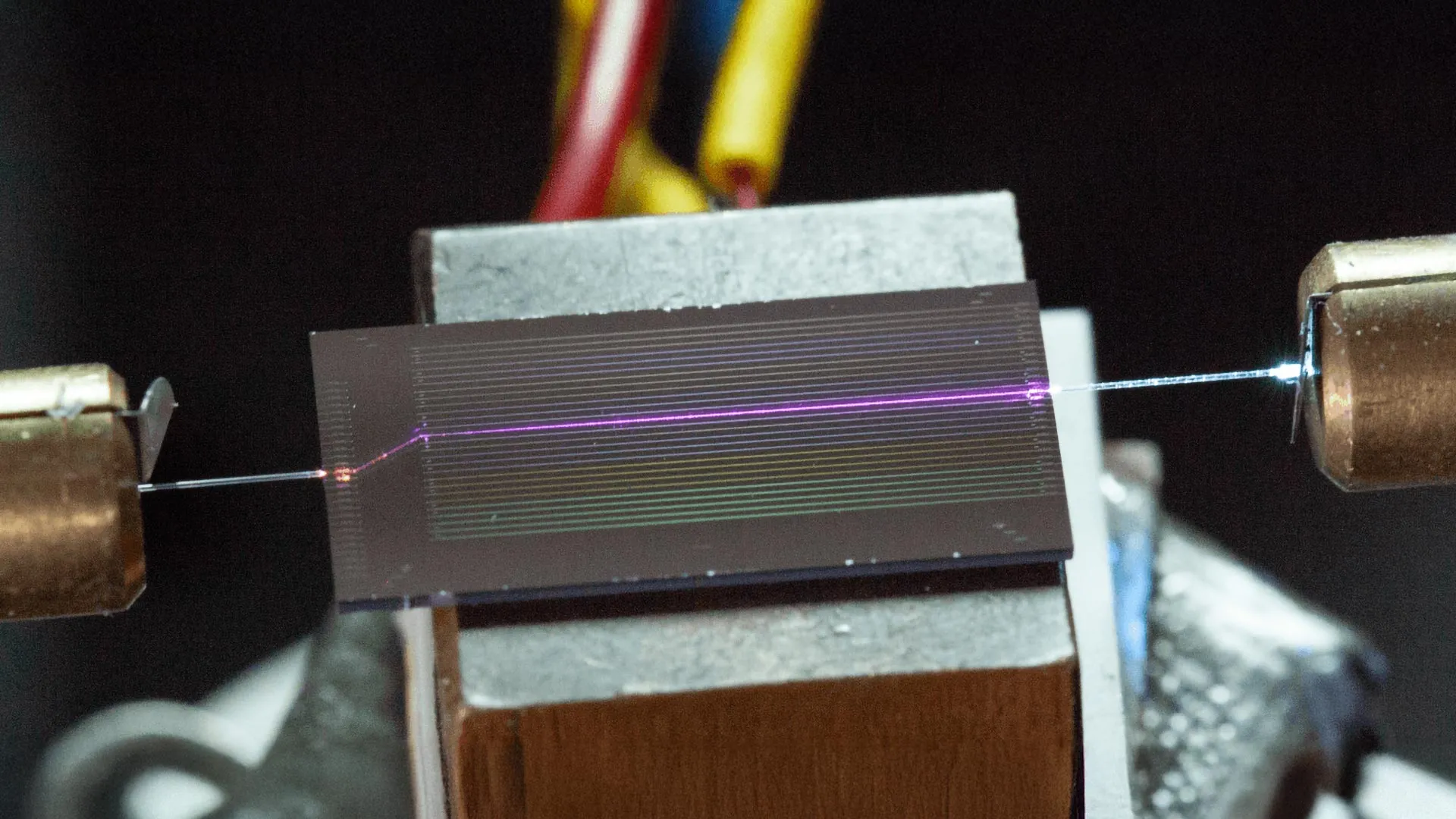
A compact source for ultraviolet light
UV light is used to disinfect surfaces, make biological materials fluoresce and manufacture computer chips through photolithography. Researchers also see potential in tiny UV sources built into photonic chips, including applications in quantum computers and atomic clocks.
But UV light quickly loses power as it moves through the narrow waveguides that carry light across a chip. That has made it difficult to produce compact sources with enough output for practical use. The Harvard-led device generated approximately 120 times the UV power of previous comparable devices.
Turning red light into UV
The team created UV light inside the chip rather than trying to transmit it through microscopic channels. The process, called frequency upconversion, combines two red-light photons inside a lithium niobate crystal to form one higher-energy ultraviolet photon.
The research, published in Nature Communications, demonstrates that thin-film lithium niobate can generate and guide light at ultraviolet wavelengths. Marko Lončar, the Tiantsai Lin Professor of Electrical Engineering, said his group is perhaps best known for using the material in devices operating at longer, infrared wavelengths.
A new way to pattern crystals
Efficient conversion requires crystal regions to be reversed in a precise repeating pattern along the waveguide. This process, known as poling, has been difficult to carry out accurately at scales below a micrometer across devices several centimeters long.
Earlier approaches involved a tradeoff: poling the film before making waveguides made it harder to correct flaws, while forming the waveguides first reduced conversion efficiency. The team addressed this with sidewall poling, placing patterned metal structures alongside the etched waveguide and applying a small voltage to reverse crystal domains.
Precision fabrication challenge
The electrode arrangement allowed the team to control crystal domains across the waveguide’s cross section. Co-first author Soumya Ghosh said positioning the electrodes required a high-precision process, with about 50-nanometer accuracy.
Co-first author Kees Franken said thin-film lithium niobate is not usually thought of as a UV material, but the work shows that it can serve that role. He also noted that the team observed nonlinear effects it does not yet fully understand.
Key points
- The Harvard-led device generated about 120 times more UV power than comparable previous devices.
- It creates ultraviolet light from red light inside a thin-film lithium niobate chip.
- The team used sidewall poling to precisely control crystal domains beside the waveguide.
- Compact UV sources could enable smaller quantum computers and ultra-precise atomic clocks.