

Scientists Created Artificial Life-Like Muscles That Help Humanoid Robots Play Piano and Hold a Gaze
Aiming for delicate control
The team’s study, published this week in Advanced Functional Materials, describes a controllable artificial muscle inspired by small muscles in human eyes and fingers. The researchers tested the fibers in a robot hand and a pair of robotic eyes.
Many large robots use rigid motors suited to actions such as walking and lifting. Reproducing fine movements, including pressing a key gently or holding a gaze, requires muscles that are flexible, strong and precise.
Materials with feedback
The fibers combine liquid crystal elastomers, or LCE, with graphene and an ultrathin copper coil. The rubber-like LCE stretches and contracts, while graphene reinforces it and helps it withstand opposing pulls.
Heating can make the LCE move, but as it cools, it can creep back toward its original length. That makes it harder to sustain a precise position for tasks such as holding a gaze or applying steady pressure to a piano key.
The copper coil acts as both heater and sensor. Researchers used its electrical resistance as feedback, adjusting heat in real time to help the muscle hold its position. Xuelin Wu, a study co-author and University of Pennsylvania Ph.D. student, said a separate feedback sensor was not needed.
Piano keys and robotic eyes
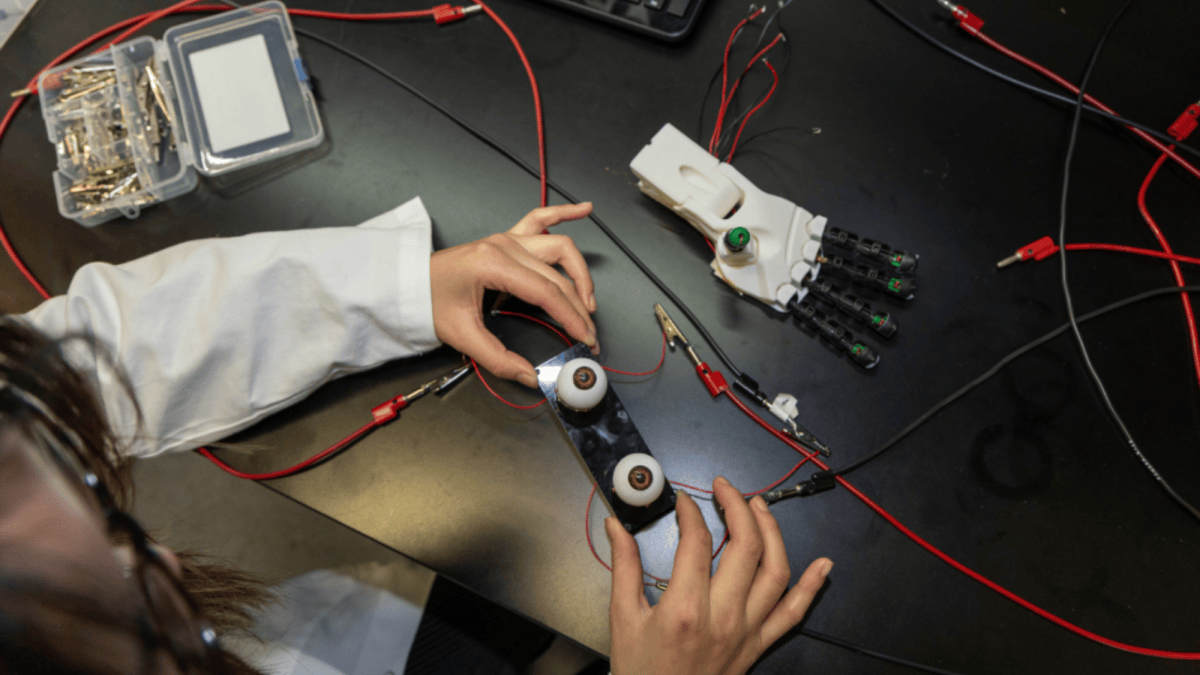
For one test, the researchers fitted the muscles into a 3D-printed hand designed to mimic finger movement. The fingers pressed piano keys with different levels of force and speed; sensors under the keys measured how hard each note was played.
In another test, the team mounted robotic eyeballs on freely rotating ball joints inside 3D-printed shells. Muscle fibers around opposing sides moved the eyes, producing controlled, repeatable shifts in gaze.
Part of a wider field
The research adds to work by labs and companies developing artificial muscle systems. The article also describes a 2025 video from Polish startup Clone Robotics showing a faceless, human-sized robot suspended from a ceiling and moving with purported synthetic muscles.
Key points
- University of Pennsylvania engineers built artificial muscles inspired by small muscles in eyes and fingers.
- The fibers combine liquid crystal elastomers, graphene and an embedded copper coil.
- A robot hand pressed piano keys at varying forces and speeds.
- Robotic eyes shifted their gaze with controlled, repeatable movements.