

Hidden climate superpower: Why some ocean “snow” carries six times more carbon
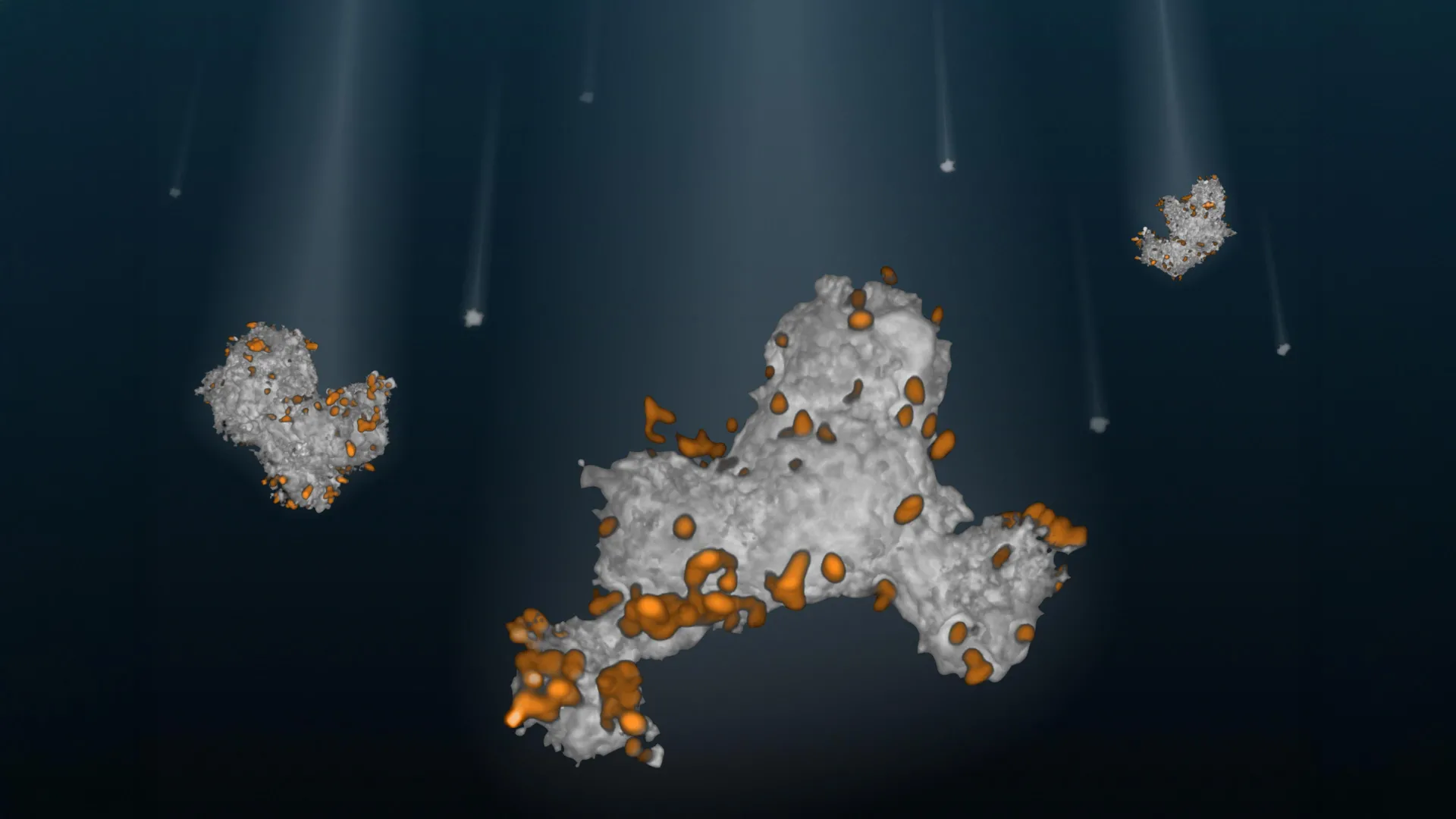
Why particle stickiness matters
Marine snow forms from material including mucus, animal feces, silt and microscopic plankton remains. As particles sink, bacteria feed on them and break them down, reducing how much carbon continues toward deep water.
A closer look at marine snow
The team developed a way to see bacteria interacting with the structure of individual particles. The technique combined 3D confocal microscopy with specially designed fluorescent molecules to reveal features within samples.
The images showed that particles have varied microscopic structures. Bacteria tended to settle near the surface, where material is less viscous, while denser, stickier areas deeper inside were harder to reach.
Four years to a new technique
The project began in 2021, when Bryce Inman was a postdoctoral researcher at Scripps Oceanography. He and colleagues, including Scripps microbiologist and professor emeritus Farooq Azam, worked for four years before developing a functioning method in 2025.
Carbon storage beyond the surface
Marine snow is part of Earth’s carbon cycle, moving carbon among the atmosphere, oceans, land and living organisms. Carbon that reaches deep water may stay separated from the atmosphere for centuries or longer.
Key points
- Only about two gigatons reach depths where carbon can remain stored for hundreds or thousands of years.
- Bacteria colonize less viscous areas near particle surfaces and have more difficulty reaching sticky interiors.