

Women bore the consequences of the first world war at home in British India
Beyond military remembrance
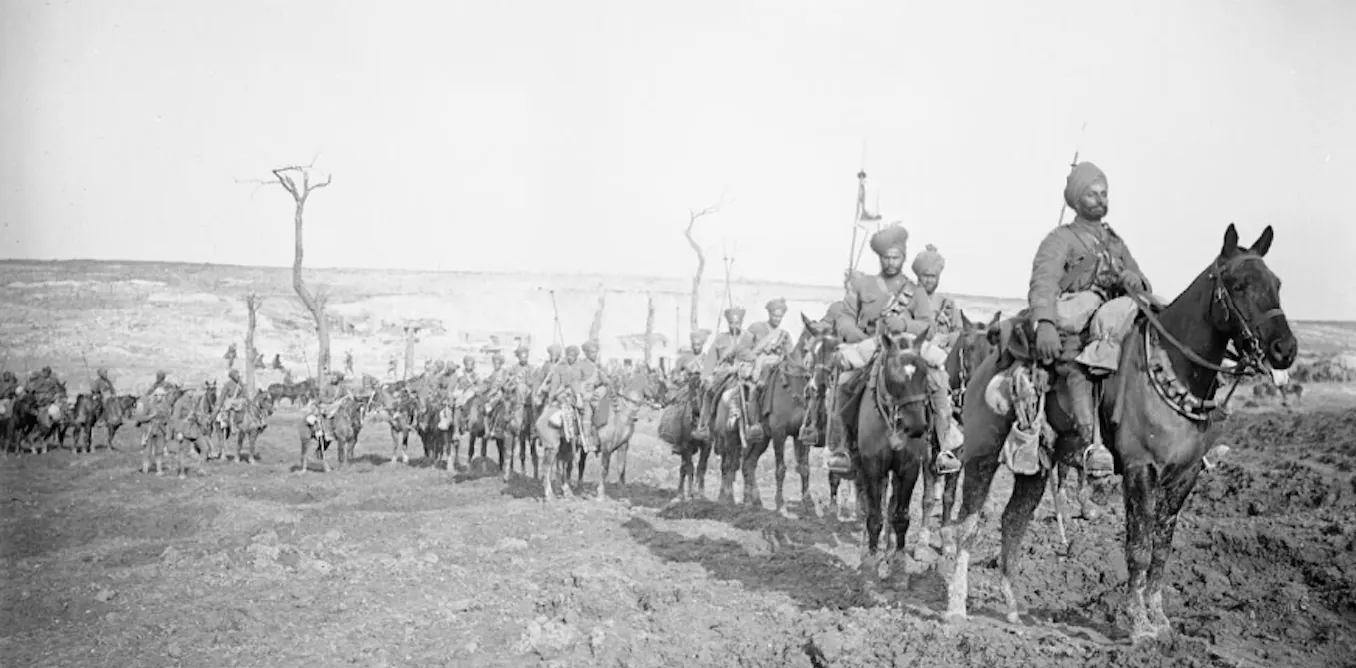
Histories of the First World War have often centered on Europe and military service. Recognition has grown for the approximately 1.4 million men from present-day India, Pakistan and Bangladesh who fought for the British Empire, but the war’s effects on British India are still often framed as masculine.
A double portrait of Sikh risaldars Jagat Singh and Man Singh, now on display at the Art Gallery of Ontario, reflects that recognition. Painted in London by Phillip de László two months before the 1916 Battle of the Somme, it depicts men from Punjab, a major center of recruitment. Historian Radhika Singha has also drawn attention to non-combatant workers, while the experiences of women and families left behind have received less notice.
Punjab’s unequal foundations
Punjab was annexed by the East India Company in 1849. Colonial officials worked with patriarchs and landowners to secure political and economic control in the agricultural region. As feminist historian Veena Oldenburg has shown, customary laws codified through consultations with male household heads reinforced male landowners’ power and women’s dependence. Colonial authorities regarded the Punjabi peasant as suited to military service, drawing on the theory of “martial races.” By the early 20th century, this thinking had helped produce what researchers call the “Punjabization of the Indian Army.” On the eve of war, Punjabi men made up about 60 per cent of the Indian army.
Women resisted recruitment
Recruitment drives offered land grants, cash rewards and secure pay, and appealed to izzat, or honour. Some middle-class and elite Indian women urged wives and mothers to send men to war, but many village women in Punjab tried to stop their husbands and sons from enlisting.
Letters and news from the front described trench warfare. Colonial reports said mothers and wives feared that men had not been adequately trained. Officials dismissed these concerns as rumours, but by December 1914 they complained that the “tears of womenfolk” were obstructing recruitment.
In Amritsar in 1915, an official recorded that women followed recruiting parties for miles, waiting for chances to persuade recruits to leave. Intelligence reports also described songs blaming King George for taking husbands and brothers away and accusing the colonial government of using men as fodder.
Songs and public memory
Women’s songs offered a critique of colonial rule and recorded the costs of war far from the Western Front. In 2016, Berlin-based Pakistani artist Bani Abidi presented contemporary renditions of folk songs in an Edinburgh Art Festival exhibition titled “Memorial to Lost Words.” The exhibition moved beyond statues and stone engravings as places of remembrance, combining translated letters and folk songs. Its approach echoed the broader effort to recognize experiences that military monuments and accounts can leave out.
Key points
- About 60 per cent of the Indian army came from Punjab on the eve of war.
- Many village women in Punjab tried to prevent their male relatives from enlisting.
- Colonial reports recorded women following recruitment parties and singing songs against the war.
- Women’s wartime experiences reveal how conflict reinforced existing gender inequalities.