

La Bola Negra: this deeply moving cinematic homage to Lorca is part of his queer legacy
An unfinished play expands
Directed by Javier Ambrossi and Javier Calvo, known as Los Javis, La Bola Negra reimagines the four surviving pages of Lorca’s unfinished 1936 work. It would have been the poet and playwright’s first play with a gay protagonist. The film was co-written by the directors and queer playwright Alberto Conejero, whose La Piedra Oscura also informs the story.
The title refers to Carlos, a young gay man played by Milo Quifes, who fails to gain entry to a private club after rumours about his sexuality. A secret ballot uses white and black balls; the black ones signify rejection and social exclusion.
Three stories across Spain
The film carries Lorca’s text into the 21st century through stories set in 1932, 1937 and 2017. The middle story draws on Conejero’s play and depicts Lorca’s real-life lover Rafael Rodríguez Rapún, played by Miguel Bernardeau, as a Republican prisoner of war.
Rapún develops a brief, platonic infatuation with Sebastián, his Nationalist guard, played by singer-songwriter Guitarricadelafuente in his first acting role. Their connection feeds a series of relationships and revelations that moves the story and queer history forward.
Lorca’s presence and legacy
Lorca’s legacy appears through the unfinished play, his homoerotic sketches and a small cameo played by Alberto Cortés. The film also evokes him through its Spanish settings and its treatment of motherhood, a subject he explored extensively in his work. Lorca, regarded as Spain’s most influential 20th-century poet and playwright, was executed by firing squad in 1936, at the start of the civil war, because of his politics and sexuality.
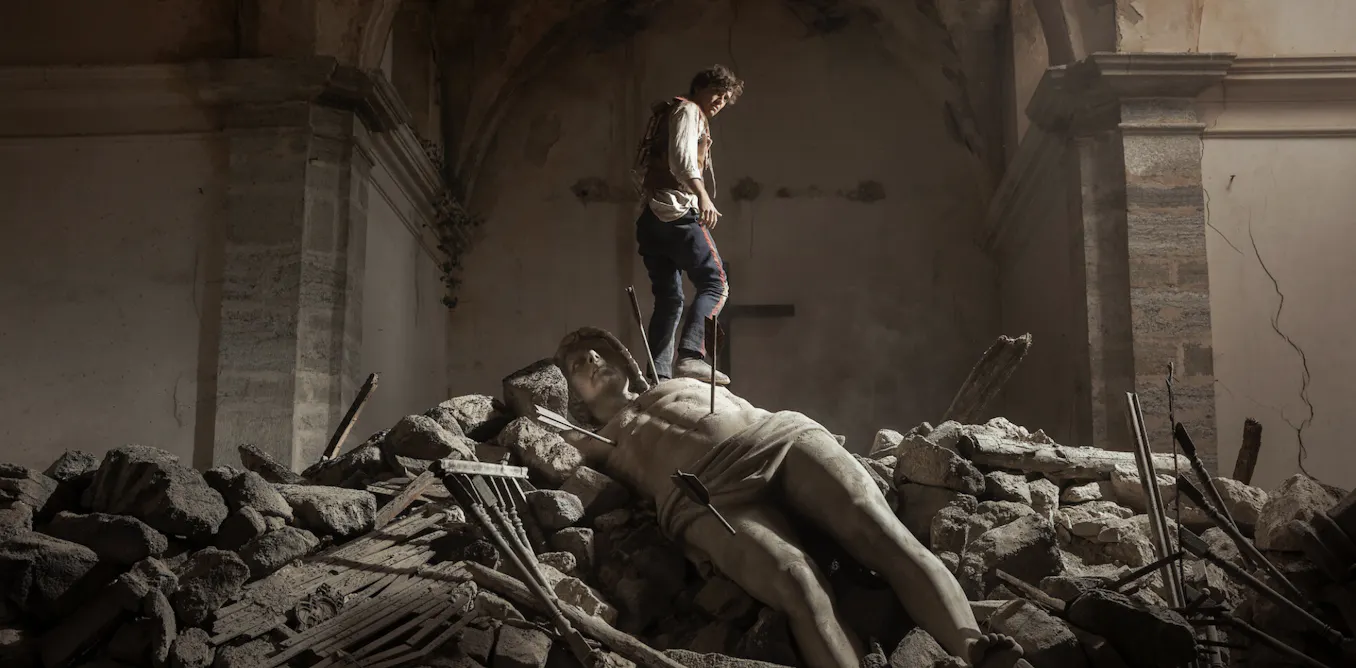
Queer imagery spans the film’s different eras, from a damaged statue of Saint Sebastian to sailor figures recalling Rainer Werner Fassbinder’s Querelle and the dating app Grindr. The final story centers on Alberto, a larger-bodied gay man played by Carlos González.
Craft, performances and reception
Shot on 35mm film, the movie moves between intimate scenes in confined spaces and expansive landscapes. Cinematographer Gris Jordana gives it a consistent visual style while shaping a distinct atmosphere for each story; Raül Refree composed the score.
Lola Dueñas plays Teresa, a troubled single mother, while Penélope Cruz portrays a glamorous cabaret singer and Glenn Close plays an American Lorca scholar in Spanish. The film won best direction at Cannes and audience awards at San Sebastián, Toronto and London. It drew full houses at festivals, became a social media phenomenon and was acquired by Netflix.
Key points
- La Bola Negra builds three gay stories around Lorca’s unfinished 1936 play.
- Its settings span Spain in 1932, 1937 and 2017.
- Los Javis won best direction at Cannes, and the film earned audience awards at three other festivals.
- Netflix acquired the film after it became a social media phenomenon.